
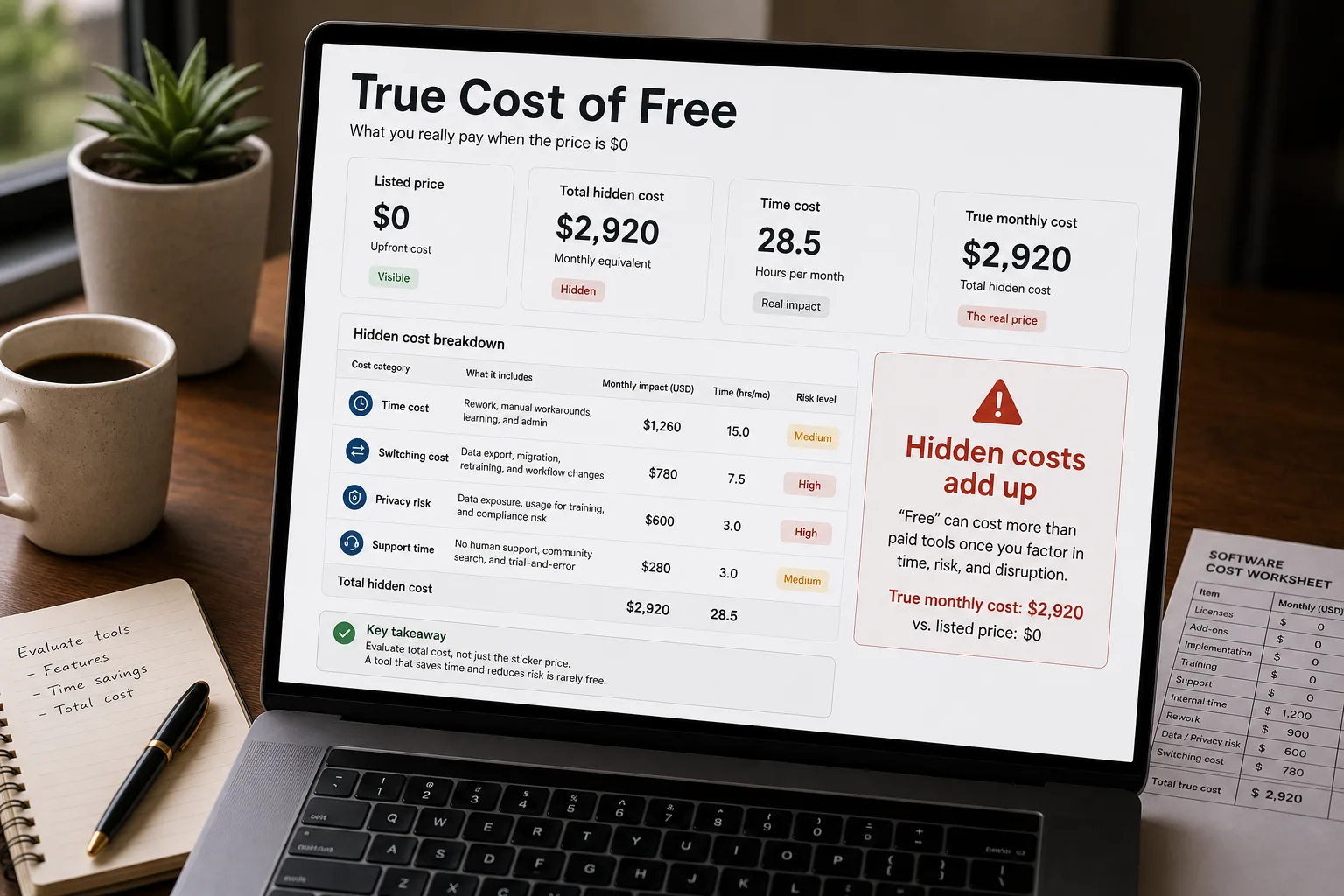
A free AI tool is one you don’t pay a subscription for. ChatGPT’s free tier, Claude’s free tier, Gemini’s free tier, and open-weights models running on someone else’s hosted endpoint all sit here. None of them are actually free — they recover their costs in ways that don’t appear on an invoice.
Someone signs up for ChatGPT free, builds a workflow that depends on it, then notices the cap is fifty messages a day, the answers come from a model two generations behind the flagship, and the privacy policy lets the vendor use the prompts to train the next version. None of that is on the invoice — there is no invoice — but every line of it is a cost.
What follows are the four cost vectors that almost every “free” AI tool uses to recover its expenses, how to spot which one a specific tool relies on, and the decision rule for when free is genuinely fine, when it’s a fair-trade exchange, and when it’s expensive in a way that doesn’t show up until later.
The four cost vectors
A free AI tool recovers cost in some combination of these four ways. Almost every tool uses at least two; the question is which.
Data. Your prompts and outputs become training data, product telemetry, or input for downstream features the vendor sells separately. The consumer free tiers of ChatGPT, Claude, and Gemini all train on user content by default with opt-outs of varying ease. Open-weights models accessed via a hosted inference API often have the same property — the model weights are free, but the inference endpoint is logging.
Switching cost. Free tools are designed to make you dependent. The “Custom GPT” you tuned for two weeks, the brand-voice profile you uploaded, the chat history you’ve built up — all of that lives in the vendor’s system, none of it ports cleanly to a competitor, and the day you decide to leave you’re paying in time to rebuild from scratch. The free tool’s UX is often deliberately tuned to encourage this lock-in.
Time tax. Rate limits, queue waits, slower model variants for free users, “upgrade for faster responses” friction. The vendor controls the throttle and uses it to convert active free users into paid ones. The cost is real — you measure it in fifteen seconds of waiting per response, multiplied by every interaction — but it’s invisible compared to a dollar figure.
Quality cap. Free tiers serve smaller, older, or quantised models than the paid tiers. You’re benchmarking the wrong product. The team that piloted Claude free tier and decided “Claude is fine but not great for our work” was often testing Claude Haiku or a daily-cap-throttled Sonnet — not Opus, not Sonnet at sustained throughput, and not the Claude that paying customers experience.
When free is fine — and when it isn't
Use free when the work is exploratory, low-stakes, one-off, or personal — sketching an idea, drafting a private email, learning what a model can do. The cost vectors don’t bite at this volume.
Treat free as a fair trade when the data exposure is acceptable to you, you can change tools cheaply if you need to, and the quality cap doesn’t materially affect the work — most personal productivity use cases sit here.
Don’t use free when the prompts contain anything you wouldn’t want leaked (customer PII, internal strategy, code intended to remain proprietary), the workflow you’re building will be hard to migrate later, or the quality cap is the reason you’d be disappointed by the model.
What each vector actually costs in practice
The pattern: the cost is rarely a dollar figure on its own. It is some combination of cheaper-model-than-you-thought, ten extra seconds per response, your prompts in someone’s training set, and the four hours it will take to rebuild your workflow when you decide to leave.
Three patterns to recognise in real tools
Examples that recur across the market, with the cost vector each one leans on most:
The SaaS that trains on your data by default with the opt-out buried. A common pattern in consumer AI: training is enabled at signup, the opt-out lives four clicks deep in settings, and the policy is written in a way that requires reading twice to be sure what it says. Cost vector: data. Mitigation: opt out immediately on every account; don’t use the consumer tier for anything you wouldn’t paste into a public forum.
The “free for non-commercial use” model with ambiguous commercial boundaries. Llama’s community license, Mistral’s earlier model licenses, several research models — the line between “internal evaluation” and “commercial use” is fuzzy enough that a careful legal team will spend hours getting comfortable with it. Cost vector: switching and time tax (you spend time evaluating something you can’t easily ship). Mitigation: read the license carefully before the team builds anything on it; pick a permissively-licensed alternative if the boundary matters.
The freemium tool that caps a critical feature to drive upgrades. Output length, integration count, seat count, file size — pick a feature your workflow needs, watch it sit just below your threshold in the free tier. Cost vector: time tax + quality cap. Mitigation: enumerate the features you’ll actually use before adopting; assume you’ll hit at least one cap and price the workflow at the paid tier from day one.
Related explainers
The vendor-strategy story continues in AI privacy — what to watch for and When AI is the wrong tool; for the unit-economics side specifically, see Tokens, context windows, and what they cost.
FAQ
Is open-weights actually free?
The weights are free. Running them is not — you pay in GPU rental, hosting, ops time, or you pay an inference API. For trivial use (a few thousand tokens a day on a laptop), open-weights is the closest thing to actually free. For production volume, the running cost typically lands between paid SaaS and self-hosted at scale; the savings come at high volume and with engineering investment.
What about university or research free tiers?
Better deals than consumer free tiers in most cases — higher caps, sometimes flagship-quality models, real research credits. The catch is licensing. "Free for research" is often paired with "not for commercial use," and the moment your research project starts looking like a product, you've crossed a line that retroactively matters. Read the agreement; talk to the institution if there's any ambiguity.
Can I just opt out of training data and call it solved?
Partially. Opt-outs are honoured by major vendors, but they cover *future* training — anything you sent before opting out may already have been incorporated. They also don't cover service telemetry, abuse-detection logging, or the ways content can leak into model behaviour through downstream use. The reliable answer for sensitive content is to use a paid tier with contractual data exclusion, or self-host.
Do free tiers ever upgrade automatically?
Almost never on the model itself — free tiers tend to lag flagship by 6–18 months. They do upgrade on other dimensions (interface improvements, new features in the free tier, occasional bumps in caps). If your team's strategy depends on free-tier quality catching up to paid, plan for it to take longer than you think; the gap is structural, not a temporary state.
Is the cost just monetary? What about reputational risk?
Reputational cost is real and underdiscussed. Public AI tools have leaked confidential prompts back to other users (rare, but it has happened); model outputs have referenced specifics from training data that should have been forgotten; some vendors have used user content in marketing examples without explicit consent. For sensitive sectors — legal, healthcare, finance — the reputational cost of an incident outweighs years of subscription fees. Price the risk; don't ignore it.