
If you’re picking AI infrastructure for your team, the “open-source vs proprietary” debate is one of the strongest religious wars in software today. Almost none of the heat in it is useful to a business decision.
The framing assumes a winner-takes-all answer to a question that is actually workload-specific. A customer-facing chatbot has different requirements from an internal classification pipeline. That has different requirements from a code-generation tool. That has different requirements from a privacy-sensitive document workflow. The right answer for any of those isn’t “open” or “proprietary” — it’s “which option matches the constraints of this specific workload?”
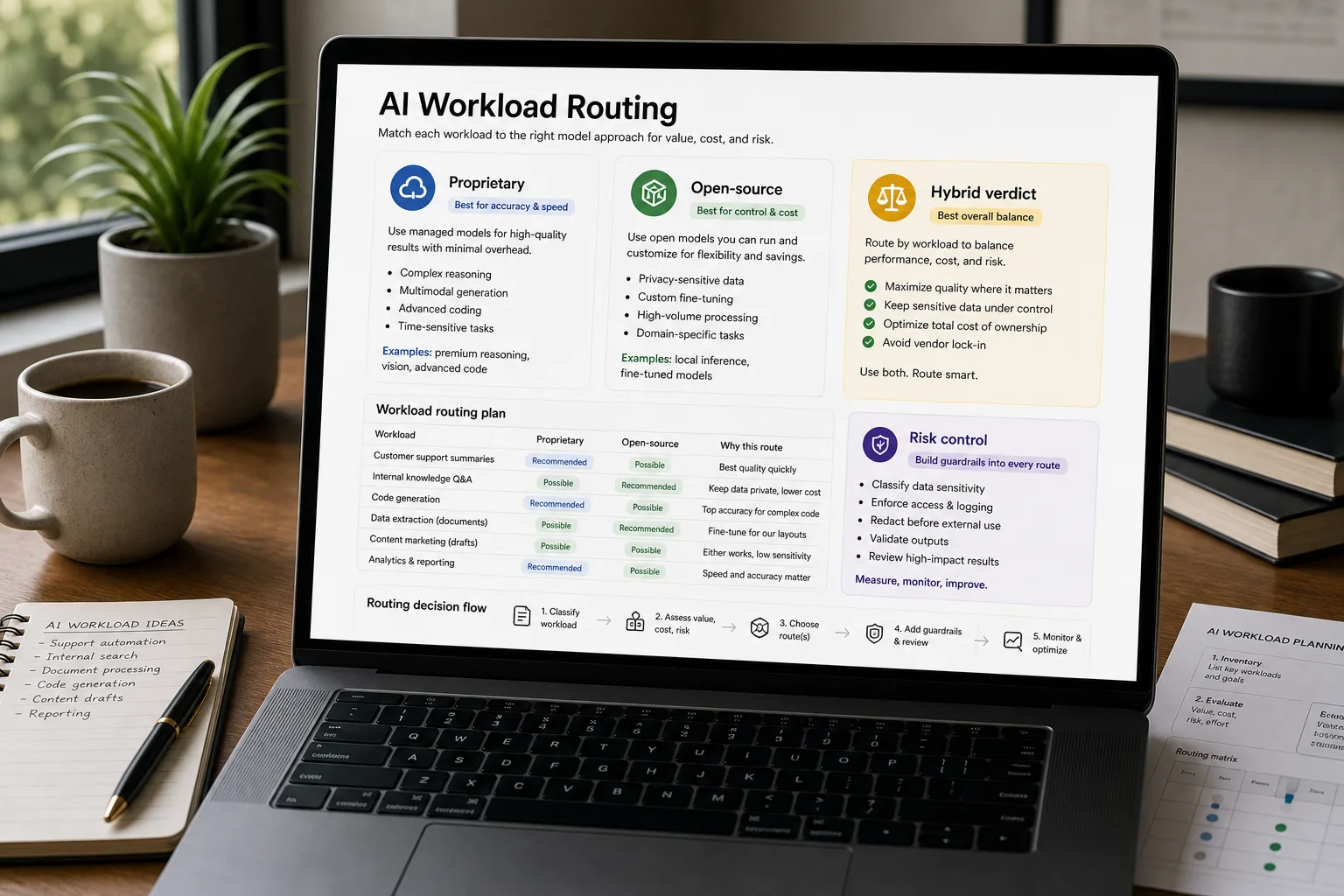
This piece replaces religious-war framing with four operational questions: capability needed, control required, cost at scale realistic, vendor risk acceptable. For most teams, the conclusion isn’t to pick a side. It’s to run a hybrid — flagship proprietary models (GPT, Claude, Gemini) for the workloads where capability is decisive, and open-source models (Llama, Mistral, Qwen, DeepSeek) for the workloads where control or cost matters more.
What the choice actually depends on
Strip the politics out, and the decision rests on four axes:
- Capability — what’s the accuracy / quality ceiling on this specific task? For the hardest reasoning, longest contexts, and most complex multi-step work, flagship proprietary models still hold a measurable lead. For most production tasks, that lead has narrowed enough that open-source is good enough. The size of the gap depends on the task.
- Control — how much do you need to own the model, the inference, the weights, the data path? Self-hosted open-source gives total control; API-only proprietary gives none. The middle ground (proprietary models with VPC deployment, fine-tuning APIs, on-prem agreements) is where many teams land — proprietary capabilities, partial control.
- Cost-at-scale — open-source has fixed-cost economics (hardware + power); proprietary has variable-cost economics (per-token). The break-even varies enormously by workload and by inference volume. Calculate it on your real numbers; the answer is rarely what the marketing slides claim.
- Vendor risk — what happens if the proprietary vendor changes pricing, deprecates the model, restricts usage, or has an outage that takes your product down? Open-source eliminates this risk; proprietary distributes it across the vendor’s incentives. For mission-critical workloads, vendor risk often dominates the other axes.
Most teams skip this analysis and default to “use the latest flagship API” or “we’ll self-host everything.” Both are right for some workloads and disastrous for others.
Workloads that belong on flagship API
Flagship proprietary models (GPT, Claude, Gemini) are clearly the right call when:
- The capability gap is decisive. For the hardest reasoning tasks — complex multi-step problem solving, long-context synthesis, sophisticated agent workflows — flagship models still lead by a measurable margin. Coding assistance, advanced research synthesis, complex tool-use loops fall in this bucket. The gap has narrowed, but it’s still real on the hardest tasks.
- Integration speed is the constraint. Proprietary APIs ship in days; self-hosted infrastructure takes weeks. For a feature you need shipped now, the API is the faster path. Many teams start on proprietary and migrate workloads to open-source as volume and confidence justify the engineering investment.
- Volume is moderate and unpredictable. If you don’t know whether you’ll process 100k tokens a day or 100M, proprietary per-token pricing keeps your downside bounded. Self-hosted infrastructure is sized for peak; underused, it’s expensive overhead.
- Compliance posture is bundled. Major proprietary vendors offer SOC 2, HIPAA, GDPR-compliant deployments out of the box. Replicating that posture on self-hosted infrastructure is a real engineering and audit cost.
- You don’t have an ML platform team. Self-hosting requires GPU operations expertise, model-deployment infrastructure, monitoring, retraining pipelines. If you don’t have that team and aren’t building one, proprietary is the only realistic path.
Workloads that belong on self-hosted
Open-source models (Llama, Mistral, Qwen, DeepSeek) are clearly the right call when:
- Data privacy is non-negotiable. Regulated industries — healthcare, legal, finance, defence — often have data classifications that prohibit external API calls regardless of vendor compliance posture. Self-hosted is the only viable path. For customer-interview recordings, internal documents, or PII-heavy workloads, open-source on your own infrastructure removes a category of legal and regulatory risk that proprietary APIs introduce.
- Volume is high and predictable. Above roughly 100 million tokens per month of inference, the fixed-cost economics of self-hosted GPUs beat variable-cost API economics — sometimes by a factor of 5–10x. The break-even depends on your workload, but high-volume teams leaving themselves on per-token pricing are leaving money on the table.
- You need to customise the model. Fine-tuning, domain adaptation, custom safety layers, specialised reasoning patterns — open-source models give you full control over training and inference. Proprietary fine-tuning APIs exist but are narrower in scope and more expensive at scale.
- Vendor lock-in is a strategic risk. For products where AI is the core differentiator, depending on a single proprietary vendor introduces concentration risk that may be unacceptable. Self-hosted open-source means you control your destiny — pricing changes, model deprecations, and policy shifts don’t break your product.
- Latency budgets are tight. Self-hosted inference can be optimised for your specific workload — quantisation, speculative decoding, custom batching. Proprietary APIs have fixed latency profiles you can’t tune below.
Why most mature teams run both
In practice, most mature teams end up hybrid. The pattern looks like this:
- Flagship proprietary for the hardest workloads — customer-facing chatbots requiring nuanced reasoning, agentic loops, complex content generation, code assistance. These workloads benefit from the capability ceiling and tolerate the per-token cost.
- Self-hosted open-source for high-volume, simpler workloads — classification, summarisation, embedding generation, structured extraction. These tasks have largely converged across model classes; open-source is good enough, and cost savings at volume are decisive.
- Self-hosted open-source for privacy-sensitive workloads — internal documents, regulated content, customer-recording analysis. Even if proprietary would be capable enough, legal and compliance posture forces self-hosting.
The hybrid path is not a fence-sitting compromise — it’s the right answer for most teams that take both axes seriously. The mistake is committing to one side ideologically and forcing every workload into that container.
What the choice actually costs
The break-even number is the most important one. Run it against your real inference volume and your real input/output token ratio — the answer is rarely what intuition predicts. Many teams discover they could halve their AI infrastructure cost by moving one or two high-volume workloads to self-hosted; many others discover they’re nowhere near the break-even and proprietary is cheaper than the engineering investment would be.
Where this decision typically goes wrong
Picking ideologically rather than by workload. “We’re an open-source shop” and “we only use the best API available” are both bumper stickers, not strategies. Every meaningful workload deserves a decision based on its specific constraints. Teams that pick a side first and rationalise the workloads to it end up over-engineering for the wrong axis.
Underestimating the engineering cost of self-hosting. Hardware is cheap; production-grade deployment is expensive. Self-hosting a model in a notebook is easy; running it as a service with monitoring, fail-over, retraining, and incident response is a real engineering investment. Many teams hit proprietary API limits, decide to self-host, and discover they’ve replaced one bill with a bigger one.
Treating “open weights” and “open source” as the same thing. Many “open” models — including Llama — have weights-available licenses with commercial restrictions. The label “open” obscures meaningful differences in what you can actually do with the model. Read the license; don’t assume.
Ignoring the capability gap on hard workloads. “Open-source has caught up” is mostly true for routine tasks and largely false for the hardest reasoning. Picking open-source for a workload where the capability gap is decisive is the most expensive mistake in this category, because the failure mode is silent — your product is just a bit worse than competitors using flagship proprietary, and you may not know why for months.
Not running the break-even math on real workload numbers. The right answer between flagship API and self-hosted depends on your actual inference volume, your input/output ratio, your latency requirements, and your engineering cost. Skipping the math and trusting intuition is how teams over-pay for proprietary or under-deliver on self-hosted. Run the numbers; the answer is usually clearer than the religious war suggests.
Related work
For the deployment-architecture side of self-hosting, see When to run AI locally vs in the cloud. For the cost-vector story behind “free” AI tiers and where the costs actually land, see The hidden costs of “free” AI tools. For the underlying token economics that drive the break-even math, see Tokens, context windows, and what they cost. For the categories of problems where AI overall is the wrong tool, see When AI is the wrong tool. For the family tree of AI / ML / DL / LLMs that this discussion sits inside, see AI vs ML vs deep learning vs LLMs.
FAQ
Is open-source really catching up to proprietary?
On most workloads, yes — and the gap closed faster in 2024–2025 than most predicted. On the hardest reasoning, agentic, and long-context workloads, there's still a measurable gap. Open-source typically lags the proprietary frontier by 6–18 months on the hardest benchmarks; on routine workloads it's at parity or close. The right framing isn't "caught up" or "behind" — it's task-specific, and the gap is closing further on each model release.
Can I fine-tune a proprietary model and get the best of both?
Sometimes. OpenAI, Anthropic, and Google all offer fine-tuning APIs of varying breadth. The trade-off: cheaper than full self-hosting, but you don't own the weights, can't redistribute the fine-tuned model, and remain dependent on the vendor's continued support. A reasonable middle path for teams that need light customisation without operational overhead. Not a substitute for self-hosting where data control is the requirement.
What about open-weight models with commercial restrictions (Llama's acceptable-use policy, etc.)?
Read the license. "Open weights" is not the same as "open source" in the strict sense — Meta's Llama license has commercial-use restrictions (notably the 700M-monthly-active-user threshold for additional licensing). For most teams these restrictions don't bite, but for large platforms and certain use cases they do. The license matters as much as the model architecture; don't skip the legal review.
Is hybrid more expensive than committing to one path?
Usually no, often the opposite. Hybrid lets each workload run on the right infrastructure — flagship for capability-decisive tasks, open-source for high-volume routine tasks. The engineering overhead of running both is real but typically smaller than the savings from not over-paying for either. The exception is small teams without an ML platform function; for them, hybrid adds operational complexity faster than it saves money, and proprietary-only is often the right pragmatic answer.
What happens if the open-source model I'm using gets discontinued or relicensed?
The weights you've already downloaded continue to work — that's the operational advantage of open weights. Future versions, support, and ecosystem investment are at the licensor's discretion (most open weights are released by large labs with their own commercial interests). Realistic scenarios: a labelling change in the license (rare but real — early Llama versions had different terms than later ones), or the lab discontinuing the model line. Plan for both by maintaining a tested fall-back model from a different lineage.
How should I think about Chinese open-source models (DeepSeek, Qwen)?
Capability-wise, leaders in their tier on most benchmarks as of 2026. Compliance-wise, the picture is more complex — US export controls, jurisdictional questions about training data, and corporate-policy considerations vary by industry. For most commercial workloads they're competitive; for regulated industries, government work, and certain enterprise contracts, the geopolitical layer is a real decision factor that goes beyond the technical comparison. Run the same workload-fit analysis you would for any other model; add the geopolitical axis where it applies.