
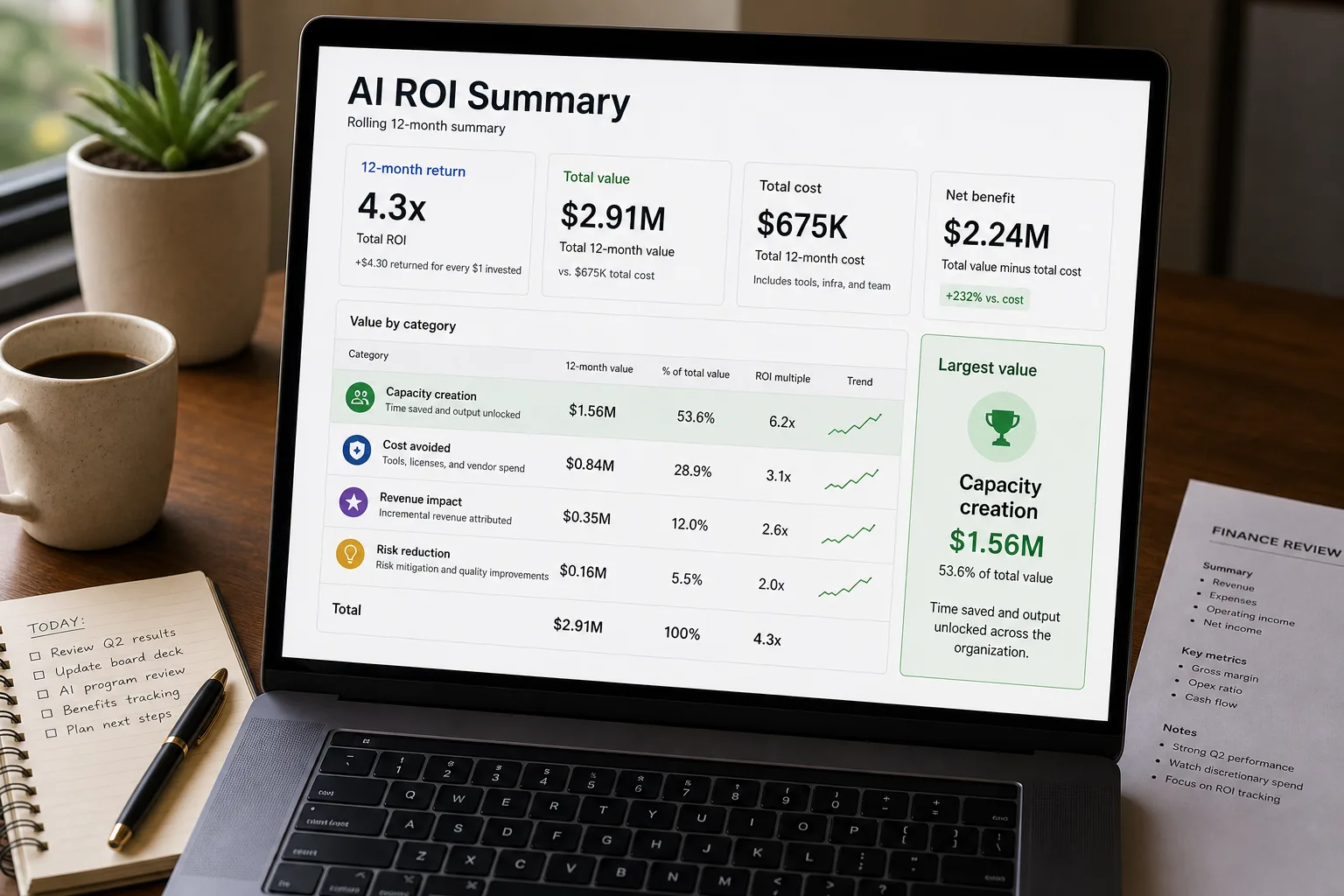
The framework splits AI return into four categories and measures each on its own timeline. Cost reduction is the direct savings — hours and spend you don’t have any more. Capacity creation is the work that now gets done without extra headcount. Revenue enablement is the new products or features AI made possible. Strategic optionality is the future moves you can make because you built the capability now.
Most ROI conversations go wrong in one of two ways. The credulous version counts every demo number, projects savings linearly, and produces a multiple that boards stop believing by the second quarter. The cynical version counts only direct labour savings, ignores capacity and strategic value, and justifies underinvestment in something that genuinely matters.
This piece walks through each of the four categories, then shows how to measure them. Cost reduction is immediate and concrete. Capacity creation shows up in six to twelve months. Revenue enablement is harder to attribute but real. Strategic optionality is hardest to quantify but matters most at the board level.
What AI actually returns
Cost reduction. The direct measurable savings — labour-hours saved, vendor spend eliminated, error-rate reduction. The easiest to calculate; the most commonly overstated by vendors. Be honest: if AI saves 30 minutes per support agent per day, that’s the labour cost of 30 minutes per agent, not the loaded cost of “a fractional FTE per agent.” Don’t multiply savings by the loaded headcount; multiply by the actual recovered time at the labour rate.
Capacity creation. The work that gets done that previously didn’t fit. A marketing team that produces 4 newsletters a month instead of 1 because of AI-augmented writing; a CS team that handles 3x the customer base on the same headcount because of AI-routed triage. Capacity creation is real value but often shows up as “we grew without hiring” rather than “we saved on hiring.” Measure it as the cost of the headcount that would have been needed to produce the equivalent capacity.
Revenue enablement. Features shipped because of AI that drive customer acquisition or retention. Better personalisation that increases conversion; smarter onboarding that reduces churn; new product capabilities that wouldn’t have existed without AI infrastructure. Hard to attribute precisely; teams that try to over-attribute produce numbers nobody believes. Better: track the high-confidence cases (a feature that directly uses AI and drives measurable revenue) and acknowledge the broader category as supportive.
Strategic optionality. The value of being able to do things in the future because you built AI capability now. Includes: team learning that makes future AI initiatives faster; data and infrastructure that supports more AI workloads; vendor relationships that benefit from existing engagement. Hard to quantify; matters most at the board level when evaluating investment vs. wait-and-see.
How to actually track each category
For each AI initiative, document:
- Investment. Vendor subscriptions, engineering time, infrastructure, training, opportunity cost of what else the team could have built.
- Cost reduction outcomes. Specific hours saved per role per week; multiplied by actual labour cost; over a defined period.
- Capacity creation outcomes. Work output volume change pre- and post-AI; converted to headcount-equivalent at market rates.
- Revenue enablement outcomes. Direct attribution to AI-enabled features where defensible; broader contribution flagged but not over-claimed.
- Strategic value (qualitative). What does this enable for future quarters; what was learned; what infrastructure or data assets were created.
Calculate the rolling 12-month return per category. The composite is the project’s actual ROI; the per-category breakdown is what makes the calculation defensible to skeptical reviewers.
What AI ROI actually looks like at growing companies
The pattern is wide dispersion: AI initiatives are high-variance investments. Successful ones produce meaningful returns; failed ones produce near-zero. The portfolio approach (multiple initiatives, willing to cut underperformers) is what makes the program’s aggregate ROI positive.
Where ROI calculations typically go wrong
Multiplying labour savings by loaded FTE cost. 30 minutes saved per employee per day isn’t a fractional FTE; it’s 30 minutes per employee per day at labour cost. The loaded-FTE math overstates by 2-3x.
Ignoring engineering investment. Building and maintaining AI integrations is engineering work. ROI calculations that count vendor subscriptions but not engineering time understate true investment.
Vendor-pitch math. Vendors quote demo numbers (80% deflection, 60% time saved). Production numbers are usually 50–70% of demo numbers. Don’t budget against demo; budget against realistic production performance.
Single-quarter measurement on multi-quarter investments. Most AI initiatives take 2–4 quarters to reach meaningful ROI. Cutting at end-of-quarter-one because ROI is below target produces the failed-initiative pattern.
Ignoring opportunity cost. Engineering time spent on AI initiatives is time not spent on other features. The ROI calculation should reflect the cost of the alternative use, not zero.
Related work
For the program-execution framework that produces measurable ROI, see Why most “AI strategies” fail in the first 90 days. For the broader cost-vector analysis on AI tools, see Hidden costs of “free” AI tools. For the framework on what AI does for businesses operationally, see What an LLM actually does for a business. For the underlying tokens-and-cost math, see Tokens, context windows, and what they cost.
FAQ
How do we report ROI to the board when the numbers are uncertain?
Honestly. Report direct savings with confidence intervals; report capacity creation with the headcount-equivalent framing; flag revenue enablement as supportive without over-claiming; describe strategic optionality qualitatively. Sophisticated boards prefer honest range-based ROI to false-precision single numbers.
When should we cut a failing AI initiative?
After realistic timeline (typically 4–6 months), structured evaluation (not gut feel), and explicit decision. Cutting too early misses initiatives that needed time; cutting too late ties up resources better deployed elsewhere. The decision benefits from a documented evaluation framework set at kickoff, not from end-of-quarter pressure.
How do we account for time spent learning vs producing?
Both are real investment. The first month of any AI initiative is largely learning; that's expected and the ROI math should reflect it. Subsequent months should produce more measurable output. Distinguish the learning curve from sustained underperformance; the first is expected, the second is the cut signal.
What if our AI program saves time but the saved time isn't redirected to high-value work?
Then the ROI is not realised. Capacity creation only produces value if the freed capacity is deployed productively. If the AI saves an hour per agent per day and that hour becomes longer breaks, you have neither cost savings (the agent is still on payroll) nor capacity creation (no new output). The leadership job is to ensure freed capacity has a productive deployment; this is the operational follow-through that determines whether AI ROI is realised in practice.