
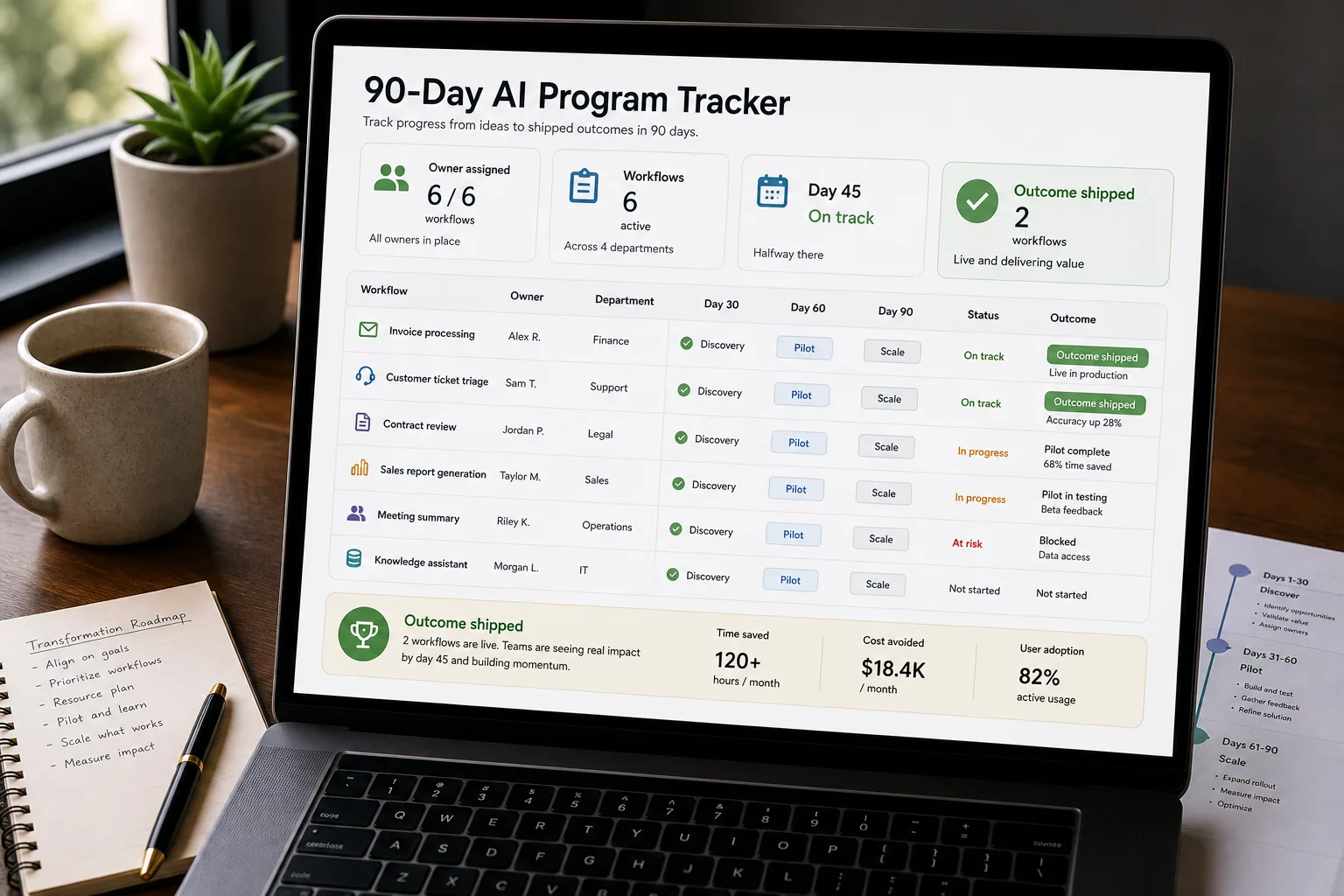
Four failure modes appear in nearly every AI strategy that stalls in its first 90 days. Over-broad scope, so nothing is shippable. No operational owner, so handoffs fail. Misalignment between the leadership pitch and team execution, so the strategic narrative and the operational reality drift apart. The gap between vendor demos and production reality, so teams conclude “the tech isn’t ready” when the real issue is integration tuning.
The pattern is consistent. The “we need an AI strategy” announcement happens at growing companies right after a board meeting where the topic came up. The first 30 days are full of energy: workshops, vendor demos, exploration teams. By day 60, the energy has dissipated into a half-built workflow nobody owns. By day 90, the company is back where it started, except the team is now more skeptical about future AI initiatives because they remember this one.
This piece walks through each failure mode, then describes the structural fix — how to set up an AI program that produces real outcomes in the first quarter and survives past its honeymoon.
Over-broad scope
The most common failure: the program scope is “transform the company with AI.” Nobody can act on this. The team needs to know which specific workflow to automate, which customer pain to address, which internal process to accelerate. Without that specificity, every team waits for someone else to decide what they’re doing.
The fix: pick 2–3 specific workflows for the first quarter. Specific means “automate the customer-support reply for billing questions” or “build a sales-call summary pipeline that integrates with Salesforce.” Not “use AI in customer support” or “improve sales productivity with AI.” The specificity is what makes the program executable.
No operational owner
The leadership champion is usually the CEO or COO. They sponsor the program at the strategic level. But execution requires an operational owner — someone whose week is dedicated to making the workflows actually ship. Without an operational owner, the work fragments across people who have other primary jobs. The fragmentation produces slow progress that frustrates everyone.
The fix: assign a dedicated AI program lead. Could be a senior individual contributor, an emerging leader, or a hire specifically for the role. The criterion is: this person’s primary success metric is the AI program’s outcomes. Without that dedicated ownership, the program is everyone’s secondary priority and nobody’s primary one.
Misalignment between strategic claim and operational reality
Leadership pitches the AI program in transformative language: “Our AI strategy will reshape our operations.” The team executes in operational language: “We automated the support-ticket categorisation, saving 5 hours a week.” Both are true; the gap between them is the strategic vulnerability. When the board asks for the “AI transformation update” in month four and the operational answer is “we automated some ticket categorisation,” leadership feels under-delivered-on and the team feels under-recognised.
The fix: align the language and the metrics. If the strategic pitch is transformation, the metrics need to track transformation (revenue impact, headcount efficiency, new capabilities enabled). If the metrics track operational wins, the pitch should match. Mismatch produces the gap that kills the program emotionally before it does operationally.
Demo-vs-production gap
The vendor demos work cleanly. The team’s first deployment produces 80% accuracy where the demo suggested 95%. The team concludes “the technology isn’t ready”; the truth is usually “the production deployment is harder than the demo, and our integration isn’t tuned yet.” The gap between demo and production reality consistently surprises teams new to AI deployment.
The fix: explicit expectation-setting in the program kickoff. AI deployments take time to tune. The first month of production usually performs below the demo; the third or fourth month often performs above it. Communicating this upfront prevents the disillusionment that comes from comparing month-one production to demo-week reality.
What a 90-day AI program that survives looks like
The pattern that produces real outcomes:
- Pick 2–3 specific workflows. Not categories; specific named workflows with specific success metrics.
- Assign one dedicated program owner. Their primary success metric is the program’s success.
- Set realistic expectations. First-month production is usually below demo; communicate this from day one.
- Build a small team across functions. Not just engineering; include the operational owner of each automated workflow. The cross-functional team is what makes the workflow actually integrate.
- Run weekly check-ins focused on operational progress. Not on strategy abstractions; on what shipped, what’s blocked, what’s next.
- Show a real outcome by day 45. Even a small one. Demonstrating that the program ships, not just discusses, builds trust internally.
- Reassess scope at day 60. What’s working gets more investment; what isn’t gets cut. The reassessment prevents the “stay committed to a failing path” failure mode.
- End the quarter with a structured retrospective. What worked, what didn’t, what’s the plan for the next quarter. Treat the program as iterative, not as a one-shot launch.
What success and failure look like in 90 days
The success-rate difference between programs with vs without dedicated ownership is the single biggest predictive variable. Get the ownership right and most other failure modes are recoverable; get it wrong and the rest of the structure doesn’t compensate.
Related work
For the framework on what AI actually does for businesses, see What an LLM actually does for a business. For the decision framework on where AI is the wrong tool, see When AI is the wrong tool. For the ROI framework for AI projects, see ROI of AI projects. For the procurement framework that often pairs with AI strategy, see AI procurement checklist for non-technical buyers.
FAQ
Should we hire an external consultant to lead our AI program?
Mixed. External consultants can accelerate the framing and bring experience; they rarely have the internal context to drive operational ownership. The best pattern is usually internal operational owner with external advisor; the inverse (external operational leadership) produces handoff problems when the consultant's engagement ends.
How do we get the leadership pitch and operational reality aligned?
Two practices. (1) Translate the strategic claim into operational metrics — "transformation" becomes specific numbers (hours saved, capacity created, revenue enabled). (2) Translate the operational wins into strategic narrative — "we automated billing-question support" becomes "customer-support capacity grew 20% without headcount." The translation is bidirectional; without both, the gap persists.
What about "AI everywhere" programs that try to surface use cases bottom-up?
Useful as input; insufficient as strategy. Bottom-up surfacing produces a long list of opportunities; the strategy is in choosing 2–3 to ship in the first quarter. Don't try to ship everything; the long list is the pipeline for future quarters.
How should we measure if the program is actually working?
Per-workflow operational metrics first (hours saved, accuracy improvement, cycle-time reduction), strategic metrics second (revenue impact, capability enabled, talent freed). The operational metrics are leading indicators; the strategic metrics are lagging. Track both; don't expect strategic outcomes in 90 days.