
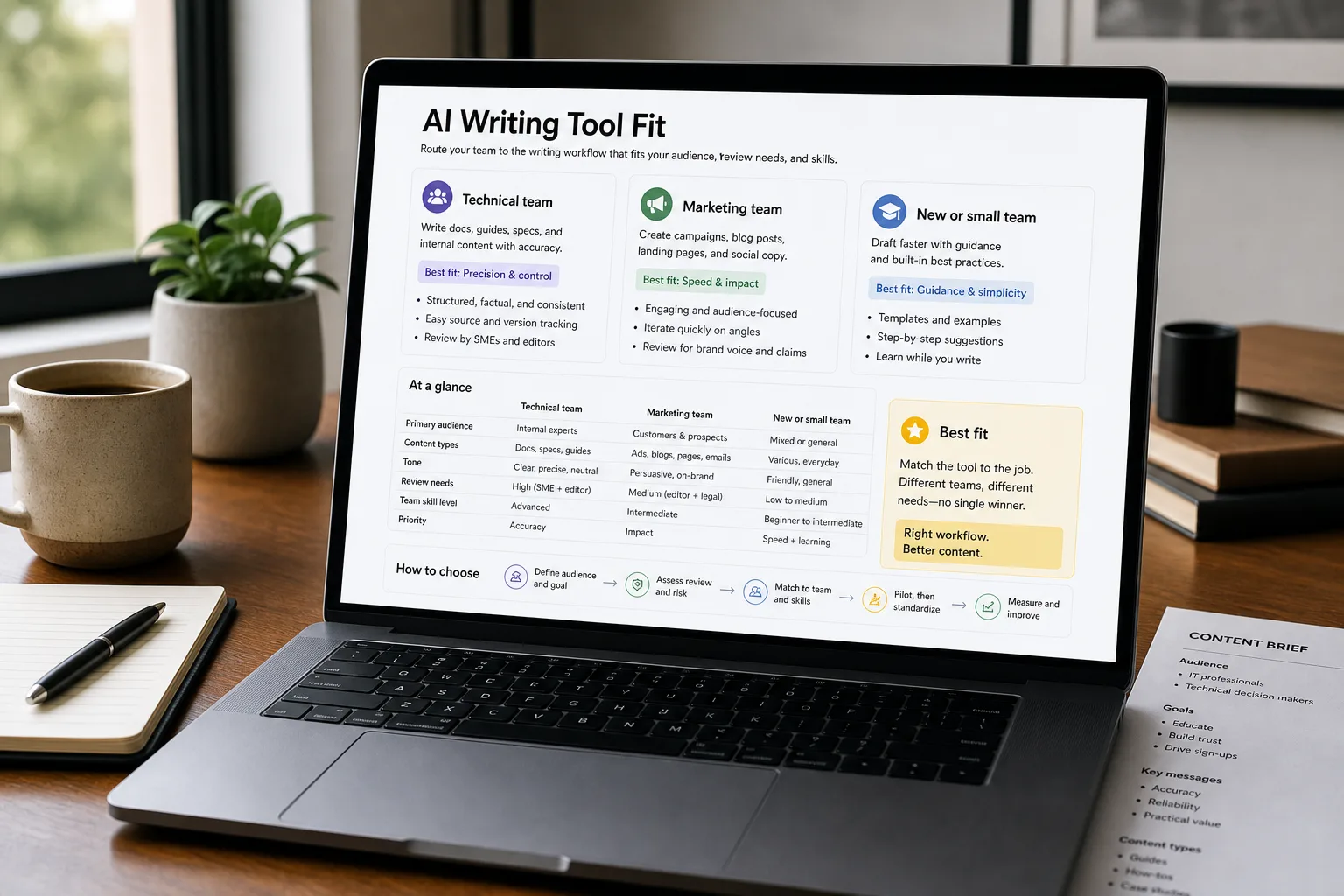
A five-person marketing team needs to ship 30 landing pages, 200 ad variants, and 50 SEO briefs every month. Two options sit on the table. Option A: Jasper or Copy.ai, around $50/seat/month, with brand-voice templates, team workflows, and approval flows already built. Option B: ChatGPT Team or Claude Team at $25/seat/month, no templates included, with one technical team-mate building shared prompts everyone uses.
The first option is faster to start; the second is cheaper and gives the team more control. The right answer depends on whether the team has someone who can build the shared prompt library, and on how much repetitive templated work the team actually produces. For some teams the wrapper’s scaffolding is worth the premium. For others, it’s rent on capability they could deliver themselves.
What follows is the side-by-side plus the decision rule. The Claude and ChatGPT rows were re-verified in September 2026; the Jasper, Copy.ai and Writer rows are a May 2026 snapshot and have not been re-checked since. Pricing and feature gaps in this category move quickly — see the change log for the freshness check, and assume any specific number can shift within a quarter.
The comparison matrix
| Jasper | Copy.ai | Writer | ChatGPT Team | Claude Team | |
|---|---|---|---|---|---|
| Architecture | Wrapper over GPT and Claude with brand-voice and template layer | Wrapper over GPT/Claude with workflow + GTM-specific automations | Enterprise-focused wrapper with proprietary Palmyra models + retrieval | Direct foundation-model access (GPT family) with team workspace | Direct foundation-model access (Claude family) with team workspace |
| Model under the hood | GPT + Claude families, with routing per task | GPT + Claude families + open-source for some workflows | Writer's own Palmyra models, with optional GPT/Claude calls | GPT-5 and GPT-6 families plus reasoning models | Claude family — Sonnet 5 and Opus 5 (Opus needs a paid plan) |
| Brand voice features | "Brand Voice" feature — uploads 5–10 docs to train a voice profile | "Brand Voice" feature — analyses uploaded samples; per-team profiles | Strongest — proprietary tone, terminology, and style guardrails; enforced at output | Custom GPTs with system prompts; manual but flexible | Projects with custom instructions and shoulder context; manual but flexible |
| Content templates / workflows | 100+ templates (blog, ad, email, social, SEO) | ~50 templates with chained workflows for go-to-market | Custom apps + AI Studio for building team-specific workflows | None as templates; built via Custom GPTs | None as templates; built via Projects |
| SEO / content-brief integration | Surfer SEO integration; built-in keyword optimisation | Limited; better as a draft tool than an SEO planner | Enterprise integrations (Adobe, Contentful, etc.) | None native; works alongside external SEO tools | None native; works alongside external SEO tools |
| Team collaboration & approvals | Folders, shared brand voices, draft sharing | Workspaces, role permissions, version history | Strongest — enterprise approval workflows, RBAC, audit logs | Shared workspace, custom GPTs, admin console | Shared projects, team console, role permissions |
| AI / plagiarism detection in product | Built-in plagiarism + AI-detection helpers (third-party Copyscape integration) | Built-in helpers; reliability varies | Strong — compliance and brand-safety checks for regulated industries | None built-in | None built-in |
| Multilingual coverage | 30+ languages with brand-voice support in major ones | 25+ languages | Strong in major business languages; weaker outside them | Excellent — strongest in major non-English languages of the three foundation models | Excellent in major languages; gap narrowing |
| API access | Jasper API (enterprise tier) | Copy.ai API (paid plans) | Yes — Writer API is a first-class product | OpenAI API — separate billing | Anthropic API — separate billing |
| Output ownership / IP terms | You own outputs; standard SaaS terms | You own outputs; standard SaaS terms | You own outputs; enterprise contracts customary | You own outputs; team-tier data excluded from training | You own outputs; team-tier data excluded from training |
| Entry paid tier (per seat / month) | Creator ~$49 (annual) — single user | Starter ~$36 (annual) | Custom — enterprise pricing not publicly published | ChatGPT Team — $25/seat (annual) or $30/seat (monthly), 2-seat minimum | Claude Team Standard — $20/seat (annual) or $25/seat (monthly); Team Premium $100/seat (annual) or $125 monthly |
| Mid / power tier | Pro ~$69/seat — adds Brand Voice, integrations, plagiarism | Advanced $186/month for 5 seats (~$37/seat) — workflows | Custom enterprise scale-up | Enterprise — custom pricing, SSO, longer context | Enterprise — custom pricing, SSO, longer context |
| Free tier | 7-day trial; no permanent free plan | Free plan with 2,000 words/month | Demo only | No free team tier (individual ChatGPT free tier exists separately) | No free team tier (individual Claude free tier exists separately) |
| Trains on your data (paid tier) | No (paid plans) | No (paid plans) | No | No (Team and Enterprise) | No (Team and Enterprise) |
What you should actually use
For technical teams comfortable with prompt libraries — Claude Team or ChatGPT Team. The $25/seat tier gives you direct foundation-model access at the cleanest pricing in the comparison, and the limitation (no templates, no brand-voice trainer built in) becomes a non-limitation as soon as one person on the team builds a shared library of Custom GPTs or Projects. This is the path with the lowest cost, the highest ceiling, and the least vendor lock-in.
For non-technical marketing teams that need scaffolding — Jasper or Copy.ai. The roughly $40–$70/seat premium over raw foundation-model access pays for templates, brand-voice training, team workflows, and an interface designed for marketers rather than engineers. The trade-off is real lock-in (your brand-voice profile lives in Jasper’s system, not yours) and dependency on a wrapper vendor whose business model is squeezed between foundation models commoditising on one side and integrated suites (Notion AI, Google Workspace AI, Microsoft Copilot) absorbing the use case on the other.
For regulated or enterprise-scale content operations — Writer. The enterprise approval workflows, terminology enforcement, and compliance tooling are where Writer is meaningfully different from the rest of the market. Pricing requires sales conversation; pilot before committing.
Skip the category entirely if your existing productivity suite already includes AI (Microsoft Copilot for Office, Gemini for Workspace, Notion AI). The integration with the tools your team already lives in beats any standalone wrapper for most marketing-team workflows.
What you'll actually pay
The pricing gap between raw foundation-model access and wrapper tools is the largest in the market right now — wrappers are roughly 2–3× the cost per seat. The decision is whether the scaffolding earns it.
Where wrappers genuinely help
Brand voice consistency across a team. Five writers all using the same Jasper or Copy.ai brand-voice profile produce more consistent copy than five writers each tuning their own ChatGPT custom instructions. The discipline of “the voice lives in one place” is real value, even if technically replicable in Custom GPTs.
Templates for repeating workflows. A marketing team that ships 30 landing pages, 200 ad variants, and 50 SEO briefs a month gets compound value from templated workflows. Wrappers do this out of the box; raw foundation models require the team to build it.
Approval and compliance. Writer in particular shines for regulated industries — finance, pharma, healthcare — where the cost of an off-brand or off-policy output is high. Approval workflows and brand-safety checks are not features you want to build yourself.
A managed surface for non-technical staff. “Open Jasper, pick a template, fill the form, get a draft” beats “open the chat box, paste a prompt, edit it” for a marketer who has never tuned a system prompt. The UX matters when the user isn’t an engineer.
Where raw foundation-model access wins
Anyone technical on the team. If one person can maintain a shared Custom GPT or Project, the wrapper’s templating advantage evaporates. Foundation models are cheaper, more flexible, and don’t lock your voice profile inside someone else’s system.
Teams already using raw GPT or Claude individually. Migrating to a wrapper costs weeks of retraining and template-rebuilding. If the individual workflows are working, formalising them with shared prompts is much cheaper than reformatting them around a wrapper.
Teams whose work isn’t repetitive. Wrappers excel at “ship 30 landing pages this month.” For a team writing one strategic post a week and ten ads a month, the wrapper’s templated workflows are mostly dead weight.
Cost-bound teams. $25/seat vs $69/seat compounds fast at 10+ marketers. The savings can fund a real editor or two — usually a better investment in output quality than the wrapper.
Volatility notes
This is one of the most volatile categories in the playbook. Concrete things to watch over the next two quarters:
- Foundation-model wrappers vs integrated suites. Notion AI, Google Workspace AI, and Microsoft Copilot keep absorbing wrapper use cases. Jasper, Copy.ai, and Writer all have strategic responses (deeper integrations, enterprise plays, vertical specialisation) — the smaller wrappers will likely consolidate.
- Wrapper pricing pressure. If foundation-model team-tier pricing keeps trending down ($25/seat is the floor today; expect $15–$20/seat within a year), wrappers will need to either drop prices or strengthen their scaffolding case.
- Brand-voice training getting commoditised. Custom GPTs and Projects now accept multi-document uploads and produce respectable brand-voice mimicry. The wrapper advantage on voice is narrower than it was 18 months ago.
- Writer’s enterprise specialisation deepening. Writer is the wrapper most likely to thrive long-term — its enterprise compliance moat is harder for foundation models to replicate. The mid-market wrappers face more pressure than the enterprise specialist.
Re-verify this comparison every 3–6 months. If a model materially shifts the ranking, the page will surface an update_notice callout.
FAQ
Does brand voice training in a wrapper survive a model upgrade?
Partially. The wrapper holds your voice reference documents and system instructions, which port forward across model versions — but the model's interpretation of those references shifts when the underlying model is upgraded. Most wrappers re-run the brand-voice fitting when they swap models behind the scenes, but the output character can shift noticeably for a week or two during a major foundation-model release. Plan for a re-tune after any major model update; don't trust the voice profile blindly across versions.
Can I bring my own model (BYOM) to these wrappers?
Limited. Writer supports its proprietary Palmyra models alongside customer-provided model endpoints in enterprise tiers. Jasper and Copy.ai are constrained to whatever foundation models they have contracts for. If you specifically need to route your workflow through a private or on-prem model, neither of those wrappers will fit; Writer is the only mainstream wrapper with serious BYOM support, and even there it's an enterprise conversation.
What about Notion AI, Google Workspace AI, and other built-in features?
Often the right answer for content teams already living in those tools. Notion AI handles drafting, editing, and summarisation inside the documents your team already writes in. Google Workspace AI (Gemini in Docs and Gmail) does the same for Google-shop teams. Microsoft Copilot fills the same role for Microsoft shops. If your team's writing already happens in one of those environments, the integrated tool's friction advantage typically beats a standalone wrapper for most workflows. Wrappers remain stronger for high-volume templated work and enterprise compliance.
How do these compare on plagiarism and AI-detection risk?
All of them produce output that AI detectors can sometimes flag — there is no wrapper that reliably defeats current AI detectors, and the detectors themselves are unreliable in both directions. Built-in plagiarism checking (Jasper's Copyscape integration, Writer's compliance tools) catches duplicated phrasing against published web sources but doesn't protect against the broader concern that AI-drafted content reads as AI-drafted to a careful editor. The reliable answer is editorial discipline — one person re-reads every published piece — not a detection tool inside the wrapper.
What about smaller open-source models for writing?
Llama, Mistral, Qwen, DeepSeek — open-source models have closed much of the gap on factual tasks but still lag the proprietary frontier on prose quality. Worth running locally for privacy-bound work or as a cost-control layer for automation pipelines; not yet worth it as a marketing team's primary writing surface unless privacy or cost makes the trade-off mandatory. None of the wrappers in this comparison route to open-source models as a primary option; Writer's enterprise tier can integrate them as a secondary model, but that path is bespoke.
How quickly will this comparison go stale?
Expect to re-verify every 3–6 months. Pricing tiers in this category have shifted multiple times in the last 18 months, and the wrapper-vs-integrated-suite competitive dynamic continues to reshape who's offering what. The last_verified date at the top of this page and the change log at the bottom are your freshness check; if pricing or a feature gap has changed materially, this page will surface an update_notice callout.