
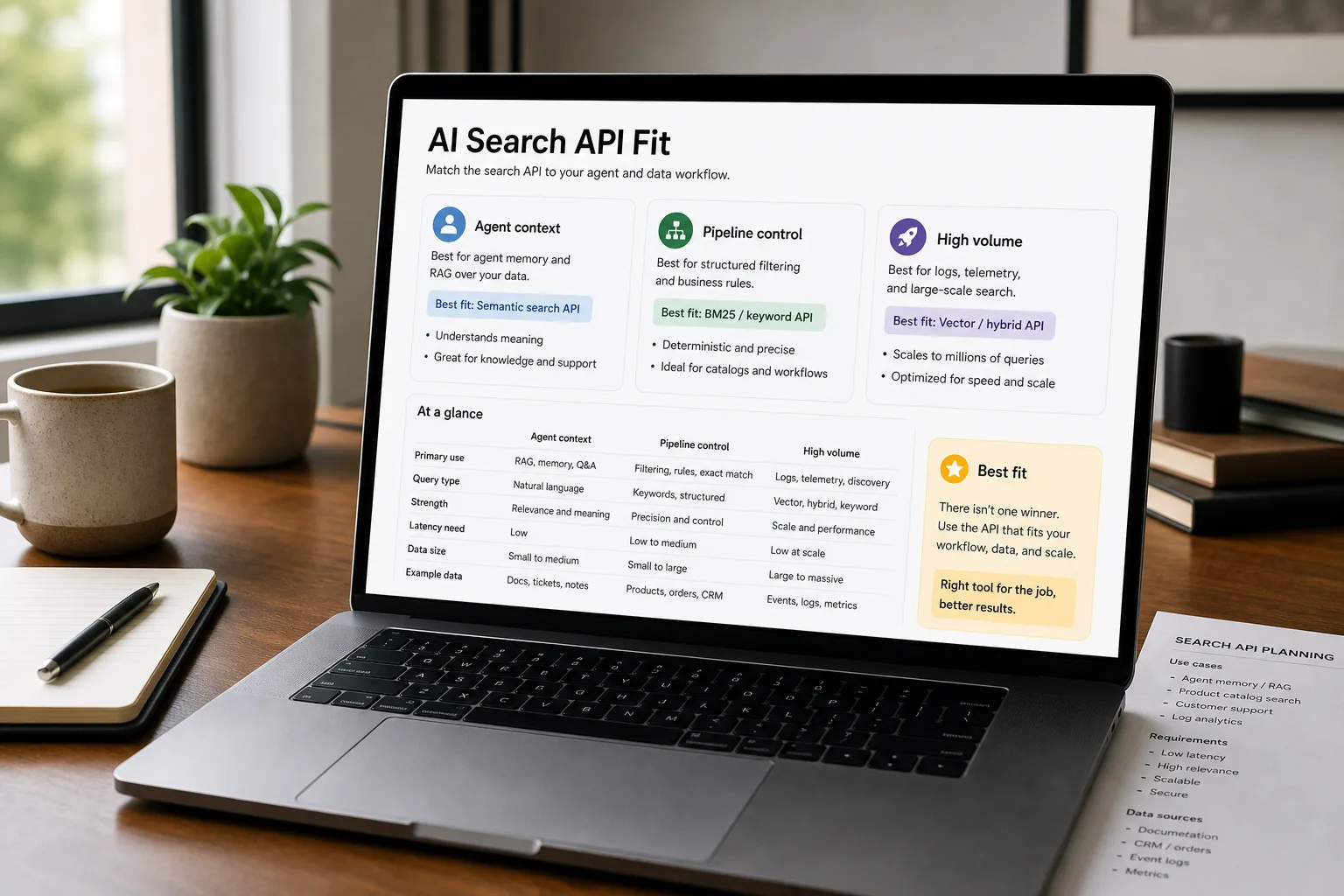
An engineer is building an AI feature for her company’s product — a research assistant that needs to look things up on the web before answering. ChatGPT and Claude can browse the web inside the chat product, but that’s not a building block; she needs an API her code can call. The choice lands at five plausible options: Perplexity’s full search-with-answer, Tavily’s search-results-as-LLM-context, the DIY combination of SerpAPI plus her own LLM, Brave’s neutral search API, or Exa’s semantic-search-for-AI.
Each is a different shape. Choosing wrong means poor result quality, high running cost, or weeks of avoidable integration work. This guide is the side-by-side: honest accuracy comparison, latency, pricing at scale, and the integration-cost differences most marketing pages don’t surface.
The comparison matrix
| Perplexity API | Tavily | SerpAPI + your LLM | Brave Search API | Exa | |
|---|---|---|---|---|---|
| Output shape | Synthesised answer with citations + sources | Search results structured for LLM context (snippets, URLs, relevance) | Raw SERP data (titles, snippets, URLs) for you to process | Raw search results similar to SerpAPI | Semantic-search results tuned for LLM context |
| Best at | One-shot research questions; quick answer with sourcing | LLM-grounded workflows; agent context | Custom processing pipelines; full control over LLM step | Privacy-aware, neutral search results | Semantic / vector-style web search for AI agents |
| Result quality (subjective) | High for general queries; weaker on niche / technical | Good; LLM-tuned ranking | Depends on which search engine (Google by default) | Good; Brave's independent index | Strong for semantic / conceptual queries; different shape than keyword |
| Citation / sourcing | Yes — every claim citeable to source URL | Each result links to source | Manual — you build the citation logic | Manual | Each result links to source |
| Pricing — entry tier | Hybrid: per-1M-token + per-1k-request; Sonar starts at $5/1k requests + $1/M input/output tokens | 1,000 credits/month free; $0.008/credit pay-as-you-go (Tavily moved to credits) | $25/month for 1,000 searches (Starter); $75/5,000 (Developer) | $5 monthly credits applied; $5/1k requests on the Search plan | Pay-per-request — $7/1k searches; 1,000 free/month |
| Latency | 1–5 seconds typical (includes synthesis) | 1–3 seconds typical | 300–800ms (search only; add LLM time) | 300–600ms | 500ms–2s |
| Search engine source | Proprietary + curated sources | Curated multi-source aggregation | Google (default), Bing, others | Brave's independent web index | Proprietary AI-curated index |
| Geographic localisation | Available | Available | Strong — Google's localisation | Available | Available |
| Best for production AI agents | Yes — answer-shaped output ready to consume | Yes — purpose-built for LLM grounding | Yes if you want full pipeline control | Yes for cost-sensitive workloads | Yes — semantic-first matches agent needs |
What to actually use
For LLM-grounded workflows where you want pre-synthesised answers with sources — Perplexity API. The output is closest to “ready to consume by an AI agent”; the synthesis layer reduces the engineering work of combining multiple search results. Trade-off: opinionated synthesis (Perplexity’s interpretation, not your LLM’s), higher per-query cost. Right for one-shot research, customer-support AI grounded in current info, RAG-over-web workflows.
For AI agents that consume search as raw context for their own reasoning — Tavily. Purpose-built for the “feed search results to an LLM for further processing” use case. Lower latency, structured output, designed for the agent-tool-use pattern. Right answer for agentic workflows where the LLM does the synthesis.
For full control over the search + LLM pipeline — SerpAPI plus your own LLM. The most flexibility; the most engineering. SerpAPI returns raw SERP data; your code decides how to process and what to feed to your model. Right for teams that want fine-grained control over the entire pipeline and have engineering capacity to maintain it.
For cost-sensitive workloads with high query volume — Brave Search API. Lowest per-query cost in the category at meaningful volume. Brave’s index is independent (not Google-derived); quality is generally good but different from Google in some categories. Right for high-volume applications where the per-query cost dominates.
For semantic-search-style queries that don’t match traditional keyword patterns — Exa. AI-curated index optimised for semantic matching (“find sites discussing X concept” rather than “find pages with keyword X”). Right for research agents, recommendation systems, content-discovery features.
What you'll actually pay
At typical SMB volumes, the cost differences are modest; at high volume the per-query cost spreads matter. Pick on integration fit and output shape, not on a few cents per query.
Volatility notes
- Pricing volatility. All providers have adjusted pricing in 2024–2025; expect further changes.
- LLM-native search integration. Built-in search in flagship LLM products (Claude, GPT, Gemini) is improving, potentially reducing the need for dedicated search APIs for some workloads.
- Specialised search APIs emerging. Vertical-specific search (legal, medical, scientific) is becoming a category.
Re-verify pricing and feature scope every 3–6 months.
Related work
For the broader RAG pattern that often uses these search APIs, see RAG explained without acronyms. For the internal-Q&A pattern that complements web search, see Internal Q&A bot over company docs. For the AI-agent patterns these often feed into, see AI agents for inbound qualification. For the underlying tokens-and-cost math, see Tokens, context windows, and what they cost.
FAQ
Why not just use Google's search API directly?
Google's Custom Search Engine API exists but has restrictive quotas and pricing for production use. The third-party providers (SerpAPI, Bright Data) handle the rate limits and present a more developer-friendly API. For low-volume use, Google's CSE works; for production, the dedicated AI-search providers are the standard path.
What about ChatGPT or Claude's built-in browsing — when is dedicated search needed?
Built-in browsing is fine for one-shot user queries. Dedicated APIs become necessary when you're building search into your own product, running at scale (thousands of queries per day), need consistent latency, or need the search output in a programmatic form your application processes further.
Do these APIs respect robots.txt and avoid copyright issues?
The reputable providers (Perplexity, Tavily, Brave, Exa) operate within established web-crawling norms. Site-content excerpts in search results are typically considered fair use; full-content scraping isn't what these APIs do. For high-stakes use cases (regulated content, competitive intelligence), check each provider's specific policies.
How do we evaluate which one fits our workflow?
Run a small test with the same 20 representative queries through 2–3 providers. Compare result quality, latency, and integration effort. Most providers offer free tiers that support a meaningful evaluation. Don't pick on marketing pages; the right fit depends on your specific query patterns.