
A visitor lands on your pricing page at 9pm. Your sales reps are offline. You can show them a 12-field form (clean data, 0.4% conversion), a 3-field form (high conversion, sparse data), or a chat-based AI agent that has a real conversation, captures the qualification fields naturally, and hands the rep a fully-contextualised lead in the morning. The agent path can convert at 6–10% — when it works.
When it doesn’t work, the failure mode is specific. The agent (“AI that can hold a multi-step conversation”) confidently invents qualifying details — “looks like you’re a 500-person company” when it’s actually 50, “the user seems very interested” when they were just polite. Reps lose trust in the first week and the system gets quietly abandoned.
The pipeline that holds up is structured: explicit qualifying questions the agent always asks, function calls that write the answers as real strings (not the model’s summary), deterministic routing based on those answers, and a clear human-handoff when qualification is complete. This piece is that pipeline.
Where this fits — and where it doesn't
Use this if your inbound lead volume is meaningful (50+ leads per week), your sales motion includes meaningful lead qualification before a rep call, and your current form-based qualification has either high friction (long forms, low conversion) or low information depth (3-field form, lots of unqualified inbound). Common fits: B2B SaaS with consultative sales motion, services businesses with discovery-call qualification.
Don’t use this if your sales motion is product-led with self-serve signup (qualification happens via behaviour, not conversation), your inbound is too low to justify the build (under ~50 leads / week), or your qualification needs are best handled by a human SDR (high-ACV enterprise where every lead deserves human attention).
What you'll need before starting
- A clear qualification framework — BANT, MEDDIC, GPCTBA/C&I, or your custom variant. The agent asks against the framework; without one, the agent’s questions feel arbitrary.
- A model API key with conversational and function-calling support. Mid-tier models handle multi-turn qualification well.
- CRM integration — Salesforce, HubSpot, Pipedrive. The qualified lead lands in the CRM with structured fields; without integration, the conversation produces information that doesn’t flow to the rep.
- A clear handoff path — calendar booking, instant-route-to-rep-on-Slack, or a follow-up email queue. The agent’s last step is the handoff; without a path, the lead drops.
- A defined “qualified” threshold. Not every conversation should hand off to a rep; only the qualified ones. The threshold is sales-defined.
Six steps to qualified leads at conversational scale
- Define the qualification schema — what fields a qualified lead needs to have
From your qualification framework, extract the fields: role / job function, company name, company size, use case / pain, timing, budget signal where applicable, decision-making authority. Each field has acceptable values and a confidence threshold. The schema is the spec; the agent’s job is to fill in the schema through conversation.
- Build the conversation flow — open-ended questions, structured capture
The agent asks open-ended questions (“What brings you to our site today?”) and captures the answers into structured fields. The conversation feels natural; the underlying state is structured. Don’t make it a form-disguised-as-chat; let the model ask follow-up questions when answers are unclear. Function-calling APIs let the model write to the schema as it learns; the schema fills in incrementally.
- Enforce field-completion before qualification — don’t let the model invent
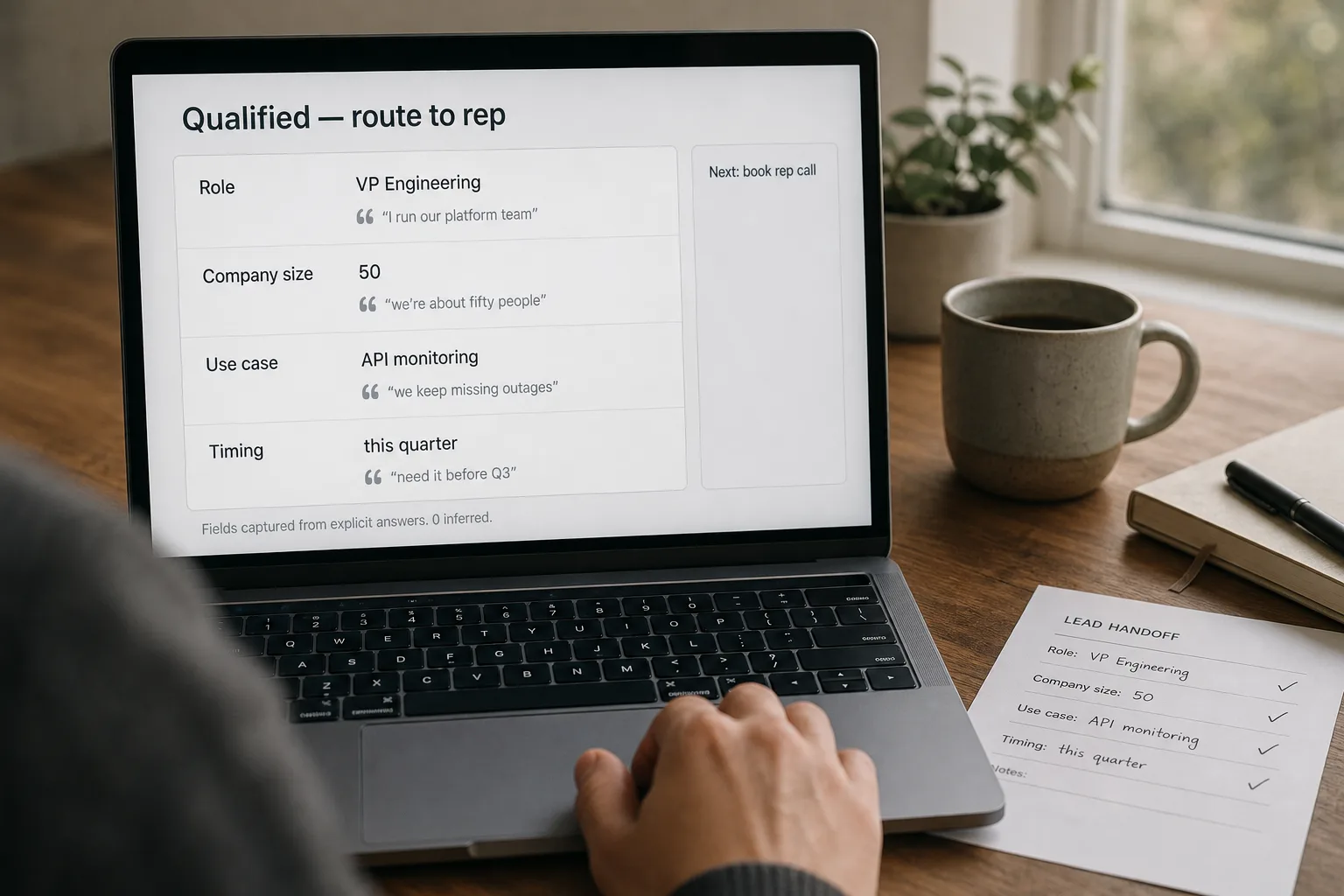
The agent shouldn’t mark a lead “qualified” until the required fields are filled with explicit user answers — not inferences. If the user hasn’t said their company size, the agent doesn’t write it; it asks again or marks the field as “unknown.” The discipline prevents the worst failure mode where the agent confidently summarises a conversation with details the user never gave. Verbatim quote capture per field is the audit anchor.
- Route by qualification signal — qualified to rep, unqualified to nurture
Three outcomes: (a) qualified by your criteria → route to sales rep immediately (calendar booking, Slack alert, CRM lead creation); (b) partially qualified or borderline → route to a nurture sequence with the captured context, follow up via email; (c) unqualified → polite close, optionally add to a long-term nurture or self-serve flow. Don’t auto-discard; even unqualified prospects sometimes become qualified later, and the captured conversation is signal for future contact.
- Hand off to the rep with full context — not just a notification
When a qualified lead is handed to a rep, the rep should see: the qualification fields, the verbatim conversation, the prospect’s stated pain or use case, any signals about urgency or buying timeline, and a recommended first-meeting agenda based on the conversation. The handoff context is what makes the first rep call land as continuation rather than restart. Without it, reps re-ask the questions the agent already covered, and the prospect feels they’re starting over.
- Track conversion at each stage — agent qualification rate, rep-meeting conversion, deal close
Measure: visitor-to-agent-conversation rate, agent-conversation-to-qualified-lead rate, qualified-lead-to-rep-meeting rate, meeting-to-deal rate. The funnel is the diagnostic; if conversion drops at the agent stage, the conversation flow needs work; if at the rep stage, the qualification threshold may be too generous. Tune the prompt and threshold based on actual stage conversion, not on theoretical qualification quality.
What it costs and what to expect
The conversion lift over form-based qualification is the headline. The hallucinated-data rate is the failure mode to design against — agent qualification that invents data is worse than form qualification that captures less.
Other ways to solve this
Conversational platforms (Qualified, Drift, Intercom Fin). Turnkey conversational qualification with CRM integration. Right answer for most teams; the platforms handle the multi-step integration. Trade-off: per-month cost, less prompt control.
Long forms. Traditional approach. Captures clean data; converts poorly. Defensible for high-value lead categories where conversion isn’t the bottleneck.
Manual SDR qualification. For very-high-touch enterprise motions. The AI agent doesn’t replace an excellent SDR; it handles volume and frees the SDR for higher-judgement work.
Short form + SDR follow-up. Hybrid. Quick form captures basics; an SDR follows up to complete qualification. The AI agent collapses the two-stage process into one conversation when it works.
Related work
For the broader live-chat AI decision framework, see Live-chat AI: when it works and when it actively hurts trust. For the CRM-data-hygiene pipeline that keeps qualified-lead data clean once the agent writes to it, see CRM data hygiene at scale. For the sales-follow-up generation that picks up after the agent’s handoff, see Sales follow-up sequences with CRM context. For the broader inbound-triage pattern that this is a specialised version of, see Triage inbound email at scale.
FAQ
How is this different from a chatbot?
Modern conversational agents use LLMs grounded in your knowledge base and writing structured data via function calls. Older chatbots followed scripted flows. The capability difference is substantial — LLM agents handle ambiguous phrasing and multi-turn context better. The risk of hallucination is also higher; the structured-capture discipline in step 3 is what mitigates it.
Should the agent book meetings directly or hand off?
Both work; pick based on rep capacity. For high-volume motions with always-available reps, direct booking via calendar integration is faster. For motions with limited rep capacity, hand off via Slack alert so the rep can engage when ready. The choice affects the conversation's last step — "let me book you a time" vs "here's how we'll follow up."
What if the visitor doesn't engage with the agent?
Multiple touch-points. The agent can be proactive (open conversation after X seconds, based on page) or reactive (visible chat button only). Test the engagement mode; aggressive proactive opens annoy some segments and convert others. The right balance varies by audience and industry.
How do we measure if the agent is qualifying as well as a human SDR?
Three signals. (1) Rep-side accept rate of agent-qualified leads vs SDR-qualified leads. (2) Meeting-to-deal conversion from each source. (3) Average deal size from each source. The agent should match the SDR on the first two and slightly underperform on the third (the SDR catches the larger / more complex deals); if the agent dominates on all three, your SDR motion was the bottleneck and the agent is the lift.