
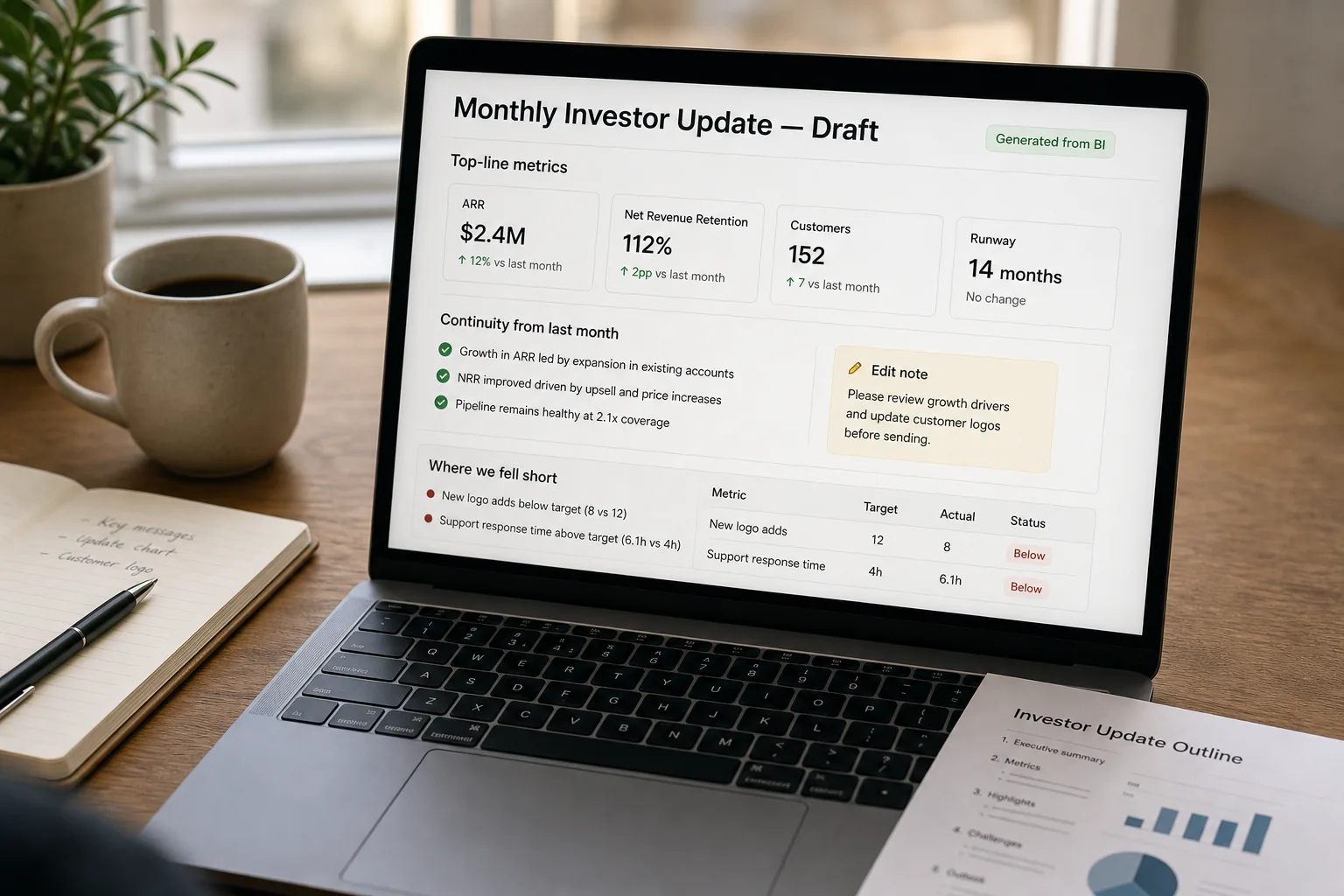
If you’re a founder past seed stage, the monthly investor update gets written at 11pm on the day it’s due — or it doesn’t get written at all. You know you should send them. Investors know they don’t reliably receive them. The missed update is one of the more reliably predictable failure modes in early-stage operations.
The reason isn’t that you don’t have time. It’s that writing the update from scratch every month means re-assembling metrics from dashboards, re-finding context from prior conversations, and writing fresh narrative when a paragraph could be largely the same as last month’s with the numbers updated.
This pipeline pulls the metrics automatically from your BI tool (Mode, Hex, Looker, or similar), references the prior month’s update for narrative continuity, surfaces the events worth highlighting from recent activity, and produces a structured draft. You edit Monday morning rather than write Thursday night.
Where this fits — and where it doesn't
Use this if you’ve committed to monthly investor updates, you’ve sent fewer than 80% of them on time over the last six months, and you have BI infrastructure that produces the relevant metrics in a queryable form. Common fits: founders post-seed, finance teams at startups past series A, founder offices with multiple investor groups (preferred, common, advisors, prospects).
Don’t use this if you don’t actually need to send investor updates (very early stage or very mature companies don’t), your BI data isn’t reliable enough to auto-pull (fix that first; auto-generated wrong numbers is worse than no update), or your investor base expects high-touch personalised communication where automation would feel inauthentic.
What you'll need before starting
- BI access — Mode, Hex, Looker, Metabase, or even structured SQL access to the data warehouse. The pipeline queries metrics from this.
- The previous 3–6 months of investor updates. These become the format anchor and the source of narrative continuity.
- A list of metrics that belong in the update — typically ARR, growth rate, runway, headcount, key product / customer milestones, asks for help. Lock this list before generating.
- A model API key. Mid-tier models handle the writing well; cheap-tier is fine for the simpler updates.
- A founder or finance lead who will review and edit the draft. Auto-sent investor updates are a worse failure mode than missed ones.
Six steps to a draft you'll actually send
- Define the update template — sections, metrics, narrative blocks
Lock a structure: top-line metrics (ARR, growth, runway, headcount), recent wins (top 3–5), key learnings or challenges, what’s next, asks. The structure is the spec; the generation populates it. Most teams have an implicit template from their existing updates — extract and codify it.
- Pull metrics from BI on the first of each month
Schedule a job to query the relevant metrics: revenue (ARR, MRR, growth), unit economics (CAC, LTV, payback), product metrics (key feature adoption, active accounts), team (headcount, key hires), cash (burn, runway). Pull both current values and 3-month and 12-month trends. The trend data is what gives the narrative context — “ARR grew X this month, continuing the Y trend over the past quarter.”
- Reference the prior update for narrative continuity
Pass the last 2–3 updates to the LLM as context. The model uses them for voice consistency, to reference commitments made in prior updates (“last month we said we’d ship X — here’s the status”), and to maintain continuity in the narrative arc. Without prior-update context, each generation reads as isolated; with it, the updates read as a continuing story.
- Pull recent events from Slack, Notion, and CRM for context
The metrics show what happened; the events show what’s worth saying about it. Pull recent significant events: major customer wins (from CRM), product launches (from changelogs), hires (from HR system), notable team accomplishments (from Slack channels), industry developments worth referencing. Filter for significance — most events are noise; the pipeline should surface the few worth the founder’s commentary.
- Generate the draft with structured output per section
For each section, generate the content with the metrics, prior context, and events as input. Structured output makes editing fast — the founder can tweak specific sections without rewriting the whole update. Keep generated language plain and specific; don’t lean into corporate-speak or hype phrasing. Investors prefer “we missed our hiring target by 1 person, here’s why” to “we made significant progress on talent acquisition.”
- Surface variant framing for different investor segments where needed
Sometimes one update goes to everyone; sometimes different segments need different emphasis. Major institutional investors want the metric trends; advisors want the customer / product story; prospective investors want the trajectory. Generate variants with the same data but different emphasis where the audience differentiation matters. Most teams don’t need this for monthly; quarterly board updates and fundraise-period updates often do.
What it costs and what to expect
The time saved per update is real; the strategic value is the discipline of monthly communication that actually happens.
Other ways to solve this
Investor-portal tools (Pulley, Carta, Visible). Some bundle update templates and reminders; few yet bundle full LLM-driven generation. Right answer for teams already on these platforms; pair with a lightweight AI-draft layer for the content.
Manual writing with a template. The traditional approach. Template plus discipline works for founders who maintain the discipline; falls apart for the ones who don’t. The AI pipeline lowers the discipline cost meaningfully.
Don’t send updates — handle investor relations ad hoc. Honest answer for pre-seed; increasingly damaging at scale. The pipeline isn’t the reason to commit to monthly updates; it’s the operational support for the commitment.
Related work
For the broader content-generation pattern this builds on, see Prompt engineering patterns for content teams. For the CRM-context integration that powers the customer-wins section, see Sales follow-up sequences with CRM context. For the BI infrastructure that produces the input metrics, see Build a private knowledge base your team can search. For the voice-and-style discipline that keeps generated content from sounding generic, see First-draft marketing copy without the AI tells.
FAQ
Should we tell investors the update is AI-drafted?
Most don't, but the substance matters more than the disclosure. The draft is the founder's review-edited output, not raw AI prose. If you'd describe the writing process as 'AI helped me organise', that's transparent enough; if it's 'AI wrote it', the disclosure case is stronger. The investor relationship is about the founder's thinking, not the prose generation; keep the founder genuinely in the loop on content choices.
How do we handle confidential metrics that shouldn't go to all investors?
Per-investor segmentation with explicit access tiers. Some metrics (commercial deals in negotiation, sensitive customer-name detail) go only to the board; others to the major preferred holders; others to the wider list. Bake this into the templates; don't rely on the model to know which audience gets which info.
What about quarterly board decks — same pattern?
Similar architecture, different format and depth. Quarterly board materials need more depth and longer-horizon framing; the pipeline scales to this but requires more structured input. Most teams run monthly updates through automation and reserve quarterly board prep for a more hands-on process.
How do we keep the pipeline honest when metrics are bad?
The pipeline reports what BI reports. The honesty discipline is in the founder review — don't soften the framing when numbers are weak. Generated drafts default to neutral, factual language; the human review should preserve that rather than spin it. Investors prefer honest weak quarters with clear context to spin.