
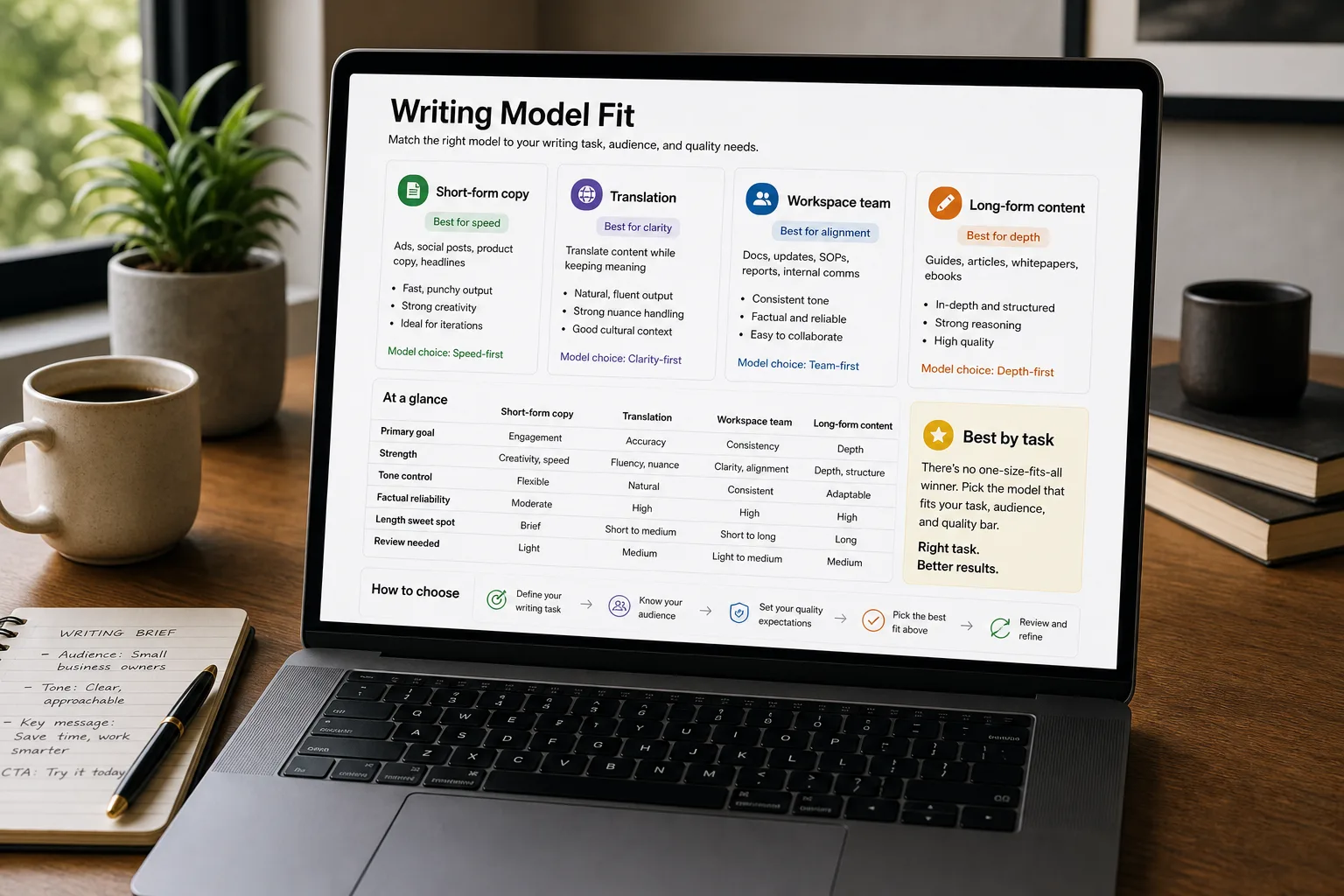
A large language model — an LLM, the technology behind ChatGPT, Claude, and Gemini — is a program that predicts what text is most likely to come next, given some text you provide. Three families dominate business writing: OpenAI’s GPT line (the models inside ChatGPT), Anthropic’s Claude (inside Claude), and Google’s Gemini (inside Gemini).
The honest answer to “which AI should I use for writing?” is: any of the three will get you 80% of the way there, the differences are real but modest for most tasks, and the cost of switching later is low. With that out of the way, this piece is the longer answer — where each one is meaningfully better, where each one is meaningfully worse, and how to pick if you’re standardising on one.
One thing to read carefully below. The prices, context windows and model names are current as of September 2026. The quality rankings — voice, editing, long-form coherence — come from a blind human evaluation run in Q1 2026, on the model versions current at our May 2026 snapshot: GPT-5.4, Claude Sonnet 4.6 and Gemini 3.1 Pro. All three vendors have shipped newer models since, and nobody has re-run that evaluation on them. So treat the rankings as a well-evidenced steer on how these three houses tend to write, not as a measurement of today’s exact versions.
This category moves quickly; see the change log for the freshness check, and assume any specific number can shift within a quarter.
The comparison matrix
| ChatGPT (GPT-5) | Claude (Sonnet 4.6) | Gemini (3.1 Pro) | |
|---|---|---|---|
| Default writing voice | Polished, slightly stiff since the GPT-5 line; more formal than GPT-4 era | Conversational, closest to natural prose; least "AI-sounding" by default | Competent but verbose; tends to over-explain |
| Following voice/style instructions | Strong with explicit constraints; weaker at imitating nuanced samples | Strongest at matching pasted voice samples | Follows instructions but often defaults to its own structure mid-piece |
| Long-form quality (1,500+ words) | Coherent but can lose narrative thread past ~2,000 words | Strongest — long-context coherence is a notable Sonnet 4.6 strength | Verbose; benefits from explicit length caps in the brief |
| Short-form / headlines / ad copy | Strong; produces snappy variants when asked | Strong; often more natural phrasing on first pass | Weakest of the three; tends toward generic |
| Editing / revising existing text | Strong; respects the input voice when asked | Strongest; preserves voice while fixing issues | Tends to rewrite more than edit |
| Multilingual writing (top tier languages) | Excellent — strongest in major non-English languages | Excellent in major languages; gap narrowing | Strong in major languages; uneven outside them |
| "AI tells" tendency in default output | High — em-dashes, "delve," tricolons, formal cadence | Lower than peers — fewer canonical AI tells, but not zero | High — verbosity, generic transitions, "in today's..." |
| Free tier | Limited daily messages; flagship access throttled | Free with daily caps on best model | Generous free tier on Gemini 3.1 Flash; 3.1 Pro limited |
| Standard paid consumer plan | ChatGPT Plus — $20/month | Claude Pro — $20/month | Google AI Pro — $19.99/month |
| Power-user plan | ChatGPT Pro — $200/month | Claude Max — $100 or $200/month (5× / 20× usage) | Google AI Ultra — $249.99/month |
| Cheapest entry tier | ChatGPT Go — $8/month (US, rolling out globally) | Free tier with daily caps | Google AI Plus — $7.99/month |
| API — flagship input price (Sept 2026) | $10 per million tokens (GPT-6 Astra) · $4 (GPT-5.6 Sol) · $2 (Terra) | $5 per million tokens (Opus 5) · $2 (Sonnet 5) · $10 (Fable 5.1) | $2 per million tokens (3.1 Pro Preview, ≤200k prompt) · $0.75 (3.8 Flash) |
| API — flagship output price (Sept 2026) | $50 per million tokens (GPT-6 Astra) · $20 (GPT-5.6 Sol) · $12 (Terra) | $25 per million tokens (Opus 5) · $10 (Sonnet 5) · $50 (Fable 5.1) | $12 per million tokens (3.1 Pro Preview, ≤200k prompt) · $3.75 (3.8 Flash) |
| Context window — flagship (Sept 2026) | ~1.05M (GPT-6 Astra and GPT-5.6 Sol), 128k max output | 1M on every Claude 5 model — default and maximum, no cheaper small-context tier | 1M (3.1 Pro Preview); 1M in / 64k out (3.8 Flash) |
| Memory across chats | Yes — opt-in "memory" feature, persists facts | No persistent memory by default; uses Projects for shoulder-context | Yes — opt-in memory across conversations |
| File / image / PDF upload | Yes (multimodal across plans) | Yes (multimodal across plans) | Yes; native multimodal across text/image/audio/video |
| Custom personas / projects (saved system prompts) | Custom GPTs (with file uploads, tools) | Projects (with shoulder context, custom instructions) | Gems (with file context, instructions) |
| Trains on your data by default (consumer tier) | Yes — opt-out in Data Controls | Yes since August 2025 — opt-out in Privacy settings (was previously no) | Yes — opt-out via Gemini Apps Activity |
| Trains on your data (API / Team / Enterprise) | No | No | No |
In Q1 2026 blind human evaluations of writing quality
The headline finding doesn’t translate to “Claude is best at all writing” — it translates to “for the kinds of writing tasks the evaluators tested, prose generated by Claude was preferred more often.” Real-world picks depend on the specific work.
Which to pick for which job
Long-form drafts (1,500+ words: blog posts, essays, narrative pieces). Claude. Long-context coherence and natural prose default give it a meaningful edge. ChatGPT is a strong second; Gemini’s verbosity becomes a tax at length.
Short-form copy variants (headlines, ads, social posts). Either Claude or ChatGPT. Both produce strong variants with explicit constraints; pick the one whose default voice you find easier to work with. Gemini is the weakest of the three here.
Editing existing prose (preserve voice, fix issues). Claude. Most reliable at preserving the input voice while making targeted fixes. ChatGPT can do this with explicit instructions; Gemini tends to rewrite more aggressively than asked.
Translation, multilingual writing. ChatGPT for the broadest language coverage. Gemini for tight integration with Google Translate workflows. All three are excellent in top-tier languages (English, Spanish, French, German, Mandarin); the gap widens in lower-resource languages where ChatGPT has historically led.
Standardising one tool for a small team (5–20 people). Claude Pro — for the writing-quality edge and the cleaner default voice — unless your team is already deep in Google Workspace, in which case Gemini’s integration with Docs and Gmail tilts the math the other way.
Standardising one tool for an enterprise. None of the above on its own. Buy Microsoft Copilot if you’re a Microsoft shop, Gemini for Workspace if you’re a Google shop, ChatGPT Enterprise or Claude Team if you want the cleanest model-only experience without the productivity-suite bundle. The integration story dominates the model-quality story at scale.
API for a custom application. Pick by latency, price, and context window for your specific workload. Claude Sonnet 5 is the default worth trying first for prose — Anthropic ships it as a drop-in replacement for Sonnet 4.6, the version that won the blind evaluation above, and at $2/$10 per MTok it is cheaper than the model it replaces. One catch to budget for: Sonnet 5 uses a new tokenizer, and the same text produces roughly 30% more tokens than on Sonnet 4.6 — so your bill does not fall by the full headline percentage. GPT-5.6 Terra is the cost-competitive OpenAI option at $2/$12; GPT-6 Astra ($10/$50) is aimed at hard end-to-end work rather than everyday copy. Gemini 3.8 Flash at $0.75/$3.75 is the cheapest of the three picks above by a wide margin — note it is a Flash-tier model set against two mid-flagships — and that is introductory pricing that doubles on 1 January 2027. If raw cost is the only constraint, GPT-5.6 Luna at $0.20/$1.20 undercuts everything here, at OpenAI’s lowest capability tier.
Cost-sensitive personal use. Free tiers of all three are useful. If you have to pick a paid one, Google AI Pro at $19.99 includes 2TB of Drive storage; ChatGPT Go at $8 is the cheapest entry that still gives flagship access. Claude has the strongest free tier for daily-cap quality.
Volatility notes
This is the most volatile category in the playbook. Concrete things to watch for over the next two quarters:
- The blind evaluation needs re-running. All three tested versions have been superseded. Until someone re-tests, the quality ranking above is the best evidence available but is two quarters and a full model generation old.
- GPT-6 Astra shipped on 3 September 2026 as OpenAI’s most capable model. It is built for “the hardest end-to-end work” — computer use, software engineering, science — and OpenAI makes no specific prose-quality claim for it. Whether a reasoning-heavy flagship writes better copy is genuinely unsettled.
- Claude Sonnet 5 is the interesting one for writing budgets: released 30 June 2026 as a documented drop-in for Sonnet 4.6, more capable, and cheaper. The $2/$10 launch price was made permanent — a scheduled rise to $3/$15 on 1 September 2026 was cancelled.
- Google’s Flash line moved three times in six weeks (3.6 in July, 3.7 in August, 3.8 in September), while Gemini 3.5 Pro was shelved — reportedly to pretrain Gemini 4. There is still no Pro model newer than 3.1 Pro Preview.
- Price competition at the API tier continues to favour buyers hard. OpenAI cut GPT-5.6 prices twice in six weeks; the cheapest tier, Luna, fell about 80% to $0.20/$1.20.
Re-verify this comparison quarterly. If a model materially shifts the ranking, the page will surface an update_notice callout.
FAQ
Can I just pick one and stick with it?
Yes. The differences between the three are real but modest for most business-writing work; switching cost between consumer plans is approximately one month's subscription. Pick one (Claude is a good default for writing-heavy roles), use it for two months, then re-evaluate. The team that picks one and goes deep on prompting and standing instructions usually outperforms the team that uses three tools shallowly.
Do I need the $200/month tier?
Almost never for writing alone. The power-user tiers (ChatGPT Pro, Claude Max, Google AI Ultra) primarily unlock higher rate limits, longer reasoning modes (o-series, Claude extended thinking, Gemini Deep Think), and unlimited research-grade features. For a marketer drafting copy, the $20 standard tier is the right default. Move up only when you've hit rate limits regularly and the time saved exceeds the price gap.
Should I use a wrapper tool (Jasper, Copy.ai, Writer) instead?
Wrappers add brand-voice features, templates, and team workflows on top of underlying foundation models — usually GPT or Claude under the hood. Worth it for marketing teams of 5+ producing high volume; overkill for solo founders or small teams. The wrapper economy is also less stable than the foundation-model market — vendors come and go faster than the foundations underneath.
What about smaller / open-source models for writing?
Llama, Mistral, Qwen, DeepSeek — open-source models have closed much of the gap on factual tasks but lag the proprietary frontier on prose quality. Worth running locally for privacy-sensitive work or for cost-bound automation; not yet worth it as your primary writing tool unless privacy or cost makes the trade-off mandatory.
Is Microsoft Copilot in this comparison?
Copilot uses GPT models under the hood (with Microsoft customisations), so its writing quality tracks GPT-5's quality. The reason to pick Copilot is integration with Word, Outlook, Excel, and Teams — not the model. If you live in Microsoft Office, Copilot is the path of least friction; if you're picking by writing quality alone, go directly to ChatGPT or Claude.
How quickly will this comparison go stale?
Expect to re-verify every 3–6 months. Model versions, pricing tiers, and feature gaps shift on roughly that cadence. The last_verified date at the top of this page and the change log at the bottom are your freshness check.