
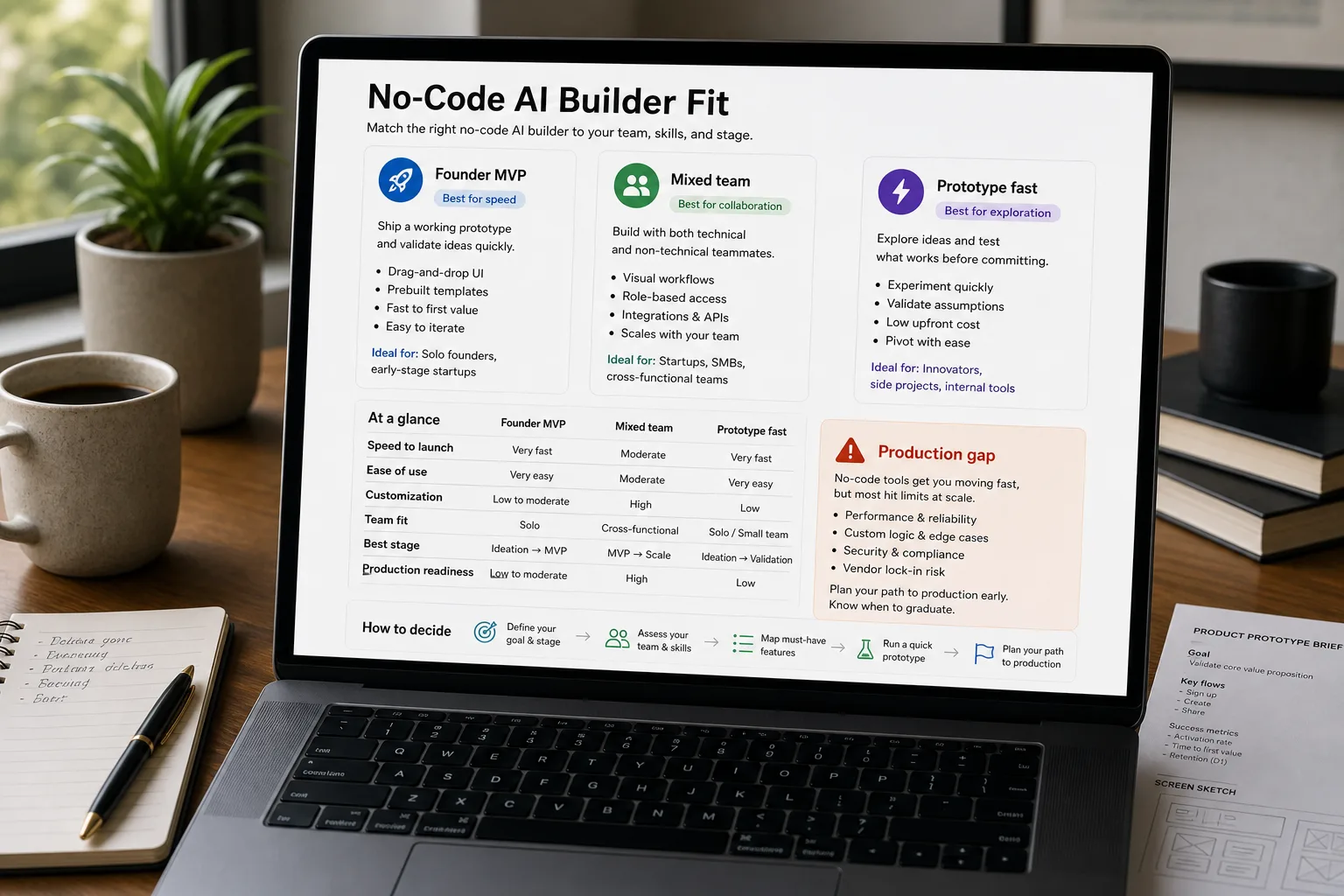
If you’re trying to build an MVP yourself with AI, you’re in the most active growth area in software in 2025–2026 — and the tool choice quietly shapes what you can actually ship. Bolt and Lovable produce full applications from a prompt. v0 produces UI components for engineers to integrate. Replit Agent works inside a full IDE (integrated development environment, where engineers write and run code). Cursor is the engineer’s daily editor with AI assistance.
The marketing pages all promise “build apps by describing them.” The reality is each tool has a different gravity well — what comes easily, what gets hard, and where the prototype-to-production cliff sits.
This piece compares them side by side: what each tool actually produces, where the limits show up, and the decision rules per team type.
The comparison matrix
| Bolt.new | Lovable | v0 by Vercel | Replit Agent | Cursor | |
|---|---|---|---|---|---|
| Target user | Mixed — both non-technical and technical | Non-technical founders / PM-style users | Engineers who need UI components | Mixed — full IDE with agent layer | Engineers; AI-assisted code editor |
| Output | Full web app — frontend + simple backend | Full web app with database, auth | React / Tailwind UI components | Full app inside Replit's hosting + IDE | Code edits in your local editor |
| Frontend frameworks | React, Vite, Next.js variants | React + Tailwind primarily | React + Tailwind (Vercel ecosystem) | Any (JavaScript, Python, etc.) | Any |
| Backend / database support | Simple Node.js / serverless functions | Supabase integration; auth and database built-in | No native backend; export to your stack | Full backend support in Replit hosting | No constraint; your project structure |
| Iteration speed | Fast — chat-driven changes | Fast — chat-driven changes with visual preview | Fast for UI; manual integration to backend | Fast within Replit's environment | Fast for code-level changes |
| Code quality | Reasonable for prototypes; varies by complexity | Reasonable; opinionated stack choices | High — Vercel's component output is production-shaped | Variable; depends on agent run | High — engineer reviews each change |
| Production-readiness | Prototype-quality; production requires engineering review | Closer to production with Supabase backend; still needs engineering | Component-level — integrates into production codebases | Demo / internal-tool ready; consumer-prod requires review | Engineer is in the loop; output is production-ready when reviewed |
| Where the no-code label breaks down | Custom integrations, performance tuning, scale | Anything beyond Supabase's capabilities | Backend integration; you need engineering | Performance at scale, custom infra | No false promise — it's an editor, not no-code |
| Pricing | Free tier; $25/month Pro (10M tokens); $30/seat/month Teams | Free tier; $25/month Pro (100 credits) | Free tier; $30/user/month Team; $100/user/month Business | Free tier; $20/month Core (annual) | $20/month Pro; $40/user/month Teams (formerly "Business") |
| Best for | MVP web apps, internal tools, demos | Founder-led MVP building with full-stack needs | UI prototyping; engineering teams shipping UI fast | Replit-native development; multi-language apps | Day-to-day engineering with AI leverage |
What to actually use
For non-technical founders building MVP web apps — Lovable. Closest to “describe the app and ship it” for full applications; Supabase backend handles auth and database without you knowing what those are. Trade-off: opinionated stack choices, production-readiness still needs engineering review. Right for validating an idea before hiring engineering.
For prototype-first product validation by mixed teams — Bolt. Fast iteration, chat-driven changes, generic web-app output. Lower opinionation than Lovable — more flexibility, slightly more friction. Right for product teams that want to prototype interactively.
For engineers building UI fast — v0 by Vercel. Produces production-quality React + Tailwind components that integrate into existing codebases. Not full-app generation; it’s UI scaffolding for engineering teams. Right answer when you have engineering capacity but want to skip the UI implementation step.
For Replit-native or multi-language development — Replit Agent. Full IDE with strong AI agent integration; works on any language Replit supports. Right for teams already on Replit or wanting an end-to-end cloud development environment.
For day-to-day engineering work — Cursor. Not a no-code tool; a code-editor with strong AI. The right answer for engineers who want AI in their everyday workflow rather than for non-technical builders. See Cursor vs Copilot vs Claude Code for the engineer-focused comparison.
For the prototype-to-production transition — Most projects need this. The tools above are excellent at the prototype stage; production typically requires an engineer to refactor, add proper testing, secure the auth, and handle scale. Plan for this transition explicitly; “we’ll just ship the no-code version” tends to produce a brittle production system that needs full rewrite anyway.
What you'll actually pay
Per-tool costs are modest. The strategic value is time-to-prototype, not the subscription savings.
Volatility notes
- Production-readiness improving. Each tool is investing in moving the prototype-to-production line; expect the gap to narrow.
- Backend capabilities growing. Lovable’s Supabase, Replit’s hosting, Bolt’s deployment options are all improving.
- Specialised entrants. Tools for specific use cases (mobile apps, internal tools, data apps) emerging.
Re-verify every 6 months; the category is changing fast.
Related work
For the engineer-focused coding tool comparison, see Cursor vs Copilot vs Claude Code for coding assistance. For the broader local-vs-cloud framework, see When to run AI locally vs in the cloud. For the open-source-vs-proprietary stack-decision lens, see Open-source vs proprietary AI — practical tradeoffs. For specific AI coding tool patterns for non-engineers, see AI coding tools for non-engineers.
FAQ
Can I really ship a production app with these tools?
Prototype: yes. Production-grade: with engineering review. The tools produce real code that can ship, but the production checklist (security review, performance, error handling, monitoring, accessibility, edge cases) is engineering work the tools don't do reliably. Plan for the engineering pass on anything that goes to real users; the tools accelerate the prototype phase, not the production hardening.
What about the security of code these tools generate?
Mixed. The generated code often has plausible-but-flawed security patterns — exposed API keys in client code, weak auth, insufficient input validation. Audit before deploying anything customer-facing. The tools are improving on this; don't assume security is solved.
How much engineering knowledge do I need to use these effectively?
Lovable and Bolt: minimal engineering knowledge for prototypes; some debugging knowledge helps for when things go wrong. v0 and Cursor: engineering-level. Replit Agent: somewhere in between. The honest answer is that even non-technical users benefit from some debugging intuition; the tools fail in ways that require basic technical problem-solving to recover from.
Will my code be portable if I outgrow these tools?
Mostly yes for Lovable, Bolt, v0 (the code is your code, in standard frameworks). For Replit, you can export but some integration with Replit's hosting is implicit. Plan for the migration even if you don't expect it; software with no exit ramp is a long-term liability.