> case_study / modernastro
ModernAstro.com ↗
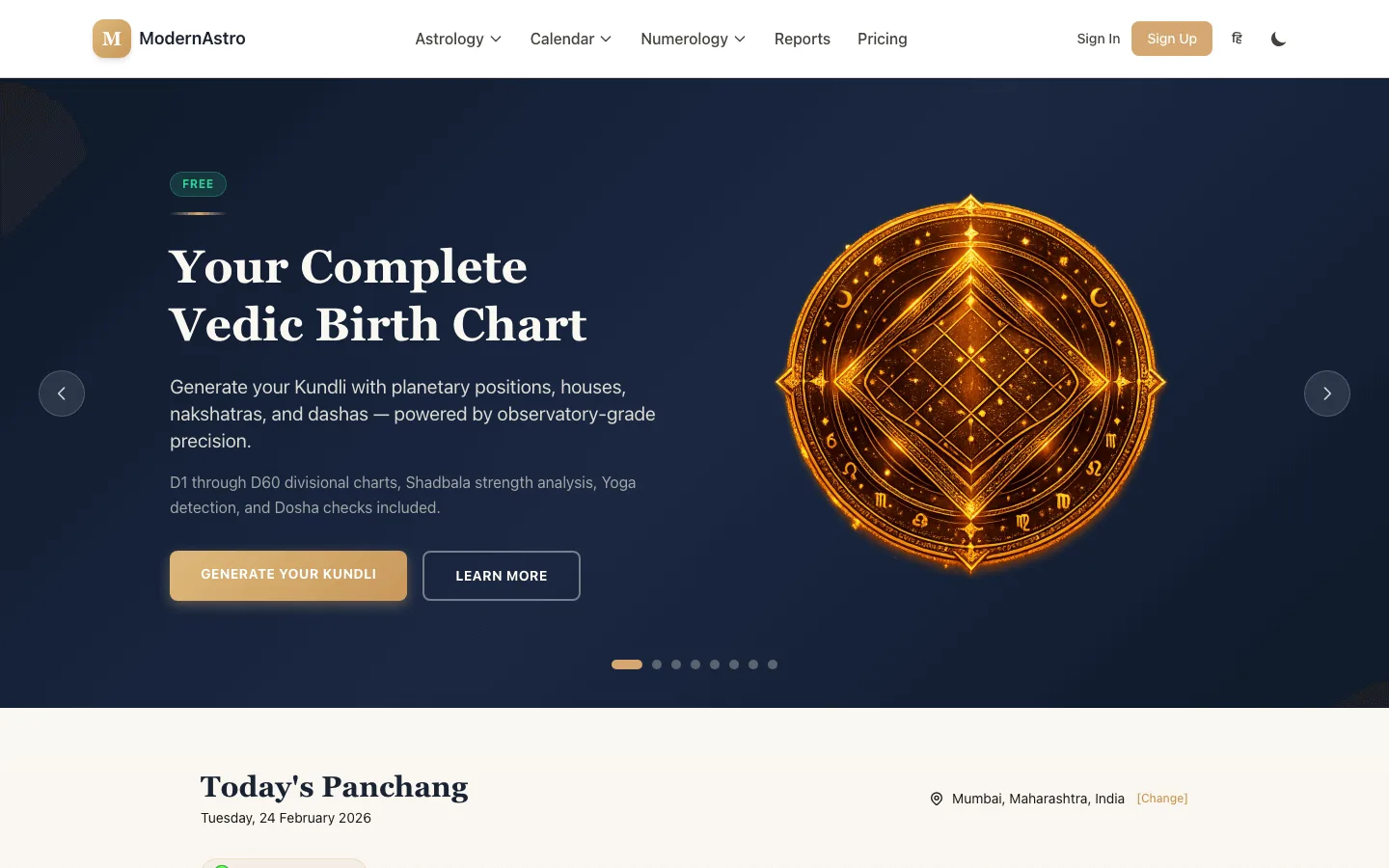
A free Vedic astrology platform built to explain itself — birth charts, dashas, transits, panchang and compatibility, each shown beside its meaning rather than a wall of symbols. Underneath runs a deterministic engine, accurate to the arc-minute from NASA/JPL ephemeris data, with AI bounded to interpretation.
- Arc-minute accuracy, computed from NASA/JPL's DE440 ephemeris
- Every chart shown beside its meaning — no wall of symbols
- AI interprets and explains; the engine computes — it never invents the numbers
- Live and evolving for years, no full rebuild — past readings stay intact
The problem
People want Vedic guidance they can trust and understand — what's happening to them now, what their chart means, whether the timing is right, whether two people are compatible. Most tools bury that behind a wall of symbols or hand-wave the math. ModernAstro had to be precise enough to rely on and clear enough that anyone can follow why a reading says what it says.
Why it's hard to get right
Vedic calculation isn't simple math — it's layered rule systems that interact. A dasha period depends on the Moon's position at birth, which depends on the ayanamsa correction used, which varies by school of thought. Change one parameter and the entire chart shifts. On top of that, the positions themselves have to be observatory-grade, the explanations have to stay faithful to what was computed, and a reading someone relied on last month can't quietly change because the engine improved this month.
How we built it
At the core, a deterministic engine computes planetary positions to arc-minute accuracy from NASA/JPL's DE440 ephemeris, cross-checked against established panchang references — and every chart is stamped with the exact ruleset that produced it, so the past stays intact as the engine evolves. Over it sits an intent-first front door: “tell us what's on your mind” routes you straight to the right tool, with the chart and its meaning side by side. And we keep AI on a short leash — it interprets and explains in plain language, but the numbers always come from the engine, never from a model. The platform has grown for years — new house systems, KP, divisional charts, AI interpretation — without a single full rebuild.
What this means for you
If your product sits on deep, layered domain math that has to be exactly right — and you also want it approachable and AI-augmented — the pattern is the same: a deterministic engine of record, an explainability layer over it, and AI bounded to interpretation rather than calculation. We build that boundary in from day one, so you get the trust of real computation and the warmth of plain-language guidance, in a system that keeps growing instead of being rewritten.
> other_work