
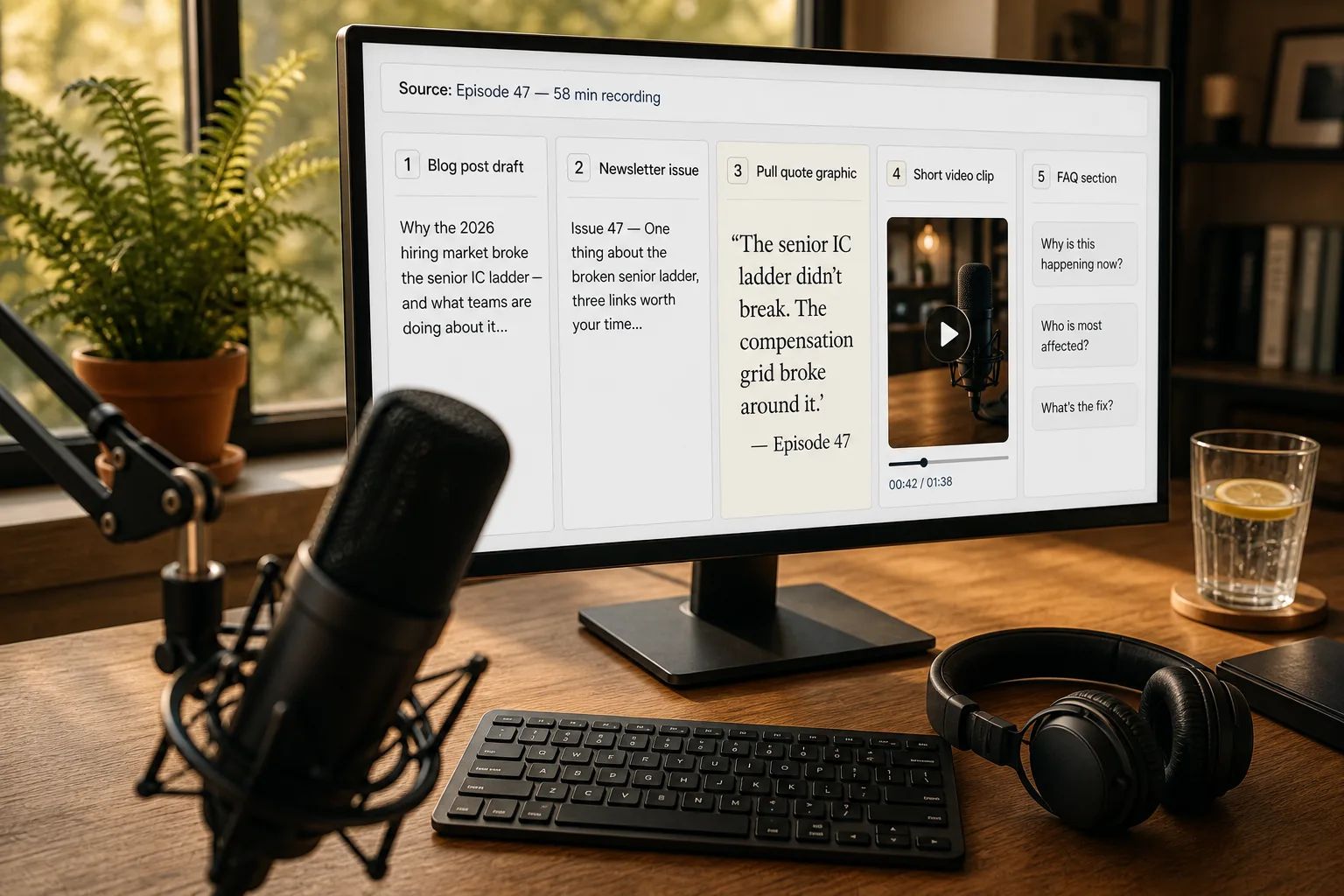
If you produce long-form content, the economics have always been awkward. You spend an hour recording, an hour editing, and the result reaches the people who already subscribe to the podcast, channel, or newsletter. Repurposing the same hour into a blog post, a newsletter, social pull-quotes, short-form clips, and an FAQ section reaches a much wider audience for a fraction of the marginal cost.
The category of AI tooling for this has matured to the point where one hour of focused work can produce 5–10 derivative pieces.
This piece is the workflow. It assumes you have a master asset — a podcast episode, a recorded talk, a long-form interview, or a webinar — and you want to do more with it than ship the audio.
Where this fits — and where it doesn't
Use this if you produce long-form content regularly and the bottleneck is “we ship the episode but never write the blog post / never cut the clips / never share on LinkedIn.” The pipeline turns one production session into a week of distribution. Common fits: podcasters, founders running customer interviews, executives doing thought-leadership content, marketing teams with webinar archives.
Don’t use this if you don’t produce long-form content (no master asset to repurpose), the long-form is too narrative to chunk (a single sustained argument that doesn’t separate cleanly), or the audience for each derivative is the same as the audience for the original (no distribution gain).
What you'll need before starting
- A master recording — audio or video, ideally with reasonably clean audio (headset audio or a good in-room mic; phone-on-table audio degrades everything downstream).
- A consistent voice / brand to derive against — if every piece sounds like a different person wrote it, the workflow loses the cumulative trust effect.
- A list of distribution channels — your blog, newsletter, LinkedIn, X, YouTube Shorts, Instagram Reels, wherever your audience is. Don’t try to publish to channels you don’t already use; the editorial cost is real.
- A consumer AI subscription or API key (Claude, ChatGPT, or Gemini) — the LLM is the multiplier here.
Six steps to a repeatable repurposing workflow
- Treat the recording as the master asset — record with repurposing in mind
Small choices at recording time pay back hugely downstream. Have the speaker(s) state names, titles, and any specific numbers / examples clearly (these become pull-quotes). Encourage 30–60 second self-contained answers (these become short clips). Put structure markers in the conversation — “Three things to know about X are…” — that make the recording easier to chunk. The editorial framing of the recording is the half of repurposing nobody talks about; it determines what’s possible later.
- Get a clean transcript with timestamps and speaker labels
The transcript is the working asset for everything else. Three paths: (1) Castmagic or Descript if you want a turnkey UI with the derivatives bundled in; (2) OpenAI Whisper API ($0.006/min, ~$0.36 per hour) for a low-cost programmatic path; (3) local Whisper (covered separately) for privacy or volume. Whatever you use, store the transcript with timestamps and speaker labels — both matter for the next steps.
- Generate the structured long-form derivatives — with explicit shape constraints
Pass the transcript to an LLM with a prompt like: “Read this episode transcript. Produce: (a) a 1,200-word blog post that follows the conversation’s main argument, with a strong opening hook and a clear concluding takeaway; (b) a 300-word newsletter intro that previews the episode and includes 3 specific things the reader will learn; (c) a 6-question FAQ section answering the most common objections or follow-up questions a reader might have.” Three derivatives in one call. Tell the model not to use the AI tells from First-draft marketing copy without the AI tells — it knows the list and will mostly avoid them when reminded.
- Find the short-form moments — pull-quotes, clip candidates, audiograms
Two complementary approaches. For text pull-quotes: ask the LLM to surface the 8–10 most quotable single sentences from the transcript, with timestamps. Filter to the ones that work standalone (no missing context). For video clips: Opus Clip analyses the recording, surfaces clip candidates with a “virality score,” reframes for vertical, adds captions. Descript does similar work in a manual-feeling UI for finer control. Headliner generates audiograms (waveform + caption) for audio-only platforms. Pick 3–5 moments to actually publish; resist the temptation to ship every clip the tool surfaces — quality > volume.
- Channel-polish each derivative — LinkedIn isn’t X isn’t a newsletter
The mistake teams make: same copy across every channel. Each platform rewards different shapes. LinkedIn wants a hook → 3 short paragraphs → soft CTA, with line breaks for skim. X wants either a single sharp sentence or a numbered thread; long blocks die. Newsletter wants a personal voice, often first-person, with the episode link near the top. YouTube short / Reel needs the hook in the first 1.5 seconds — re-cut if your clip starts slow. The LLM can do this channel-shaping if you instruct it specifically; “write three social posts” produces generic; “write a LinkedIn post optimised for skim, an X thread of 5 tweets, and a 50-word Instagram caption” produces channel-fit copy.
- Schedule across a week, not a day — and link back to the master asset
Don’t dump everything on publish day. Stagger the derivatives over 5–10 days: long-form blog on Monday, newsletter Wednesday, LinkedIn pull-quotes spread Tuesday/Thursday/following Tuesday, video clips on the days each platform performs best for you. Every derivative should link back to the master asset (podcast / video) — discovery happens through the derivatives, conversion (subscribe, follow) happens through the master. This is the cumulative-distribution effect that makes the workflow worth doing.
What it costs and what to expect
The “4–6× faster” figure is real but only if you do the editorial pass. Skip it and you ship recognisable AI output across every channel, which compounds negatively over a quarter as your audience learns your content has gone hollow.
Other ways to solve this
Hire a content writer to do the repurposing. Higher quality on each derivative; slower turnaround; meaningfully more expensive ($300–$1,500 per episode depending on writer and scope). Right answer for high-stakes thought-leadership content where each derivative is a serious piece in its own right.
Single all-in-one tool (Castmagic, Riverside Magic Clips, Opus AI). Lower setup; less control; works well for high-volume creators who want the workflow standardised. The lock-in is real — moving off the platform later means re-doing the integrations.
Manual repurposing with AI assist on each step. The hybrid most experienced creators run: human picks the angles and structure; AI drafts the prose; human edits. Highest quality; lowest scale. Right answer when each derivative is genuinely a separate piece, not a chunk of the master.
Don’t repurpose at all — just ship the long-form well. Underrated. Some podcasts and channels grow primarily by being deeply good at the long-form format; the repurposing distracts from the work that matters. If your audience is loyal and growing on the master asset alone, don’t manufacture work to look productive on social.
FAQ
How many derivatives is the right number per episode?
5–7 is a good steady-state target — long-form (blog post), medium-form (newsletter), 2–3 short-form text (LinkedIn / X), 1–2 short video clips, 1 audiogram. More than 10 hits diminishing returns for most audiences (the same audience starts seeing the same content too often). Less than 3 means you're leaving distribution on the table.
Should I write the blog post or have AI write it?
Hybrid: AI drafts, human edits hard. Pure AI blog posts based on transcripts are recognisable and weaker than the underlying conversation — they sand off the specifics that made the conversation interesting. The editing pass adds back the specifics: real names, concrete examples, the actual tension in the conversation. See First-draft marketing copy without the AI tells for the editing pattern.
What about copyright and consent for repurposing interview content?
Standard rule: if your guest agreed to the recording, the derivatives are usually yours to publish under the original consent. For specific quotes — especially as social pull-quotes attributed to the guest — give them a heads-up before publishing. Most guests appreciate the visibility; some prefer to review specific clips first. The friction of asking is small; the cost of a guest seeing themselves quoted out-of-context publicly is meaningful.
Will AI-generated clips actually go viral?
Sometimes — but the virality scores are noisier than the marketing implies. Treat them as a useful filter (these 10 clips are the most likely to perform of the 50 the tool surfaced) but don't expect them to be predictive at the per-clip level. Real virality depends on the moment in the conversation, the editing, the audience, and the platform's algorithm in that week — none of which the score captures fully.
Should I publish the full transcript publicly?
Increasingly yes for SEO and accessibility reasons — full transcripts are crawled by search engines, indexed by AI search tools, and serve readers who can't or don't want to listen. The cost is small (just publish the cleaned-up transcript on a separate page linked from the episode page); the cumulative discovery benefit compounds. Many serious podcasts have made this standard practice.
How is this different from just dumping the transcript into ChatGPT and asking for everything?
The dump-and-ask approach gives you generic, dump-and-ask-shaped output — long, hedged, transitionally heavy, and recognisably AI. The structured workflow above (specific shape per derivative, channel-aware constraints, explicit "avoid these AI tells") gives you derivatives that read as if a thoughtful editor produced them. The work is in the prompts and the editorial pass, not in the underlying tool.