
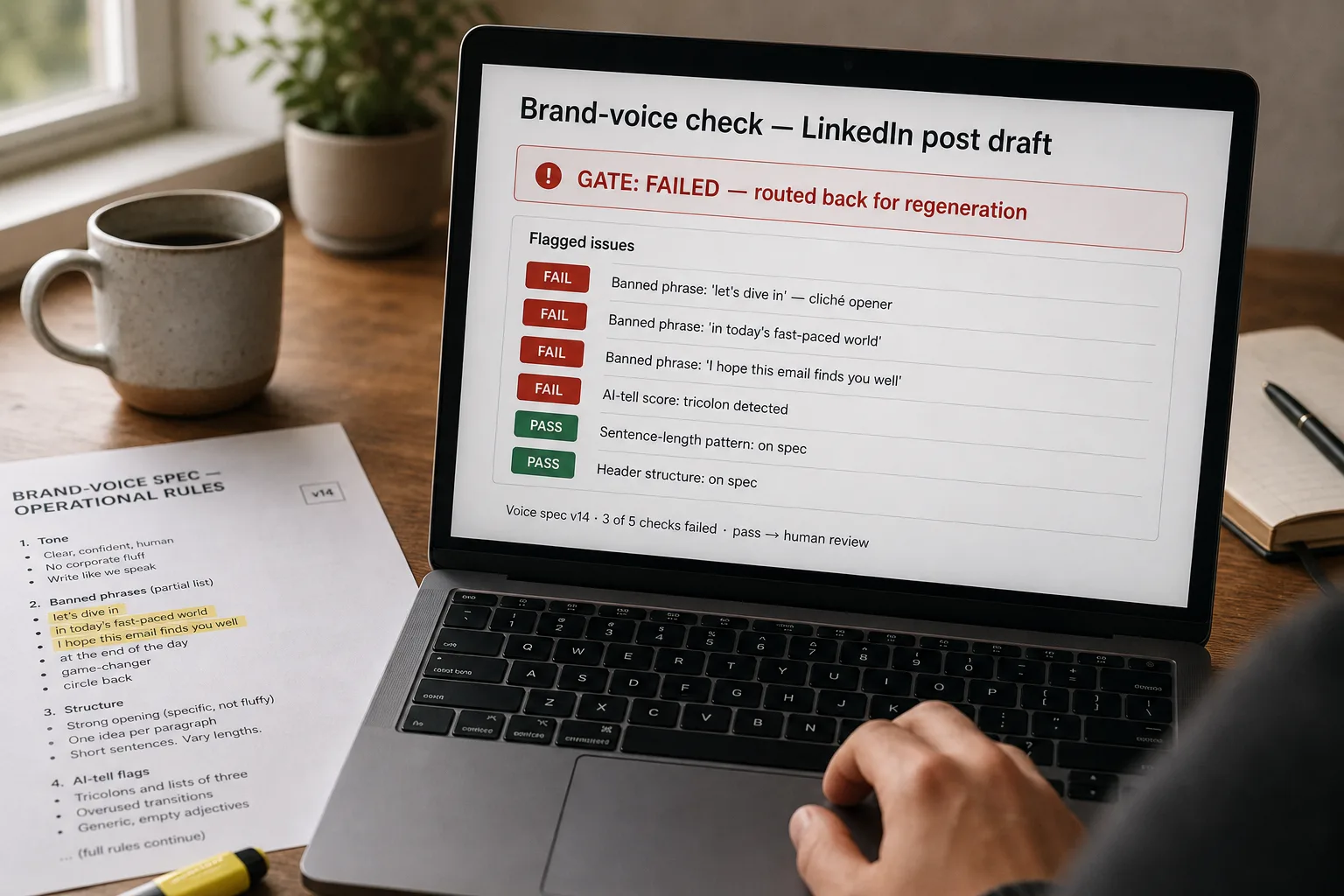
A marketing director opens her team’s recent LinkedIn posts, blog drafts, and ad copy. Three different writers produced them, but they all sound the same — a kind of generic AI-flavoured prose. The “let’s dive in” openers, the tricolons, the “in today’s fast-paced world” framings, the “I hope this email finds you well” salutations. Every brand using the same flagship models with the same generic prompts produces content that sounds like every other brand using those models, and the brands using them lose differentiation faster than they save on production cost.
The marketing leverage of AI is real; the absence of brand voice is what makes that leverage net-negative on differentiation. The fix is a guardrail layer that enforces brand voice on every generated piece, not just on the prompt. The voice spec lives in a versioned document, gets compiled into prompts and validation rules, and gets audited against output every month. This piece is that system.
Where this fits — and where it doesn't
Use this if your marketing team produces meaningful AI-generated content volume (10+ pieces per week), brand differentiation matters to your business, and your current AI output has visibly drifted toward generic. Common fits: B2B SaaS scaling content marketing, consumer brands with strong voice identity, agencies serving multiple clients with distinct voices.
Don’t use this if your content volume is small enough that hand-editing each piece works, your brand voice isn’t well-defined yet (write the brand-voice doc first), or your team is using AI mostly for internal-facing content where voice matters less.
What you'll need before starting
- A written brand-voice doc — not aspirational adjectives (“we sound smart and friendly”), but operational rules with examples. Banned phrases, preferred phrasings, tone calibration, sentence-length patterns, audience-specific variants.
- A model API key. Mid-tier models handle constrained generation well.
- Integration points with your content workflows — wherever marketing AI is currently being used (Notion, Google Docs, Hubspot, Writer / Jasper, custom tools).
- A content lead who owns the voice spec and the guardrail tuning. The spec evolves as the brand evolves; without an owner, it ossifies and gets ignored.
- Sample content from your team’s best pre-AI work. The voice anchor needs real examples, not just rules.
Six steps to voice that holds across generated content
- Write the brand-voice spec — operational rules, not aspirational adjectives
The spec should be measurable. Banned phrases (with examples). Preferred phrasings (with substitutions). Sentence-length patterns (we write mostly short sentences, occasional longer ones for emphasis). Audience-specific variants (we’re casual in social, professional in enterprise). Voice anchors with 5–10 sample pieces of your best pre-AI work. The spec is the artifact; without it, “brand voice” is folklore.
- Compile the spec into prompt prefixes for every generation context
Each AI-assisted content workflow — social-post generation, email drafting, ad copy, blog drafting — gets a system prompt derived from the spec. Banned phrases get an explicit prohibition; voice anchors get included as few-shot examples; audience variants get conditional rules. The prompt prefix is what makes the model produce on-voice output the first time, before validation.
- Build the post-generation validator — automated checks before publish
For each generated piece, run validation: banned-phrase detection (regex against the prohibited list), AI-tell scoring (a model-based check for cliché openers and tricolons), structural rules (sentence-length distribution, paragraph-length, header structure). Pieces that fail validation route back for regeneration with the failures specified; the model corrects on the second pass. Pieces that pass move to human review.
- Train per-team voice variants where the brand legitimately has more than one
Most brands have a primary voice plus 2–3 contextual variants (formal for enterprise sales, conversational for consumer support, technical for developer docs). Build per-context variant prompts; don’t try to enforce one voice across genuinely different audiences. The variants share the brand’s core elements (banned phrases stay banned everywhere) and differ on tone calibration.
- Integrate validation into the content workflow — pre-publish gate
The validator runs as a CI-style gate on content. In Notion / Google Docs, an extension or webhook runs validation before “ready for review.” In marketing automation tools, validation runs before scheduling. The integration is what makes the guardrails operational rather than optional — if validators run only when someone remembers to run them, drift returns within a quarter.
- Audit drift monthly — sample published content, refresh the spec
Once a month, sample 20–30 pieces of published content. Score against the current voice spec; identify cases where the spec doesn’t capture what the brand actually wants. Update the spec — add new banned phrases that emerged, refine rules that are too strict, add new examples. The spec is a living document; the audit is what keeps it current with how the brand is actually evolving.
What it costs and what to expect
The AI-tell rate reduction is the differentiation signal; the time saved is the operational ROI. The strategic value is brand-distinguishable content at AI scale.
Other ways to solve this
AI writing platforms with built-in voice features (Writer, Jasper, Copy.ai). Right answer for teams that want a working voice-controlled platform without engineering. Trade-off: less control, per-seat cost.
Editor-in-the-loop on every piece. Highest quality; doesn’t scale. Pairs well with this guardrail layer; the editor reviews fewer pieces because the layer caught the obvious failures.
Skip guardrails, accept generic voice. Honest current state at many companies. Defensible if voice differentiation isn’t strategic; increasingly costly as competitors invest in voice.
Related work
For the broader content-team prompt patterns, see Prompt engineering patterns for content teams. For the AI-tells pattern specifically, see First-draft marketing copy without the AI tells. For the programmatic-SEO pattern where guardrails are critical, see Programmatic SEO at scale. For the audit-discipline pattern, see Find patterns in customer feedback.
FAQ
How is this different from a custom GPT or Claude Project?
A custom GPT / Project handles the prompt-side of voice (system instructions shaped to your brand). The guardrail system adds post-generation validation — catching outputs that drifted despite the system prompt. The two are complementary; the validation is what catches the drift the prompt doesn't prevent.
What about voice for very different content types — blog vs ad vs product copy?
Per-content-type variants of the spec. The core brand elements (banned phrases, tone identity) stay constant; structural rules (length, format, voice calibration) vary. Build the variants explicitly rather than expecting one spec to cover everything.
How do we handle agency content that should match our voice?
Share the spec with the agency. The same compile-to-prompts approach works on their side; the validation can run on their content before delivery. Many agencies are now used to working from brand-voice specs; the discipline transfers.
Does this stop content from sounding AI-generated entirely?
No, but it reduces it materially. Determined readers can still pattern-match some signal. The goal isn't "undetectable" — it's "on-brand and useful." Brands that read distinctly like themselves rather than like a generic AI tone are differentiated in the marketplace, regardless of whether the underlying generation was AI-assisted.