
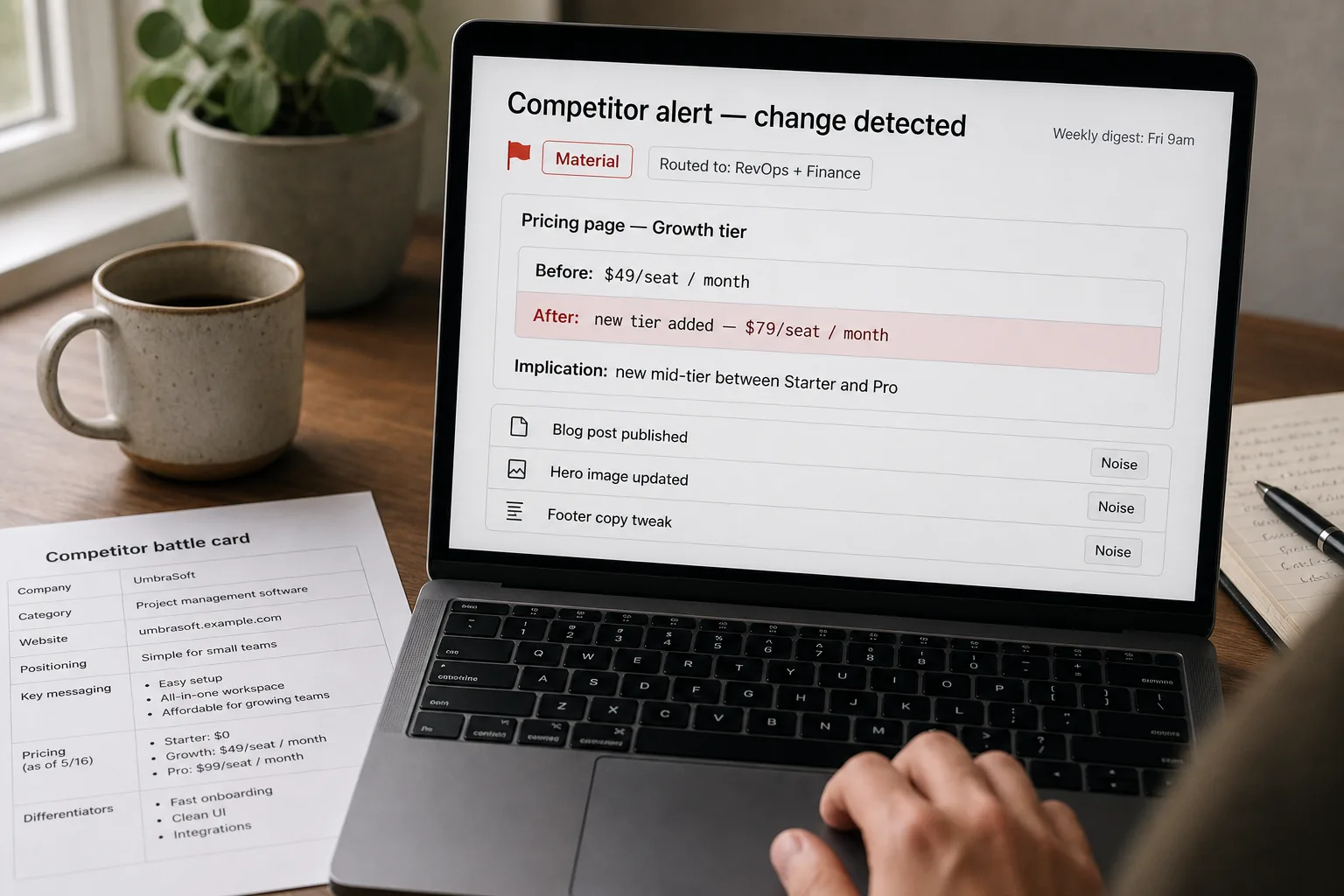
A sales rep loses a deal on a Friday because the prospect mentioned a new pricing tier on a competitor’s site. The product-marketing team checks. The tier launched two months ago. The competitive binder doesn’t mention it. Three other reps have probably hit the same objection without flagging it. The team holds a quarterly competitive review, but quarterly is too slow when competitors ship every week.
The fix is a monitoring pipeline that watches each competitor continuously, scores changes by how material they are, and pings the right team when something worth reacting to happens. Pricing changes route to RevOps and finance. Product launches route to PM and product marketing. Hiring patterns route to BD. The team’s mental model stays current; the competitive binder becomes a real-time view rather than a quarterly artifact. This piece is the architecture.
Where this fits — and where it doesn't
Use this if you compete against 3+ identified competitors, your category moves fast enough that quarterly updates are insufficient, and you have sales / product-marketing teams that would act on competitive signal. Common fits: B2B SaaS in competitive categories, consumer brands with named alternative players, marketplaces and platforms with category competition.
Don’t use this if your competitive landscape is fuzzy or category-level (no specific competitors to watch), you’re in a slow-moving category where quarterly is fine, or your team won’t act on the signal regardless of how fast it arrives. Monitoring with no operational follow-through is just noise.
What you'll need before starting
- A defined competitor list — 5–15 named competitors with specific URLs to monitor (pricing page, product page, blog, careers, social profiles).
- A scraping or web-fetch infrastructure with respect for robots.txt and reasonable politeness — use the right tier service (ScrapingBee, Bright Data) or your own crawler with rate limits.
- A model API key for the change-detection and materiality-scoring.
- A team-routing definition — who acts on pricing changes (RevOps, finance), product changes (PM, product marketing), hiring signals (BD, recruiting), social tone (marketing, brand).
- A reasonable expectation that change-detection will produce noise — most changes aren’t material; the pipeline filters but doesn’t eliminate.
Six steps to a monitor that doesn't drown teams
- Build the watch list — URLs and change types per competitor
For each competitor, define: pricing page URL, product / features page URL, blog URL (last-5-posts feed), careers page URL, social profiles (LinkedIn, Twitter), changelog or status pages if public. For each URL, define what kind of change you care about (pricing-tier changes, new product mentions, new hiring patterns, social-tone shifts).
- Fetch and snapshot on a schedule — daily for fast-moving pages, weekly for slow
For each URL, snapshot at the appropriate cadence. Pricing pages: weekly. Blogs: daily. Social: daily. Careers: weekly. Store snapshots with timestamps; the diff between snapshots is the input to change detection.
- Detect material changes — not just any changes
For each snapshot diff, use the LLM to classify whether the change is material. Pricing-page changes: was a tier added, removed, or repriced (material) vs typographical changes or marketing copy tweaks (not). Product page: was a feature added or removed vs visual redesign without functional change. The LLM does the materiality scoring; without it, every CSS update produces an alert.
- Summarise the change with verbatim quotes and the diff context
For each material change, generate a structured summary: what changed, when, the specific section of the page, the verbatim before-and-after quotes, and an initial assessment of implications. The structured summary is what makes the alert actionable — the team can read it in 30 seconds and decide whether to dig deeper.
- Route alerts by change type to the right team channel
Pricing changes → RevOps Slack channel + finance email. Product launches → PM and product-marketing channel. Hiring patterns → BD (for partnership signals) and recruiting. Social-tone shifts → marketing. Generic competitive Slack channel for the cross-functional discussion. Each alert includes the structured summary and a link to a longer-form analysis if needed.
- Weekly digest plus real-time alerts — for the team that wants both
In addition to real-time alerts, produce a weekly digest summarising all competitor activity over the week. Senior leadership reads the digest; operational teams read the real-time alerts. The two cadences serve different audiences and prevent the alert-fatigue failure mode where one channel gets too noisy and everyone tunes out.
What it costs and what to expect
The lead-time improvement is the operational ROI; the false-positive rate is the metric to keep below the team’s noise tolerance.
Other ways to solve this
Bundled competitive intelligence platforms (Crayon, Klue, Kompyte, Contify). Right answer for most teams — turnkey monitoring with battle-card workflows for sales. Trade-off: per-month cost, dependency on the platform’s coverage.
Manual quarterly intelligence reviews. Traditional approach. Slow but high-fidelity if the analyst is sharp. The pipeline doesn’t replace this — it provides the raw signal the analyst synthesises.
Don’t monitor — react to customer signal. Some teams learn competitor moves through customer conversations. Reactive; slower; loses the chance to pre-empt.
Related work
For the broader content-strategy implications, see Prompt engineering patterns for content teams. For the cross-channel feedback pattern that’s complementary, see Voice-of-customer reports from cross-channel feedback. For ad-creative monitoring specifically, see Ad creative A/B testing at scale. For the social-listening side of the same competitive picture, see Social listening and brand-mention triage.
FAQ
How is this different from Crayon or Klue?
Functionally overlapping. The platforms bundle monitoring with battle-card management, win/loss analysis, and sales enablement. Build custom if you want very specific monitoring patterns the platforms don't support, or if competitive intelligence is small enough to not justify a platform. For most growing teams, the platforms are the faster path.
What about competitors that detect monitoring and respond?
Some do — cloaked pricing pages, signed-in-only content, IP-based variation. The visible web is the input; what's behind authentication walls usually isn't accessible programmatically. Combine the pipeline output with win-loss interviews and customer conversations to capture what monitoring can't see.
Are there legal concerns with continuous scraping?
Respect robots.txt, use reasonable rate limits, don't scrape behind authentication. Public-content monitoring is broadly legal in most jurisdictions; the platform players (Crayon, Klue) have legal teams that have established the boundaries. For very-sensitive industries or international markets, consult counsel before building.
How do we keep the watch list current as competitors evolve?
Quarterly review of the competitor list and URLs. New competitors emerge; URLs change as sites are restructured; some competitors become irrelevant. Without the quarterly refresh, the pipeline drifts; with it, the data quality holds.