
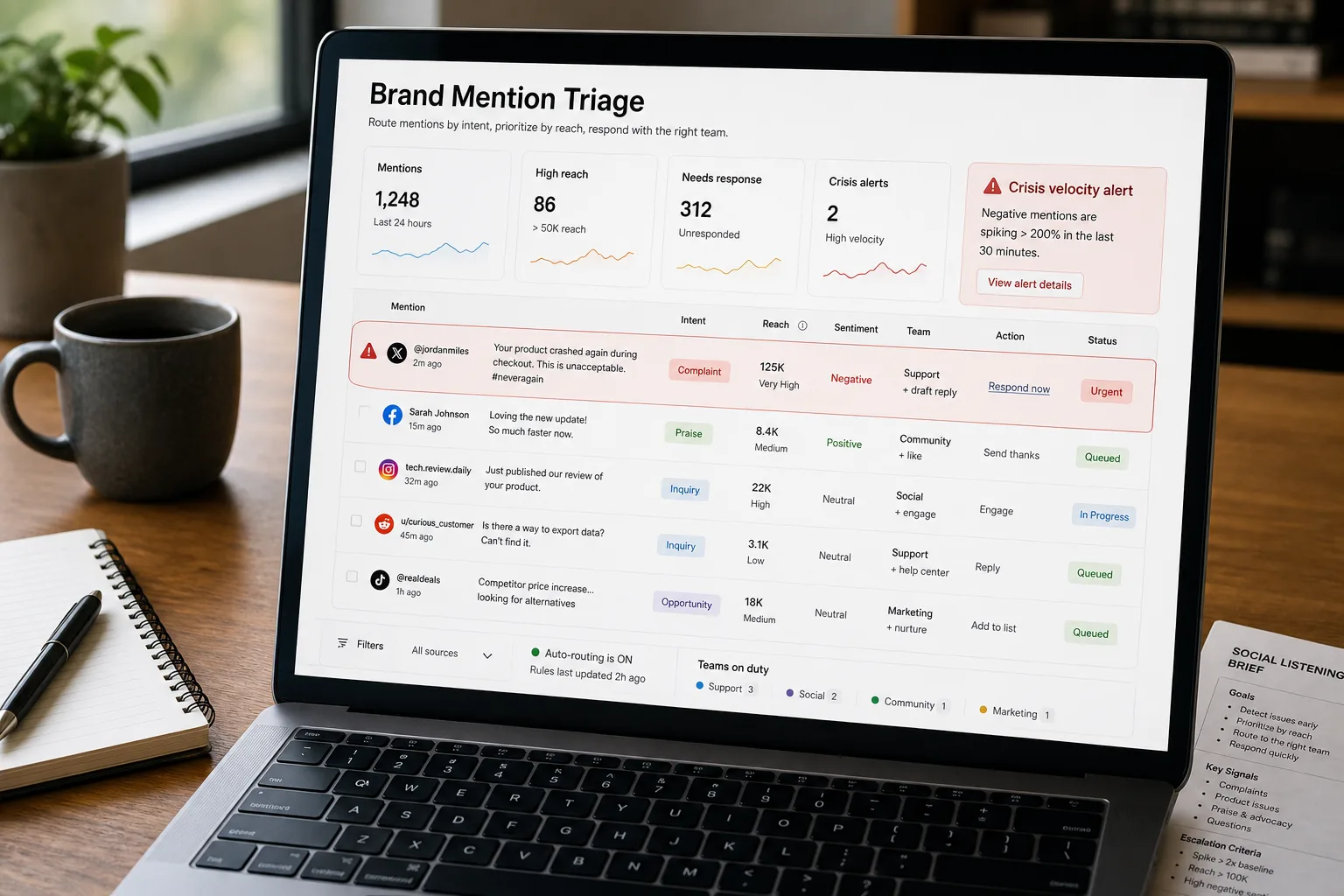
The pipeline goes: pull every public mention of your brand from social platforms and the web, classify each by intent (compliment, complaint, journalist query, customer support, partnership feeler), score urgency, and route to the team that can actually respond. It’s the inbox-triage pattern applied to public mentions instead of private messages.
The founder who Googles their own company three times a day is doing this manually, badly. So is the marketing manager who spots an angry tweet six hours after it went viral, and the PR team that finds out about a press story when a customer forwards the link. Public conversation about a growing brand exceeds what any one person can track. The cost of missing the important mentions ranges from a lost retention opportunity to a PR crisis that could have been a quiet response in hour one.
This piece walks through the pipeline end to end: the monitoring layer, the classification prompt, the routing rules, the urgency thresholds that trigger an alert, and the weekly digest that summarises the rest.
Where this fits — and where it doesn't
Use this if your brand has meaningful public visibility (customers, journalists, partners regularly mention you), your team’s current process for tracking mentions is manual and inconsistent, and the cost of missing important mentions is real. Common fits: B2C and B2B brands at any meaningful scale, founder-led companies with public profiles, consumer products with active social communities.
Don’t use this if your mention volume is too low to need automation (under ~20 mentions per week), you don’t have a team capable of responding to mentions even when surfaced (the pipeline produces alerts; somewhere they have to land), or your brand is in a sensitive category where every mention deserves direct human attention.
What you'll need before starting
- A social-listening tool that aggregates mentions across platforms — Brandwatch, Sprout Social, Mention, Talkwalker, Hootsuite Streams. Building this from scratch against platform APIs is possible but the platforms have negotiated official access most teams can’t replicate.
- Defined mention-type categories with routing destinations.
- A model API key for the classification and summarisation layers.
- Crisis-response definition — what counts as urgent enough to alert leadership immediately. Most mentions aren’t crises; the few that are need rapid response.
- Honest acknowledgement of what monitoring can’t catch — closed groups, private DMs, deleted-quickly posts, conversations in messaging apps. The pipeline catches the public-and-persistent layer.
Six steps to mentions that get answered in time
- Define the mentions you actually want to catch
Brand-name variations (official, casual, common misspellings), key product names, executive names (founder, CEO, public-facing leaders), and key hashtags. Avoid over-broad terms — “AI” matches everything; “YourProductName AI assistant” is specific enough to produce useful signal. The query design is the input quality lever.
- Classify each mention by intent and sentiment
Intent categories: customer support / complaint, customer praise, journalist query, partnership feeler, competitive comparison, conference / event mention, generic discussion. Sentiment: positive, neutral, negative, or escalating. The classification is what routes the mention; sentiment alone is insufficient because positive mentions need different handling from negative ones.
- Score by author reach and recency — not every mention deserves the same response
A mention from a 50-follower account with no engagement is different from a mention from a verified journalist with 50K followers and high engagement. The pipeline scores by author reach (follower count, verification status, engagement-rate proxies) and recency (real-time alerts for high-reach; daily digest for low-reach). The score determines routing speed and depth.
- Route by category to the team that can respond
Customer complaints → support team Slack with the mention attached and a draft response. Customer praise → marketing channel for amplification consideration. Press → comms with author profile attached. Partnership → BD CRM. Competitive comparison → product marketing for battle-card update. The routing is the operational lift; without it, the classification produces a feed nobody acts on.
- Generate suggested responses where appropriate
For customer complaints and questions, draft a response in the brand voice with the specific issue acknowledged. For press queries, draft a “we’ll get back to you” with appropriate context for the comms lead. Don’t auto-publish; route the draft to the human responder for review and send. The drafted response accelerates the response time; the human approval keeps it from being tone-deaf.
- Crisis detection — separate path for high-velocity negative trends
The pipeline should detect when negative mentions are rising rapidly (5x baseline rate in a few hours) and trigger a separate alert to leadership and PR. Most mentions, even negative ones, are routine; the rare cases where momentum is building are different and need executive awareness in hour one, not in the next-day digest. The crisis detection is the safety layer; it should fire rarely and correctly when it does.
What it costs and what to expect
The time-to-response improvement on customer complaints is the operational ROI; the crisis-detection layer is the strategic safety net that justifies the investment even when it fires rarely.
Other ways to solve this
Bundled social-listening platforms (Brandwatch, Sprout Social, Talkwalker, Meltwater). Right answer for most teams. Trade-off: per-month cost, varying coverage by platform.
Native platform tools. LinkedIn Listening, Twitter/X advanced search, Reddit subreddit watches. Free but fragmented; doesn’t aggregate across platforms.
Manual monitoring. Founder Googles every morning. Doesn’t scale; misses overnight mentions.
Don’t monitor. Defensible for very-early-stage; increasingly costly as brand visibility grows.
Related work
For the broader cross-channel feedback aggregation, see Voice-of-customer reports from cross-channel feedback. For the social DM triage that’s complementary, see Auto-tag and route inbound social DMs. For the competitive monitoring pattern, see Competitor monitoring with automated alerts. For the customer-support reply pattern when social complaints route to support, see Draft customer support replies that hold up to scrutiny.
FAQ
What about mentions in closed groups (private Slack communities, Discord)?
The pipeline can't see them — closed-platform content isn't accessible via standard listening. The mitigation: cultivate human relationships in the communities your brand is discussed in, and have those community members surface relevant discussions back to the team. Listening covers the public layer; relationships cover the private layer.
How do we handle multilingual mentions?
Modern listening platforms handle 30+ languages; AI classification works similarly. For specific markets with heavy local-language conversation (Japanese, Brazilian Portuguese, Vietnamese), tune the keyword queries per language and route to native-speaker responders where they exist. Don't try to respond in machine-translated language; the cultural tone matters as much as the literal translation.
Should we respond publicly to every customer complaint we see?
No. Public response to public complaint is sometimes the right move (visible accountability) and sometimes the wrong move (amplifying a small complaint to wider audience). Use the DM-or-email reach-out for sensitive cases; reserve public response for cases where the customer has invited public dialogue or where silence would read as ignoring. Each platform's culture differs; train the responding team on the platform-specific norms.
How fast should we respond to journalist queries?
Within hours for major-outlet queries. Journalists work on deadlines; a query that arrives at 9am and gets responded to at 5pm has often already had the story filed without your input. The crisis-detection / high-reach alerting tier is designed to surface these immediately; the routing to comms should be a real-time alert, not a daily digest.