
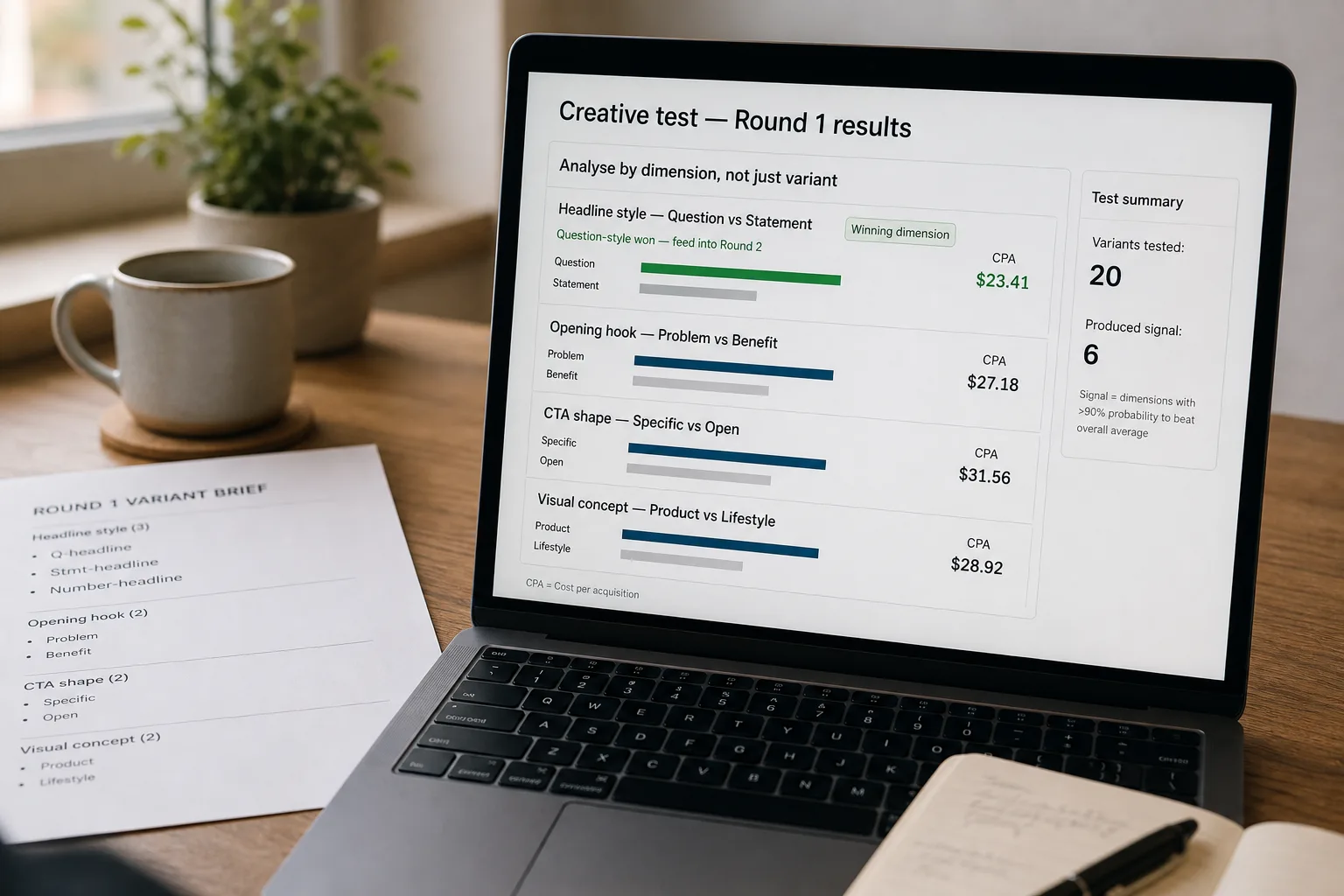
A performance marketer ships 20 ad variants on Monday. By Friday, the results show no clear winner — every variant performed within a percentage point of the others. The team concludes “ad testing doesn’t work for us” and goes back to running one creative director’s favourite ad. The hidden problem: all 20 variants came from one prompt, so they were lightly-rephrased versions of the same idea. The test had no real diversity to measure.
This piece is the version of AI-augmented ad testing that produces real signal. Structurally different variants across explicit creative dimensions (headline style, hook, CTA shape, visual concept), pushed programmatically to Meta and Google ad APIs, with performance data feeding into the next round’s prompts.
What follows: the variant taxonomy, the multi-prompt generation pattern that produces actual diversity, the platform-integration for programmatic testing, and the feedback loop that compounds learnings over quarters.
Where this fits — and where it doesn't
Use this if you run meaningful paid spend (typically $20K+/month per channel), you have the platform integration to push variants programmatically (Meta Ads API, Google Ads API), and your creative team is bottlenecked on variant generation. Common fits: performance-marketing teams, growth teams, agencies running paid for B2B SaaS or DTC ecommerce.
Don’t use this if your paid spend is small enough that the per-variant test signal is weak (under $5K/month — the noise dominates), your products’ winning creatives are stable enough that constant testing isn’t valuable (some B2B categories), or your creative team is bandwidth-rich and producing diverse variants by hand.
What you'll need before starting
- Ad-platform API access — Meta, Google, LinkedIn, TikTok ads APIs.
- A model API for variant generation. Image models (DALL·E, Imagen, Flux) for visual variants; text models for copy.
- A defined creative taxonomy — what dimensions are you varying across (headline style, opening hook, CTA shape, visual concept, ad format)?
- A baseline performance benchmark per ad — current CPM, CPC, conversion rate. The test results are relative to baseline.
- A statistician’s view on sample size — variants need enough impressions to produce statistically meaningful signal. Don’t ship 20 variants on a $500/day budget and expect clean data.
Six steps to creative tests that produce signal
- Define the creative taxonomy — what dimensions are you testing?
Common dimensions: headline style (question vs statement vs specific-number), opening hook (problem vs benefit vs curiosity), CTA shape (specific vs open), visual concept (product-focused vs lifestyle vs abstract), ad format (single image vs carousel vs video). Pick 3–4 dimensions per test cycle; varying too many at once produces results you can’t attribute to any one dimension.
- Generate variants with structurally different prompts per dimension
For each dimension being tested, write a distinct prompt that produces a meaningfully different output. Same product, but the prompt for “question headline” is different from the prompt for “specific-number headline.” Generating 20 variants from one prompt produces 20 lightly-rephrased versions of the same idea; generating 4 variants from 5 distinct prompts produces structural diversity. Diversity is what makes the test informative.
- Push variants programmatically to the ad platforms
Use the ad-platform APIs (Meta, Google, etc.) to publish variants as separate ads in the same ad set or campaign. Tag each variant with the dimension it tests (which headline style, which hook, etc.). The platforms’ own optimisation will allocate impressions based on early performance; respect or override based on the test design.
- Wait for statistical significance — don’t kill variants prematurely
Most variants need 5,000–20,000 impressions to produce statistically significant signal. Smaller budgets need longer test windows. Don’t kill an underperforming variant after 1,000 impressions — that’s noise, not signal. Conversely, don’t keep a clearly-losing variant past its statistical death; the platform’s auto-allocation handles this but you may need to override on tests where the platform’s optimisation conflicts with the test design.
- Analyse by dimension, not just by variant
The headline number is “variant X won” — useful but limited. The analytical question is “which dimensions matter”: did question-style headlines outperform statement-style across the variants? Did problem-hook opens outperform benefit-hook? Dimension-level analysis is what makes the test produce learnings beyond the single-cycle winner. The next round of variants leans into the dimensions that performed.
- Feed learnings back into the next round’s prompts
The winning dimensions from this round become the constraints for the next round. If question-style headlines outperformed, the next round generates variants within question-style with deeper exploration of question types. Compounding learnings over rounds is how the system gets meaningfully better than the gut-feel approach over a few quarters.
What it costs and what to expect
The performance lift is the operational ROI; the per-cycle compounding is the strategic one. Systematic testing beats gut-feel after enough cycles even at the same spend.
Other ways to solve this
Specialised ad-creative AI platforms (AdCreative.ai, Pencil, Smartly). Right answer for most teams — they bundle generation, testing, and analytics. Trade-off: per-month cost, less control over the creative taxonomy.
Platform-native creative testing (Meta Advantage+, Google Performance Max). Built-in optimisation that picks creative variants and audiences. Less control over what’s being tested; more leverage on platform optimisation. Worth using alongside the custom pipeline.
Manual creative testing with a creative director. Highest fidelity per variant; can’t scale variant count. The AI pipeline is what makes testing 20+ variants per cycle feasible.
No testing — run gut-feel creative. Honest current state at many companies. Defensible for stable categories where winning creatives don’t shift; increasingly costly in fast-moving paid channels.
Related work
For the broader content-team prompt patterns, see Prompt engineering patterns for content teams. For the brand-voice discipline that ad variants need to honor, see Brand-voice guardrails for marketing teams. For the image-generation tier comparison, see Image generation models for business use. For the broader pattern of AI-tells in generated content, see First-draft marketing copy without the AI tells.
FAQ
How is this different from Meta Advantage+ or Google Performance Max?
Those are platform-native optimisation; they pick winners but don't expose the underlying logic, and they constrain you to the platform's variants. The custom pipeline gives full control over what's being tested. For most teams, both layers coexist — platform-native handles audience and bidding optimisation; custom handles creative-side experimentation.
What about image / video variants — can AI generate those at quality?
Image generation is reliable for many ad styles; video generation is improving but still limited for production-quality. Image variants from Flux, Imagen, or DALL·E are usable for testing static creative; video typically needs human editing on top of AI-generated B-roll. See image generation models for business use for the comparison.
How do we prevent ad fatigue when generating high volumes?
Schedule refreshes per audience and per platform — Meta's algorithm penalises stale creative on the same audience after several thousand impressions. The pipeline should produce new variants at a cadence that keeps creative fresh per audience cohort. This is one of the strongest arguments for systematic AI testing — manual generation can't keep up with the refresh cadence at meaningful budgets.
Should the same variants run across platforms (Meta + LinkedIn + TikTok)?
Usually no. Platform cultures and ad formats differ enough that the same creative underperforms outside its native platform. Generate platform-specific variants with the dimension constraints adjusted per platform — TikTok hooks differ from LinkedIn ones; Meta visuals differ from Google display. The pipeline architecture is the same; the prompts are platform-specific.