
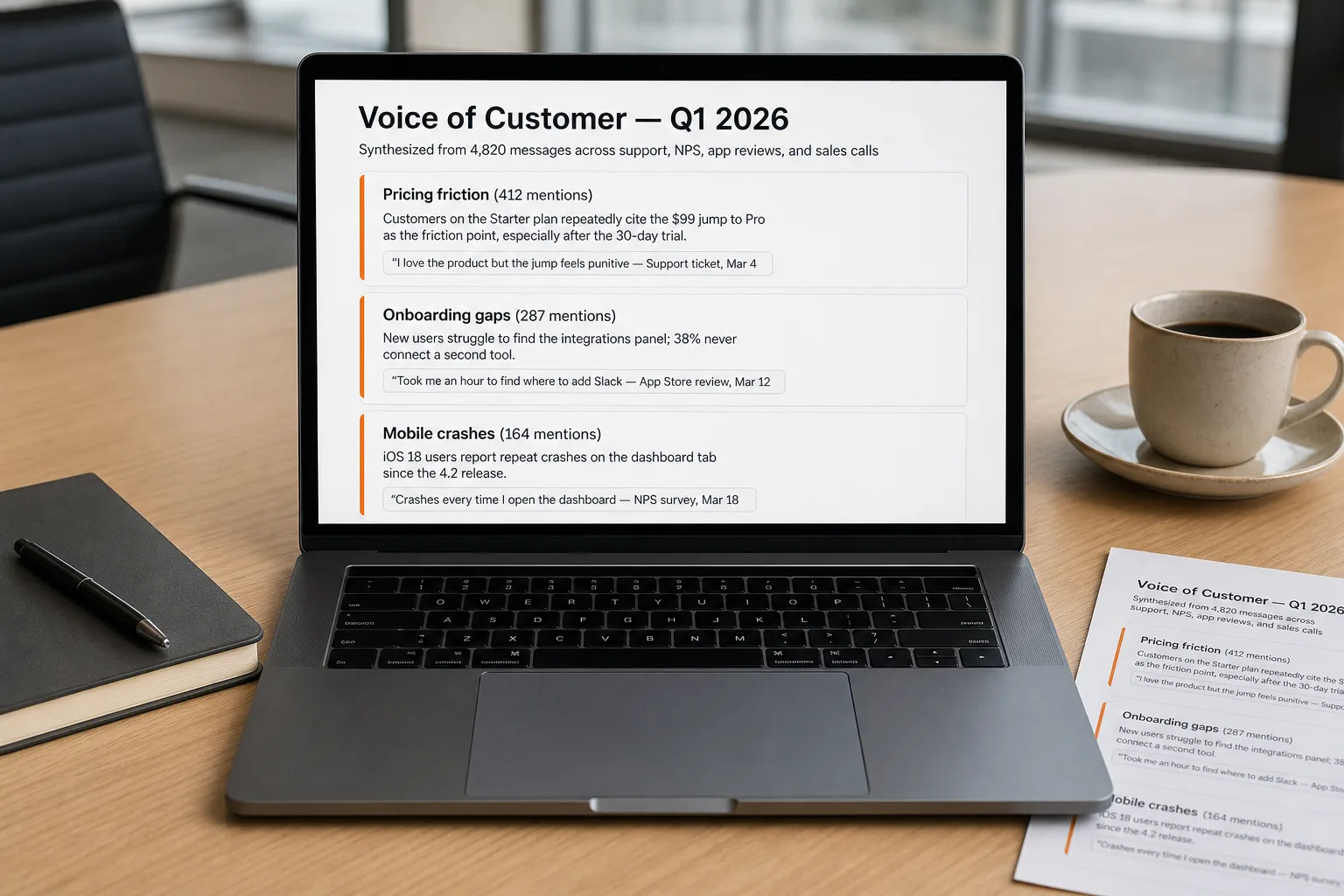
The pipeline goes: pull feedback from every channel (support tickets, NPS surveys, app store reviews, sales call transcripts, social mentions), cluster items by theme rather than by channel using embeddings (the way AI represents meaning as numbers), track frequency and severity over time, and produce reports that product, customer experience, and leadership read on a regular cadence.
The reason this matters: the product manager asks support what customers are complaining about and gets a vague “lots about feature X.” The CEO reads three app-store reviews and decides the whole product needs fixing. The customer success team has 12 examples of a specific pain point but never surfaces them because nobody asked. Every channel produces data in its own format, no one team owns the synthesis, and decisions get made on whatever subset of channels the decision-maker happens to read.
This piece walks through the pipeline end to end: the aggregation, the theme detection that goes beyond keyword counting, the cross-channel synthesis, and the report design that actually lands.
Where this fits — and where it doesn't
Use this if you have meaningful customer-feedback volume across 3+ channels, product or leadership decisions are being made on partial signal, and your team would benefit from a unified view. Common fits: B2B SaaS post-product-market-fit, consumer apps with reviews and support, growing services businesses with multiple feedback channels.
Don’t use this if your feedback volume is low enough that manual review is faster (under ~500 items per month across all channels), you’re at a stage where leadership directly handles every customer (very early stage — the synthesis isn’t needed yet), or your team doesn’t have product or CX bandwidth to act on the reports.
What you'll need before starting
- Access to each feedback channel via API — Zendesk / Intercom / Front for support; survey tools (Qualtrics, Wootric, SurveyMonkey) for NPS; app-store APIs; social-listening tools or direct platform APIs; sales-call transcripts.
- A data warehouse or aggregated storage — putting all feedback in one place is the first lift; without it, cross-channel analysis is impossible.
- Embeddings and clustering infrastructure — embeddings API, vector store, clustering algorithm. See Vector databases compared.
- A model API key for synthesis and report generation. Mid-tier flagship models handle the synthesis well; long-context capability is useful for aggregating large clusters.
- A clear consumer of the reports — product, CX, leadership. Reports that nobody reads are worse than no reports; identify the recipient and the decision the report supports.
Six steps to reports that drive decisions
- Pull from every channel, with metadata preserved
For each feedback item, capture: source channel, customer ID (where known), customer tier / segment, timestamp, raw text, any structured fields (NPS score, app rating, ticket category). The metadata is what lets the analysis filter by segment, channel, and time. Stripping metadata to “just the text” loses the ability to ask “is this issue concentrated in enterprise customers or all customers?”
- Embed and cluster across channels — themes, not channels
Compute embeddings for every feedback item. Run clustering (HDBSCAN or k-means) on the full cross-channel set. Themes emerge naturally — “checkout friction” surfaces in support tickets, app reviews, and NPS comments simultaneously. The cross-channel theme view is the lift; channel-specific reports miss the patterns that span channels.
- Score each theme by frequency, sentiment, severity, and trend
For each theme cluster, compute: count of items, sentiment distribution, severity proxies (escalation rate from support, low scores from NPS, mentions of “cancel” or “switch”), trend (rising over the last 90 days vs stable vs declining). The score is composite; raw count alone is misleading because some channels generate volume on minor issues and others generate sparse-but-severe signal.
- Filter for the report’s purpose — product priorities, CX issues, leadership signals
Different audiences need different filters. Product needs themes that map to roadmap decisions (feature requests, usability friction, missing capabilities). CX needs themes about service quality and customer effort. Leadership needs themes that affect retention, expansion, or brand. Generate audience-specific views from the same underlying theme data — don’t try to write one report that serves everyone.
- Synthesise themes with representative examples and recommendations
For each top theme, produce: a 1–2 sentence description, the frequency and trend numbers, representative quotes from each channel, and a recommended action (investigate, escalate, prioritise, monitor). The verbatim quotes are what makes the synthesis trustworthy — readers can verify against the source. The recommendation is what makes the report actionable — without it, reports describe state without prompting decision.
- Cadence the reports — weekly digests, monthly deep-dives, quarterly trends
Different cadences serve different decisions. Weekly: emerging issues that warrant immediate attention (new theme spiking, sentiment shifting). Monthly: top-10 themes with quarter-over-quarter comparison, for product and CX prioritisation. Quarterly: trend reports, for leadership and board-level discussion. The cadence builds organisational habit around the reports; ad-hoc reports get read once and forgotten.
What it costs and what to expect
The trend-detection lead time is the operational signal; the cross-channel overlap is the strategic insight — most issues affect multiple channels and a channel-by-channel view misses them.
Other ways to solve this
Bundled VoC platforms (Enterpret, Anecdote, Productboard, Birdeye). Turnkey aggregation across channels with built-in clustering and reporting. Right answer for most teams that have outgrown manual aggregation. Trade-off: per-month cost, dependency on the platform’s integrations, less control over theme logic.
Channel-specific tools loosely coordinated. Each team uses their own tool (Zendesk Explore for support, Wootric for NPS, Sprout Social for social) and aggregates manually for occasional reviews. Cheaper; misses cross-channel synthesis; works at smaller scales.
Manual quarterly synthesis by a CX or product analyst. Old-school but functional. One person reads everything for a week, writes a report. Quality varies by analyst; doesn’t scale; misses the trend-detection that ongoing analysis provides. The AI pipeline doesn’t replace the analyst — it amplifies them, letting them focus on synthesis rather than aggregation.
Don’t aggregate — read the loudest signal. The implicit default at many companies. The CEO reads three app reviews and decides; the product manager reads the latest customer call and decides. Produces decisions misaligned with actual customer signal.
Related work
For the pattern-detection mechanics across customer feedback specifically, see Find patterns in customer feedback. For the support-ticket signal that’s one input, see Auto-categorize support tickets. For the sales-call analysis that feeds the sales-channel signal, see Sales-call coaching at scale. For the churn-detection pipeline that operates on a subset of this feedback, see Detect churn signal from support patterns.
FAQ
How is this different from Productboard or Enterpret?
Functionally overlapping at the platform level. The platforms ship turnkey VoC analytics; building a custom pipeline gives more control over clustering parameters, integration with non-standard channels, and customisation of report formats. For most SMBs, the platforms are the faster and more sustainable path; custom builds make sense at enterprise scale or for unique integration needs.
What about feedback in languages other than English?
Modern multilingual models cluster across languages reasonably well, but the synthesis quality drops for lower-resource languages. For global products, build language-aware reports — top themes per major language, plus an aggregated global view. Don't blend languages into a single cluster set; the theme labels become confusing and the synthesis misses cultural nuance.
How do we handle the bias of vocal customers — the loud minority overrepresented in feedback channels?
Weight by segment and behaviour, not just by feedback volume. A theme expressed by 100 free-tier users in app reviews is operationally less significant than the same theme expressed by 10 enterprise customers in support tickets. Cross-channel reports should display volume metrics by segment, not aggregated counts that conflate the two. The platforms handle this variably; the custom-build approach gives more control.
Can the AI write the report autonomously, or does it need human review?
Human review on every report. The synthesis is good; the framing matters and benefits from a human owner who knows the audience. Auto-published reports get read once and ignored; human-curated reports become part of the company's decision rhythm. The pipeline produces the draft; a CX or product analyst polishes for tone and audience fit before publishing.
How do we measure if the reports are actually driving decisions?
Track decisions that reference the report — feature prioritisations citing the report's themes, CX-program changes citing the trend data, leadership conversations citing specific quotes. After a quarter, the citation count tells you if the report is in the decision loop or sitting unread. Adjust report design, cadence, and audience based on what's actually being used.