
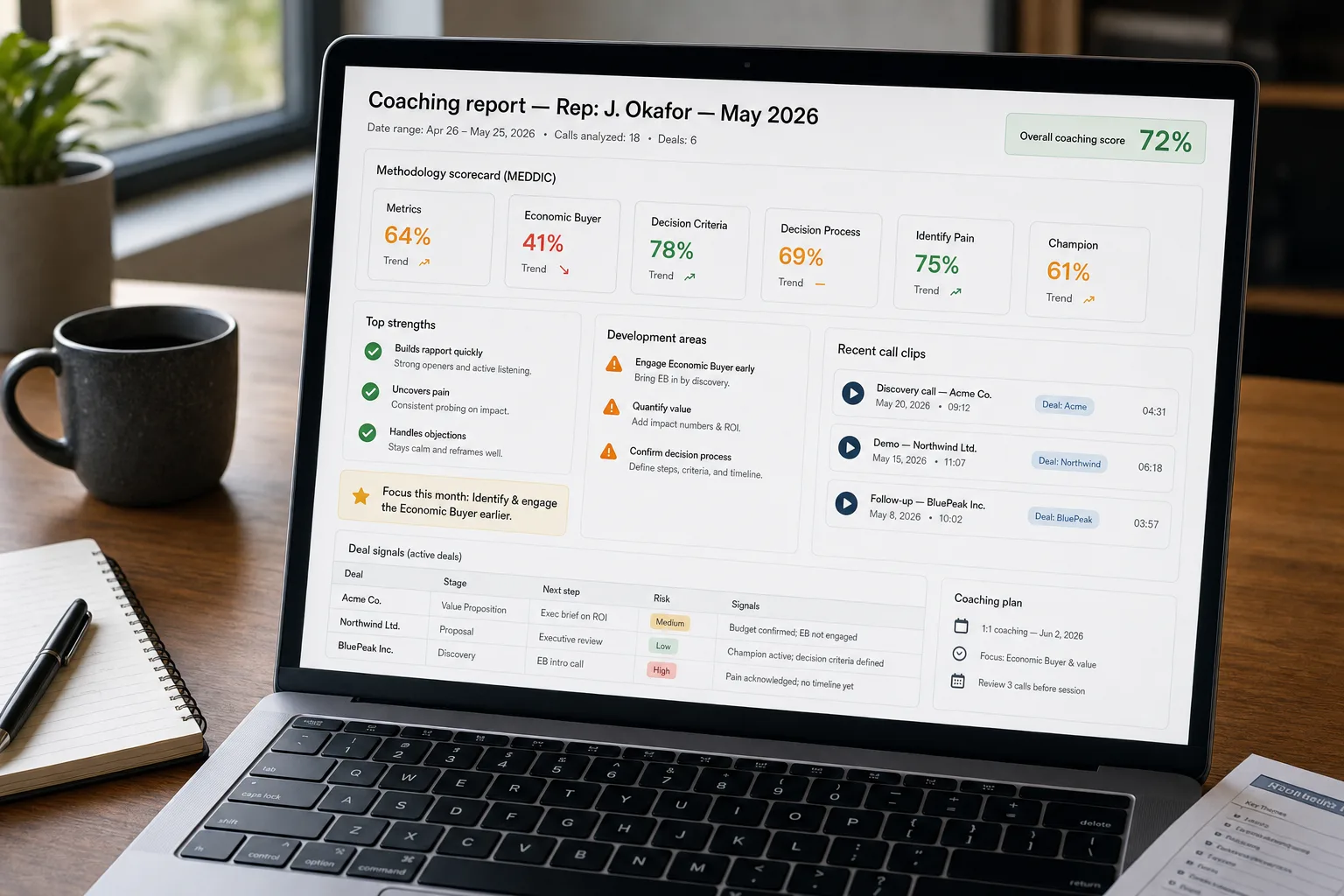
The pipeline goes: process every recorded call, score each one against your sales methodology, look for the patterns that separate top reps from the rest, and generate a per-rep coaching report the manager can read in minutes. The manager still does the coaching conversation — the pipeline just removes the work of finding the right calls and the right moments inside them.
Most sales orgs already record their calls. The bottleneck is the listening. A 45-minute call is 45 minutes of focused attention. Finding the right call to coach on means reviewing several. So coaching ends up happening systematically for new hires, sporadically for mid-tenure reps, and almost never for the senior team that could most benefit from an outside perspective.
This piece walks through the pipeline end to end: the transcript analysis, the rep-level pattern detection, the deal-signal extraction, and the coaching report that turns 4 hours of manager time into 30 minutes. None of it replaces the manager’s judgement — it gives them a structured starting point and a wider view of the team.
Where this fits — and where it doesn't
Use this if you have 5+ sales reps making recorded calls, your team has a defined sales methodology (MEDDIC, SPICED, Challenger, your own) that calls should reflect, and your sales managers are bottlenecked on coaching capacity. Common fits: B2B SaaS sales orgs, professional services with consultative sales cycles, agencies running structured outbound-to-close motions.
Don’t use this if your sales motion is largely transactional (call coaching has less leverage on short cycles), your team is too small to need systematic coaching (under 5 reps — manager listens directly), or you don’t have buy-in on the recording-and-analysis posture from the sales team. The last is critical — call-analysis pipelines deployed without rep buy-in feel like surveillance and erode the culture they’re meant to improve.
What you'll need before starting
- Recorded sales calls — Gong, Chorus, Otter, Fireflies, or your meeting platform’s native recording. The corpus is the input.
- A clear sales methodology your team operates by. The coaching pipeline scores against it; without one, the analysis produces generic feedback.
- Manager buy-in on the coaching workflow. The pipeline produces reports; managers use them. Without manager engagement, reports go unread.
- Rep buy-in on the analysis posture. Be explicit: this is for coaching, not for surveillance or performance ranking. Define what the data is and isn’t used for.
- A model API key with long-context support. Calls are 5,000–25,000 tokens after transcription; all flagship models handle this comfortably.
Six steps from recorded calls to systematic coaching
- Get clean transcripts — accuracy at the rep-level matters
For each recorded call, produce a transcript with speaker labels. Most recording platforms produce decent diarisation; for sales calls specifically, custom diarisation tuned on rep-vs-prospect distinction outperforms generic. Quality matters because rep-level analysis depends on attributing statements correctly — “the rep handled the objection well” requires knowing what the rep said versus what the prospect said.
- Score per call against the sales methodology
For each call, score the rep’s execution of the methodology stages. MEDDIC: were Metrics, Economic Buyer, Decision Criteria, Decision Process, Identify Pain, Champion explored? SPICED: Situation, Pain, Impact, Critical Event, Decision? Use a structured-output extraction with the methodology as a schema. The output is a per-call scorecard that’s comparable across calls and reps.
- Extract deal-level signals — objections, competitors, decision-criteria changes
From each call, extract the deal-meaningful events: objections raised (and how they were handled), competitors mentioned by the prospect, decision-criteria the prospect surfaced, stakeholders named, timeline indicators. These are pipeline-quality signals as much as coaching signals — the manager learns about deals as much as about reps from the extraction.
- Aggregate to rep-level patterns over rolling windows
Per-call signals roll up to per-rep patterns. Which methodology stages does this rep consistently skip? Which objection types do they handle well or badly? How does their question-to-statement ratio compare to the team’s? Are they talking 60% of the time on discovery calls? Rolling windows (last 20 calls, last quarter) smooth single-call noise into pattern signal.
- Generate per-rep coaching reports — patterns plus specific call examples
For each rep monthly, produce a report: top 2–3 strengths with specific call examples, top 2–3 development areas with specific call examples, deal-level signals worth manager attention, suggested coaching conversation topics. The report is the manager’s prep document for the coaching conversation. Specific call references with timestamps let the manager and rep listen to the same 2-minute clip rather than discussing in the abstract.
- Manager review and rep conversation — not auto-published feedback
The report goes to the manager first, not directly to the rep. The manager reviews, adds context the AI doesn’t have (deal complexity, rep’s experience level, recent events affecting the rep), and uses the report as the prep for a coaching conversation. Don’t auto-send reports to reps — the human framing of the feedback matters more than the data quality. Reports without manager context produce defensive responses; reports as conversation input produce growth.
What it costs and what to expect
The time-saved-per-manager is the operational ROI. The coverage increase (from 1–3 to 8–15 coached calls per rep per month) is the development-systemic-shift that drives rep performance over a few quarters.
Other ways to solve this
Bundled conversation-intelligence platforms (Gong, Chorus, Modjo, Avoma). Full-feature platforms with call recording, analysis, coaching workflows, and deal intelligence. Right answer for most teams — turnkey, well-integrated. Trade-off: per-seat cost, less customisation, dependency on the platform’s methodology models.
Manager-only listening, no AI. The traditional approach. Highest fidelity per call coached; can’t scale past a handful per manager per month. The AI pipeline doesn’t replace manager judgement; it accelerates manager preparation and broadens coverage.
Self-coaching by reps. Some teams have reps listen back to their own calls weekly. Useful as a complement; doesn’t substitute for manager coaching because reps lack outside perspective on their own patterns.
Don’t coach systematically. Honest current state at many companies. The cost shows up in slower rep ramp-time, more variance in performance, and missed deal-quality signals. The pipeline lowers the threshold where systematic coaching is feasible; for many sales orgs, “feasible” arrives sooner than expected.
Related work
For the upstream call-transcription tooling that produces the input, see Voice transcription for sales calls and customer interviews. For the comparison of transcription services, see Whisper API vs Deepgram vs AssemblyAI. For the broader voice-of-customer aggregation that this feeds into, see Voice-of-customer reports from cross-channel feedback. For the sales-follow-up generation that uses call notes as context, see Sales follow-up sequences with CRM context.
FAQ
How do we get rep buy-in on call recording and analysis?
Three things matter. (1) Transparency on what the data is used for — coaching and deal insight, not performance ranking or PIPs. (2) Reps see their own reports first, with the manager's framing. (3) Surface the wins as much as the development areas — "top reps do X consistently" gives reps something to aspire to, not just things to fix. Get this culture work right early; retrofitting trust after a botched rollout is hard.
Does this replace sales managers?
No — it gives them leverage. The manager's role shifts from "listen to enough calls to know what's happening" to "focus on the patterns the pipeline surfaced and the coaching conversations that matter." Good managers become better with this leverage; the pipeline doesn't help managers who weren't coaching anyway and can mislead them if they trust the output uncritically.
What about privacy — recording customer calls?
Disclose the recording per local-jurisdiction laws (two-party-consent states require explicit disclosure; one-party-consent states allow it without). Most B2B sales contexts have explicit recording disclosure at meeting start. Beyond compliance, customer trust matters — overt recording for coaching purposes is fine; covert recording for any reason damages relationships when discovered.
How is this different from Gong or Chorus?
Gong and Chorus are full-feature platforms that bundle this pipeline along with call recording, deal-board integration, and coaching workflows. Build a custom layer if you have engineering capacity and want very specific methodology scoring, or if you're integrating with non-standard tools. For most teams, the platforms are the faster path; custom builds make sense for sales orgs that have outgrown what the platforms offer.
What if our methodology is informal or evolving?
Start by capturing the methodology in writing — even a one-page version with the 5–8 core elements your team should be hitting. The pipeline scores against the written version; revise the methodology as you learn what's actually predictive of close. Many teams use the pipeline as the forcing function for finally writing down what they expect calls to look like. The methodology and the pipeline co-evolve over the first quarter or two.