> case_study / astrocentral
AstroCentral.com ↗
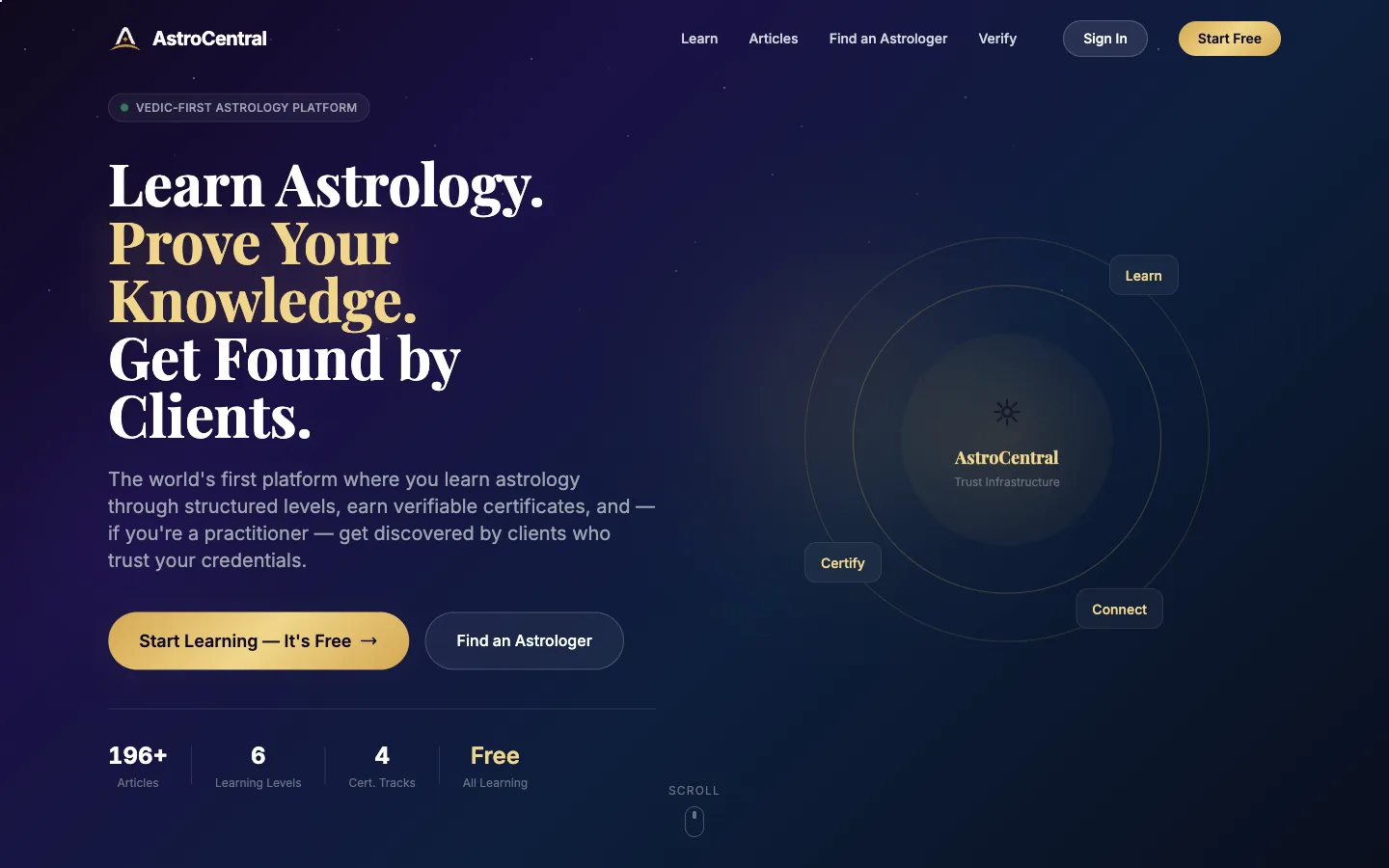
A learn-certify-connect platform for astrology: students take structured courses, earn verifiable certifications, and — soon — find vetted practitioners. All backed by real astronomical calculation, not guesswork.
- 429 commits in ~4 months — built fast, still active
- ~3,579 graded questions across 45 banks; 277 lessons & articles
- Two full tracks — KP (4 levels) and Vedic (6 levels)
- Charts & KP sub-lords validated against a live ephemeris API — no hand-authored positions
The problem
Astrology online splits between throwaway horoscope pages and, now, confident AI answers — with no reliable way to tell rigor from guesswork. AstroCentral puts trust into the category: structured courses people actually learn from, certifications outsiders can verify, and — soon — a directory of vetted practitioners. All of it resting on calculations that are actually correct.
Why it's hard to get right
It's two hard problems at once. First, the output has to be astronomically correct — planetary positions, ayanamsa, KP sub-lords, and chart geometry are real ephemeris math, and most astrology software hand-rolls it and quietly ships impossible placements: a planet where it astronomically can't be. Second, a certificate is only worth something if the assessment bank behind it is accurate and the credential is governed. Get either wrong and the whole platform is just a skin over guesswork.
How we built it
The calculation pipeline validates chart geometry and KP sub-lords against a live ephemeris API and auto-generates North and South Indian chart SVGs — no hand-authored positions to drift out of truth. On top sits the product: two full course tracks (KP across four levels, Vedic across six), roughly 3,579 graded questions across 45 banks, 277 lessons and articles, and verifiable PDF certificates. Built on ASP.NET Core 10, SQL Server with EF Core, Tailwind and Alpine.js, and QuestPDF, on Windows Server — 429 commits in about four months, and still moving.
What this means for you
If you have a domain where the computed answer has to be right — where 'looks plausible' fails because the experts will catch the error — and it has to be wrapped in a real product (courses, exams, credentials, content at scale), that's the build we do. Not CRUD with a skin on top: correctness-critical software in a specialist domain.
> other_work