
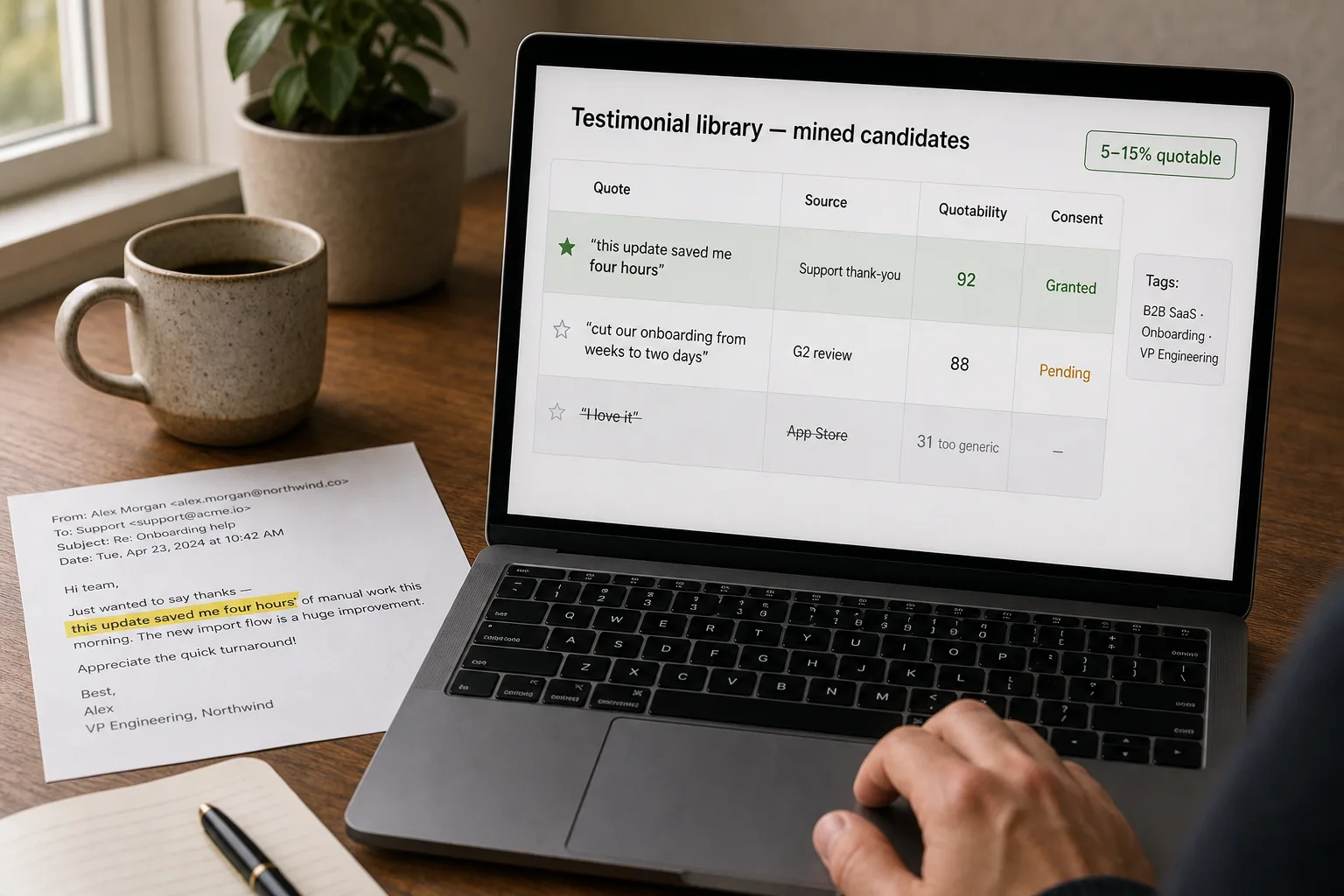
Testimonial mining is the practice of scanning every place your customers already say good things — reviews, NPS comments, support thank-yous, interview recordings — and extracting the quotes worth using in marketing. The social proof is being produced continuously; the operational gap is in surfacing it and getting permission to use it.
The pattern is everywhere. The customer who emailed support last week saying “this update saved me four hours” is producing exactly the kind of testimonial that would land on a landing page and convert a prospect. But no one mines support thank-yous. The customer’s name sits in an internal ticket only finance and support see. By the time marketing thinks to ask “do we have testimonials,” the moment has passed. The same gap plays across G2 reviews, App Store ratings, sales-call transcripts where the prospect-now-customer described why they bought, and customer interviews recorded for product research.
The pipeline that fixes this monitors every feedback source, extracts the genuinely quotable passages, captures permissions, and routes the content into your marketing asset library. Most of the cost is in the workflow, not the AI. This piece is the architecture.
Where this fits — and where it doesn't
Use this if you have a meaningful customer base producing reviews, NPS feedback, and support interactions, your marketing team would benefit from richer social-proof assets, and your current testimonial collection is ad-hoc. Common fits: B2B SaaS post-series-A, DTC ecommerce with reviews, services businesses with case-study-quality engagements.
Don’t use this if your customer base is too small to produce enough testimonial volume (under ~100 active customers), you don’t have a marketing motion that uses testimonials (some pure-PLG products), or your industry restricts customer-name use (regulated industries, some B2B contexts where customer logos are commercially sensitive).
What you'll need before starting
- Access to your customer-feedback sources — review platforms (G2, Trustpilot, App Store), NPS tool, helpdesk (Zendesk, Intercom), CRM (Salesforce, HubSpot), customer interview recordings.
- A permissions workflow — explicit consent process for using quotes in marketing. Most jurisdictions require this; most customers grant it when asked.
- A marketing asset library — where testimonials land and get used. Notion, Webflow CMS, an internal tool.
- A model API for extraction and scoring. Cheap-tier models suffice for this work.
- A marketing operator who reviews and edits extracted testimonials before publication. Auto-published testimonials risk misrepresentation; reviewed ones land cleanly.
Six steps from feedback to landing-page testimonials
- Pull from every customer-feedback source — review platforms, NPS, support, interviews
For each source, build a continuous pull. G2 / Trustpilot reviews via API. NPS responses from your survey tool. Support thank-yous flagged by sentiment classification on resolved tickets. Customer interview transcripts from sales / product research. The aggregate corpus is the input; broader corpora produce more material.
- Extract genuinely-quotable passages — specific, vivid, attributable
For each feedback item, ask the model to extract the passages that would work as testimonials: specific (mentions a specific outcome or use case, not “I love it”), vivid (concrete language, not corporate generic), attributable (the speaker is identifiable, or could be with attribution work). Score each passage by quotability; reject the generic ones, surface the specific ones.
- Capture metadata — speaker role, company, use case, source
For each extracted passage, capture: speaker name, speaker role, company / customer name, use case described, the source where the quote came from (review, support, NPS, interview). Metadata is what makes the testimonial usable — “Customer at Acme Corp” is more compelling than an anonymous quote.
- Trigger the permissions workflow for promising candidates
For each high-scoring candidate, send a permissions request to the customer — typically a brief email asking if you can use the quote, with the verbatim quote and the planned context. Most customers consent; some ask for light edits; a few decline. Track consent explicitly with a database; never use a quote without recorded consent. Marketing-platform tools (Senja, Testimonial.to) handle this workflow if you don’t want to build.
- Edit lightly for clarity — preserve voice, fix typos and grammar
Customer testimonials need light editorial polish — fix obvious typos, clean up casual grammar where it would distract — but the editing should preserve the customer’s voice and content. Don’t rewrite for marketing tone; the authenticity of customer voice is the testimonial’s value. Send any meaningful edits back to the customer for re-confirmation.
- Route to the marketing asset library with appropriate tagging
Tag testimonials by: use case, industry, customer size, product area, sentiment. Marketing pulls testimonials by tag for landing pages, ad creative, case studies, and sales materials. The tagging is what makes the library useful at scale — without it, finding “the right testimonial” becomes manual search through a long list.
What it costs and what to expect
The library growth rate is what compounds over quarters; the conversion lift is the strategic ROI for the marketing investment.
Other ways to solve this
Testimonial-collection platforms (Senja, Testimonial.to, Vouch). Bundled collection, permissions, and library workflows. Right answer for most teams. Trade-off: per-month cost; less customisation of mining logic.
Outbound testimonial requests — ask customers explicitly. Higher quality per request (the customer crafts a written testimonial); lower volume (most customers don’t respond). Pairs well with mining — the mining handles the bulk; outbound handles the high-touch cases.
Manual extraction from review platforms. What most teams do today — scroll G2, copy quotes, ask permission. Doesn’t scale; misses non-review sources.
Don’t use testimonials. Defensible for some categories; increasingly unusual at any meaningful B2B / DTC stage.
Related work
For the broader voice-of-customer aggregation that overlaps, see Voice-of-customer reports from cross-channel feedback. For the support-corpus pattern that surfaces gratitude messages, see Detect churn signal from support patterns. For the structured-content generation that uses testimonials, see Programmatic SEO at scale. For the brand-voice discipline that landing-page testimonial usage benefits from, see Brand-voice guardrails for marketing teams.
FAQ
Do we need consent if the customer left the review publicly?
Best practice: yes, even for publicly-posted reviews. Some platforms' terms of service allow republishing with attribution; others require explicit re-use consent. The simplest discipline is to ask in every case — most customers consent quickly, and the documented consent prevents downstream legal questions. For high-stakes uses (paid ads with the quote), explicit consent is non-negotiable.
What about negative reviews — can we mine those too?
Yes, for product and CX learning, not for marketing use. Negative reviews surface improvement areas; the mining pipeline can flag patterns in negative feedback for product attention. Don't try to spin negative reviews into testimonials; the more honest use is feedback-loop signal.
How do we handle changes if the customer asks us to remove or edit a quote later?
Honor the request promptly. Track every published location of every quote so you can update or remove. Customer-relationship cost of leaving an unwanted quote in marketing is much higher than the editorial cost of removing it. Build the removal workflow alongside the publishing workflow.
What about anonymous testimonials when the customer can't use their name?
Acceptable in some industries (regulated, security-sensitive) where customer-name use isn't possible. Replace name with role + industry — "VP Engineering at a Series B fintech" — and capture enough metadata to make the testimonial credible even without the company name. Some industries have established this as the norm.