
If you want your business apps to talk to each other — pull customer data from your CRM into a spreadsheet, post a Slack message when a deal closes, send AI-generated email drafts based on form submissions — you need an automation platform. These platforms connect software services together and run sequences of steps between them, mostly without code.
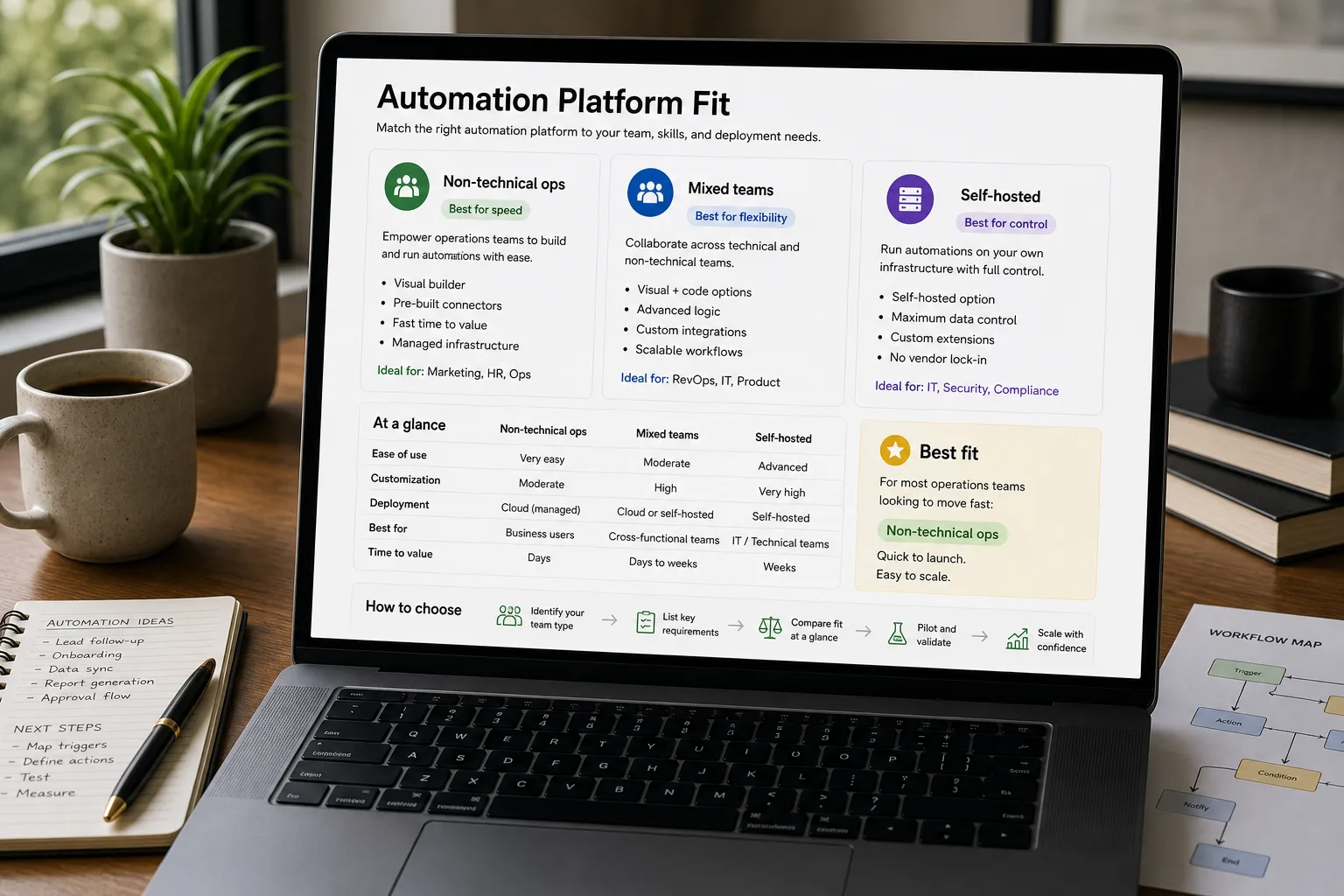
Three platforms dominate the category. Zapier has the broadest set of app integrations and is the easiest to start with, but it gets expensive as your volume grows. Make has a visual drag-and-drop editor, costs less at higher volume, and takes a little more learning. n8n is free and runs on your own servers (or theirs), is the most flexible of the three, and requires more technical setup.
Each one fits a different kind of team. Picking the wrong one usually means your team fights with the platform for years — either because it’s too expensive at your real volume, or too complicated for the people actually using it.
What follows: a side-by-side comparison on the things that actually matter — how many apps each one connects, how the pricing scales as you grow, what their AI features can do, and how the choice between cloud-hosted (where the vendor runs everything for you) and self-hosted (where you run it on your own infrastructure) shapes the day-to-day operational work.
The comparison matrix
| Zapier | Make | n8n | |
|---|---|---|---|
| Hosting model | Cloud-only (SaaS) | Cloud-only (SaaS) | Self-hosted (open source) or n8n Cloud |
| Integration count | 8,000+ apps — the broadest in the category | 3,000+ apps — wide but narrower than Zapier | Hundreds of official integrations + open-source community nodes; HTTP-fallback covers anything with an API |
| AI features (built-in) | Zapier AI Actions, AI by Zapier, ChatGPT actions — extensive | OpenAI / Anthropic / Mistral modules, Make AI agents — strong | LangChain nodes, OpenAI / Anthropic / Ollama integrations — strongest for AI-agent workflows |
| Ease of use (non-technical operator) | Highest — step-based workflow builder, accessible to non-engineers | High — visual scenario builder; modest learning curve | Moderate — node-based; familiar to engineers, harder for non-technical users |
| Workflow depth (loops, conditions, branching) | Adequate for most workflows; complex branching gets clunky | Strong — visual branching, error-handling, iterators | Strongest — programmatic control flow, code nodes, full JavaScript / Python |
| Code nodes (write custom logic) | Code by Zapier (JavaScript / Python) — available on paid plans | Custom modules; less seamless than dedicated code nodes | First-class JavaScript / Python code nodes; full filesystem access self-hosted |
| Pricing — entry tier | $19.99/month Professional (formerly Starter; Zapier consolidated to a single paid entry) | $9/month Plan tier for 5,000 credits (Make moved from operations to a credit model) | $0 self-hosted; €20/month n8n Cloud Starter |
| Pricing — mid tier (~50,000 ops/month) | ~$300–$500/month depending on task type | ~$30–$50/month — re-verify at make.com/en/pricing | €50/month n8n Cloud Pro; $0 self-hosted (infra cost only) |
| Pricing — high volume (millions of ops/month) | Enterprise pricing; can reach $5,000+/month | Substantial but cheaper than Zapier | Self-hosted is essentially free; n8n Cloud Enterprise mid-cost |
| Self-hosting | Not supported | Not supported | Fully supported; the primary positioning |
| Data residency / compliance | US-hosted; SOC 2 + GDPR; enterprise tier offers regional | EU-hosted (CZ); GDPR-native; SOC 2 | Self-hosted: total control; Cloud: EU or US options |
| Team / collaboration | Strong team features on paid plans | Strong team features; mid-tier and up | Self-hosted: depends on deployment; Cloud: team features in Pro+ |
| Reliability (executions per second, error handling) | Highest — battle-tested at large scale | Strong — solid at typical volumes | Self-hosted: depends on infrastructure; Cloud: comparable to Make |
| Open source | No (proprietary) | No (proprietary) | Yes (fair-code license) |
What to actually use
For non-technical operators building broad AI workflows on a small budget — Zapier. The integration breadth means you can connect almost anything; the workflow builder is accessible to anyone who can read a spreadsheet. Trade-off: pricing climbs fast as workflow volume grows. Right for early-stage teams where time-to-shipped-workflow matters more than per-task cost.
For mid-stage teams with meaningful volume that want visual workflows — Make. The pricing-vs-Zapier gap is real and grows with volume; the visual-scenario builder handles branching better; AI integrations are solid. Sweet spot is the team that’s outgrown Zapier’s pricing but hasn’t yet hit the engineering capacity to self-host. Most growing companies land here for the bulk of automation work.
For engineering-capable teams running high volume or data-sensitive workflows — n8n. The self-hosted path is free at runtime; the per-task math at 1M+ ops/month favours n8n by orders of magnitude over the hosted alternatives. Plus full code-node flexibility for AI agents, complex workflows, and integrations the official catalog doesn’t cover. Trade-off: operational responsibility (deployment, monitoring, upgrades). Right for teams with platform engineering capacity.
For AI-agent workflows specifically (LangChain-style, multi-step reasoning) — n8n. The LangChain integration and agent-node architecture is the deepest of the three; Zapier and Make handle linear AI calls well but get awkward at agentic workflows. If your AI work is mostly tool-using agents, n8n is the platform shape that fits.
For very-large enterprise with compliance requirements — All three offer enterprise tiers; the decision typically comes down to existing-vendor relationships, regional data-residency requirements, and the trade-off between in-house operation (n8n self-hosted) and managed compliance (Zapier / Make enterprise).
What you'll actually pay
The per-task pricing differentiates sharply at volume. A workflow that costs $50/month on Make can cost $500/month on Zapier and $0 on self-hosted n8n; pick the platform whose cost curve matches your expected scale.
Volatility notes
This category moves moderately. Concrete watch-list:
- Zapier’s AI features. Heavy investment; expect Zapier to bundle more AI-agent capabilities and reduce friction with built-in models.
- Make’s pricing. Make has been pricing aggressively against Zapier; expect further moves on the pricing front.
- n8n’s commercial trajectory. n8n has been raising and investing; expect more cloud-tier features and possibly tighter licensing terms (the fair-code license has been adjusted before).
- AI-native automation entrants. Pipedream, Workato, Tray.io, and others are competing in the same category with different AI-focus levels; the three-way comparison may become four- or five-way within a year.
Re-verify pricing and AI-feature depth every 6 months. Integration coverage drifts more slowly.
Related work
For the specific workflows these platforms typically run, see Email-to-task automation, Triage inbound email at scale, and Sales follow-up sequences with CRM context. For the broader local-vs-cloud framework that informs the n8n self-hosting decision, see When to run AI locally vs in the cloud. For the underlying tokens-and-cost math when AI calls drive the platform’s cost, see Tokens, context windows, and what they cost.
FAQ
Can I migrate workflows between platforms easily?
No. Each platform's workflow format is proprietary; migration is essentially rebuilding. The cost of switching matters for the initial decision. Pick the platform that fits your scale and capability now, and accept some migration cost if you need to switch later.
What about Workato, Tray.io, Pipedream — should I consider them?
All are credible alternatives. Workato leans enterprise; Tray.io similar. Pipedream is developer-focused with strong AI integrations. They occupy slightly different niches than the three above. For most SMB / mid-market decisions, the Zapier / Make / n8n triad covers the common use cases; the specialised alternatives matter at the edges.
How do AI tokens get billed — by the automation platform or directly?
Directly to your LLM API account in most setups. The automation platform charges per task / operation; the LLM call is billed by Anthropic / OpenAI / Google directly. This is operationally clean (your AI costs are visible separately) but means "platform cost" plus "LLM cost" is the full picture; don't compare platforms on just the platform cost.
What's the realistic effort to self-host n8n?
Lower than the marketing suggests for technical teams. Docker-based deployment is essentially copy-paste; database is PostgreSQL; runs comfortably on a small VPS. The ongoing maintenance is light if you stay on stable releases; the operational responsibility is real (you patch, you upgrade, you backup). For teams with any platform engineering capacity, it's straightforward; for teams without, the cloud tier exists.