
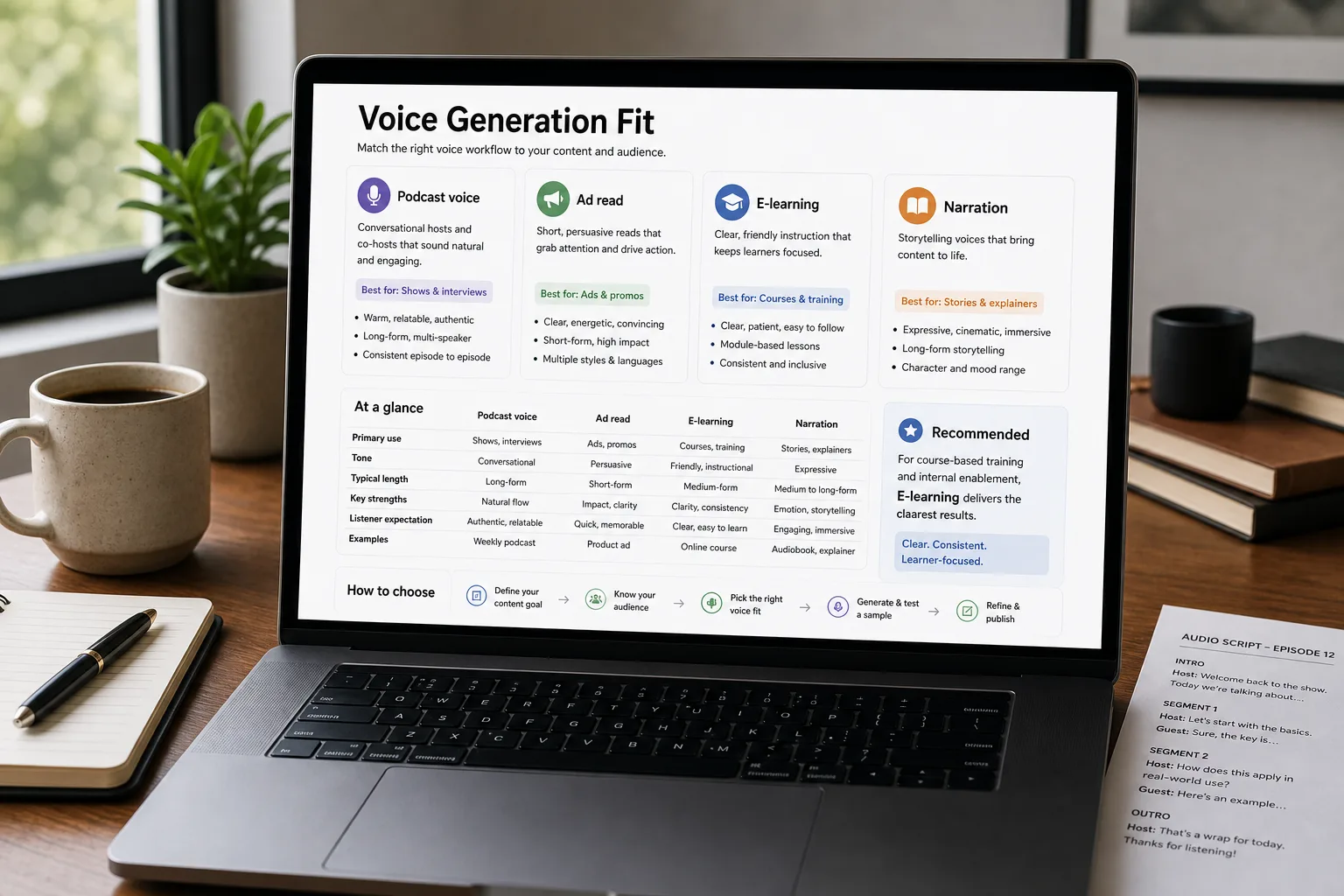
AI voice generation — also called text-to-speech, or TTS — takes a written script and produces an audio file that sounds like a human reading it. The five main vendors in 2026 are ElevenLabs, Murf, Play.ht, OpenAI TTS, and Google Cloud TTS. They look similar on the demo page and diverge sharply in production.
ElevenLabs sounds best on the demo; the pricing is the highest. Murf is enterprise-friendly with strong structured workflows; voice quality sits below ElevenLabs. Play.ht offers good quality and a broad voice library; the ecosystem is less mature. OpenAI TTS and Google Cloud TTS are the API-first (application programming interface — the way one piece of software calls another) options that integrate cleanly into broader stacks.
This piece walks through voice quality, the licensing fine print on cloned voices, language coverage, and the production-fit decisions that matter beyond “which demo sounds most natural.”
The comparison matrix
| ElevenLabs | Murf | Play.ht | OpenAI TTS | Google Cloud TTS | |
|---|---|---|---|---|---|
| Voice quality (subjective) | Top tier — among the most natural in the category | Good; less expressive range than ElevenLabs | Good; competitive with Murf | Strong; six pre-built voices, less customisation | Good; broad voice library; less natural than the leaders |
| Voice cloning support | Strong — Instant Voice Cloning (small samples) and Professional Voice Cloning (high-fidelity) | Voice cloning available; requires longer samples | Voice cloning available | Not standard (research-only) | Not standard |
| Emotional / style control | Strong — style prompts and emotion control | Moderate — pace and emphasis controls | Moderate | Limited at API tier | Some via SSML markup |
| Language support | 70+ languages with high quality | 20+ languages with varying quality | 142+ voices across many languages | 12 languages currently | 50+ languages with extensive voice options |
| API maturity | Strong — well-documented, broad SDK support | API available; less developer-focused | Strong API with developer focus | Native OpenAI API; strong integration | Strong; part of Google Cloud ecosystem |
| Workflow / studio UI | Strong studio with project workflow | Strongest — enterprise-friendly project workflow | Strong studio | API-first; less UI | API-first; minimal UI |
| Pricing — entry tier | Free 10k credits/month; $6/month Starter | $19/month entry tier (re-verify at murf.ai/pricing) | $39/month entry | $15 per 1M characters (API only) | $4-$16 per 1M characters depending on voice type |
| Pricing — production tier | $11/month Creator, $99/month Pro, $299/month Scale, $990/month Business | $66/month for Business tier (re-verify) | $99/month Studio (re-verify) | Pay-as-you-go API | Pay-as-you-go |
| Voice cloning ethics / consent | Strong policy — explicit consent required, watermarking, takedown process | Requires permissions for cloned voices | Requires permissions | No cloning offered (deliberate ethical stance) | No cloning offered |
| Best for | Premium-quality voice content; cloned-voice workflows | Enterprise narration; e-learning at scale | Long-form audio content; AI agents | Voice for AI applications integrated with OpenAI | Voice in Google Cloud applications, accessibility |
What to actually use
For premium-quality voice content (podcasts, ads, premium narration) — ElevenLabs. The voice quality leads the category and the emotional / stylistic range is the differentiator. Trade-off: highest cost, character-limit math at scale. Right for content where voice quality is a marketing-quality lever.
For enterprise narration and e-learning at scale — Murf. The structured project workflow, team features, and enterprise-friendly licensing make it the operational fit for L&D teams, internal-comms video, corporate training. Trade-off: voice quality below ElevenLabs at the top end.
For developer-integrated voice in applications — Play.ht or OpenAI TTS. Both have strong APIs; OpenAI TTS is the natural fit if you’re already on the OpenAI stack; Play.ht has a wider voice library and longer track record. Right for product integrations (voice agents, accessibility features, audio content APIs).
For broad language coverage and Google Cloud integration — Google Cloud TTS. 50+ languages, mature, well-priced for high volume, integrates with the rest of Google Cloud. Right for global products serving many languages.
For voice cloning workflows — ElevenLabs (with explicit consent). The Professional Voice Cloning tier produces high-fidelity clones; ElevenLabs’ policy on consent and watermarking is the strongest in the category. Don’t use voice cloning without explicit written consent from the voice owner; the legal and ethical considerations are material.
What you'll actually pay
For routine voice generation, all options are affordable. The cost differences matter at the very-high-volume end (millions of characters per month) or when premium quality is a marketing-spend lever.
Volatility notes
- Quality improvements continuous. Each provider iterates; the quality leader shifts.
- Real-time voice agents. OpenAI Realtime API, ElevenLabs Conversational AI — real-time voice is the next frontier and is bundling differently than batch TTS.
- Voice-cloning regulation. Some jurisdictions are introducing regulations on AI-generated voices; expect compliance requirements to evolve.
- Pricing pressure. Open-source TTS models are improving; commercial pricing may face pressure over 2026.
Re-verify every 6 months.
Related work
For the broader voice-and-transcription pattern that pairs with generation, see Whisper API vs Deepgram vs AssemblyAI. For the broader privacy-and-licensing considerations, see AI privacy — what to watch for. For the AI agents that increasingly use voice generation, see AI agents for inbound qualification. For the content-team workflow that often consumes voice generation, see Repurpose a podcast episode into pieces.
FAQ
Is voice cloning legal?
Cloning your own voice or a voice with documented consent is legal in most jurisdictions. Cloning someone else's voice without consent is a legal minefield — defamation, right-of-publicity, and increasingly, AI-specific regulation. The reputable providers (ElevenLabs especially) have consent requirements and takedown processes; respect them. The legal landscape is evolving fast in this category.
How is real-time voice (voice agents) different from batch TTS?
Real-time voice operates with very low latency for conversational use (live customer-service agents, voice-driven applications). Batch TTS is fine for pre-generated content (podcasts, narration, audio articles). The two require different products in most vendor lineups — OpenAI Realtime API, ElevenLabs Conversational AI, Deepgram Voice Agent for real-time; ElevenLabs Studio, Murf, Play.ht for batch.
Should we disclose AI voices in marketing content?
Increasingly the right answer. Some jurisdictions require disclosure for synthetic voices; others recommend it. Even where not required, listener trust is at stake — AI voices used to mimic a human spokesperson can damage brand credibility when discovered. Disclose clearly; the audience-impact is usually positive when handled transparently.
Can we run voice generation locally?
Open-source TTS models (Coqui TTS, Bark, XTTS, OpenVoice) are increasingly capable and self-hostable. Quality is below the commercial leaders but improving. Right for privacy-sensitive workloads or very-high-volume cost optimisation; not yet at parity for premium-quality consumer-facing content.