
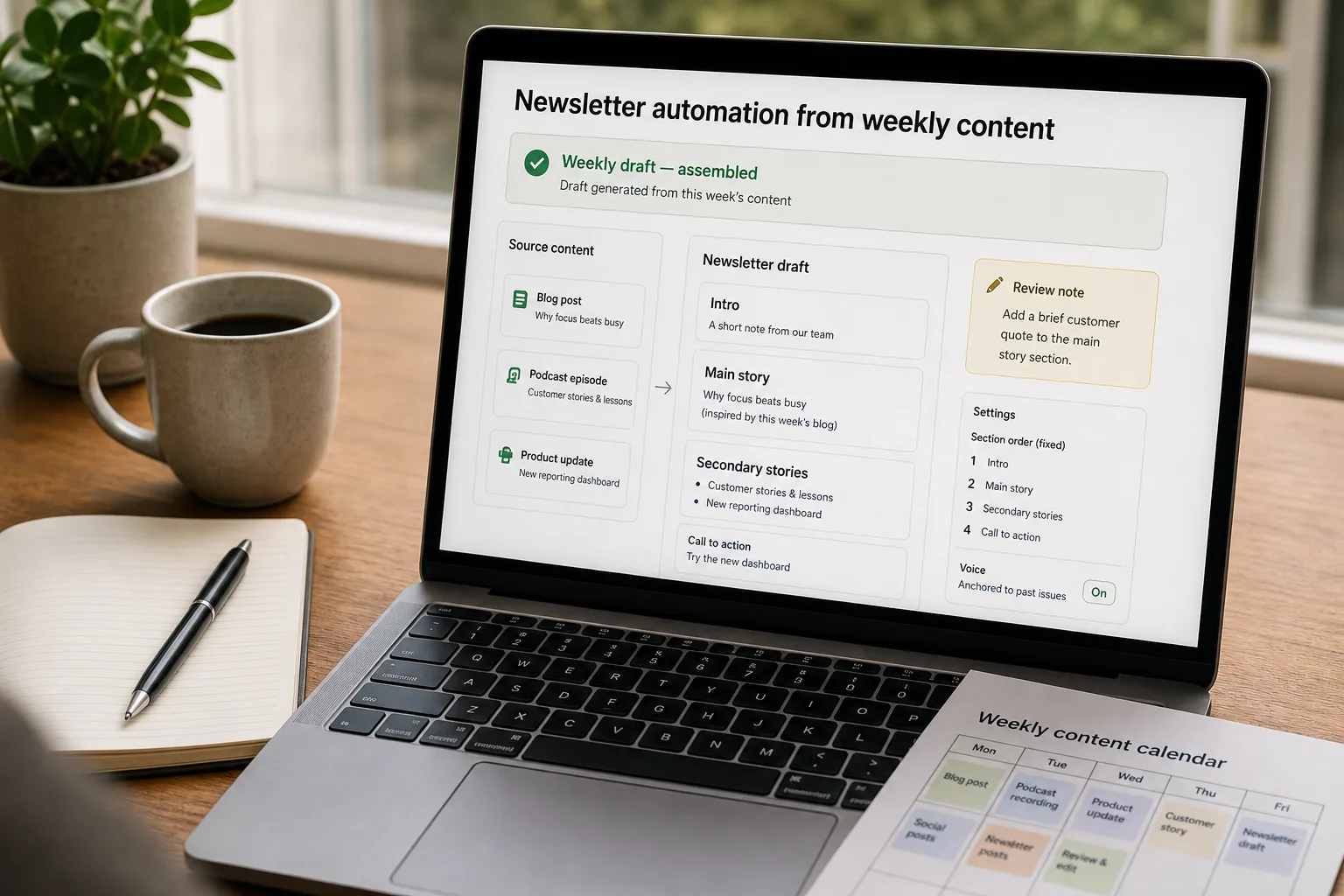
If you run a weekly newsletter, you know the pattern. The Friday newsletter that’s supposed to ship Tuesday is the most reliably procrastinated artifact in early-stage content marketing. The week’s content exists — a blog post or two, a couple of customer wins, a product update, some Slack-channel highlights — but turning it into a newsletter requires assembling, framing, writing transitions, and crafting a header that makes someone open the email.
The friction is high enough that the weekly cadence becomes fortnightly, then monthly, then stops.
This pipeline aggregates the events automatically, drafts the newsletter in your established voice, and produces a structured draft for editing. The editor’s job is to polish and add the human voice; the assembly work disappears.
This piece is the architecture — what to aggregate from where, how to draft in the established voice, and how to keep the newsletter from sounding like a corporate roundup.
Where this fits — and where it doesn't
Use this if you have a regular newsletter cadence (weekly or biweekly), you’re producing meaningful content across multiple channels each week, and the assembly time is the bottleneck on cadence. Common fits: founder-led newsletters, B2B SaaS content teams, services businesses with consultative content motion.
Don’t use this if your newsletter is highly editorial / opinion-driven (the value is the writer’s voice, not aggregation), your content volume is too low to need aggregation (under ~2 content events per week), or you’re at the stage where the newsletter is purely founder-written and adding automation feels inauthentic.
What you'll need before starting
- Source-content APIs or feeds — your blog RSS, social posts, product changelog, Slack channels worth excerpting, customer-win database in CRM.
- A newsletter platform — Beehiiv, Substack, ConvertKit, Customer.io, Mailchimp.
- A model API key with long-context support — the assembly step combines multiple sources.
- 3–6 months of past newsletters as voice anchors. The model uses these to maintain consistency with the established editorial voice.
- An editor who reviews and polishes the draft before send. Auto-published newsletters lose the relationship-building tone that makes newsletters work.
Six steps to a newsletter that actually ships weekly
- Define the section structure — fixed sections, dynamic content
Most successful newsletters have a stable structure: intro, main story, secondary stories, customer / community highlight, product update, useful link, closing. Lock the section structure; the dynamic content per section varies weekly. Stable structure is what makes readers know what to expect; without it, every newsletter feels like an experiment.
- Aggregate the week’s events from every source on the schedule
Pull from each source: new blog posts (RSS feed), social engagement worth highlighting, product changelog entries, customer wins from CRM, notable Slack-channel discussions worth referencing externally. Filter for significance — most events are noise; the newsletter highlights the few worth reader attention.
- Generate the draft per section with voice anchors
For each section, generate content using: the aggregated events as input, the past newsletters as voice anchors, the section’s purpose as framing. The voice anchors are the differentiator — without them, generated newsletters sound generic; with 3–6 months of past issues in the prompt, the output reads as a continuing voice.
- Write the subject line and intro hook last — they’re the highest-leverage
Subject lines decide open rates; intros decide whether readers continue past line 1. Generate 5–8 subject-line variants and 3–5 intro hooks per draft; the editor picks the best or writes their own. Don’t trust the model to pick the winning subject line; treat it as variant generation, not selection.
- Route to the editor for review — not to the send-list
The draft lands in the editor’s inbox or Notion workspace, not in the newsletter platform’s ready-to-send queue. The editor reviews, polishes the voice, adds the human notes that the AI can’t write, signs off. The human-in-the-loop framing is what keeps newsletters from feeling automated.
- Schedule the send and track performance over time
After editor approval, schedule via the newsletter platform. Track open rate, click rate, unsubscribe rate over months. The performance data informs the section structure (which sections drive clicks), the subject-line patterns (which produce opens), and the aggregation choices (which sources feed the most engaged content).
What it costs and what to expect
The on-time delivery rate is the operational ROI — a reliably-shipped newsletter compounds value over months in a way that an inconsistent one doesn’t.
Other ways to solve this
Newsletter platforms with AI assist (Beehiiv AI, Substack with custom prompts). Increasingly bundle drafting features. Trade-off: less control, platform-specific.
Manual writing with a content schedule. Traditional approach. Works for disciplined writers; falls apart under load. The pipeline lowers the discipline cost.
Skip the newsletter — use social and blog instead. Defensible answer for some audiences. Newsletters compound differently from social; the choice depends on audience preferences.
Highly curated, edited-from-scratch. For high-prestige newsletters where every issue is a labour of love. Doesn’t scale to most company newsletters but is the right model for some.
Related work
For the brand-voice discipline the newsletter draft needs to maintain, see Brand-voice guardrails for marketing teams. For the cross-source content aggregation pattern, see Federated search across your tools. For the AI-tells problem that newsletter generation can exhibit, see First-draft marketing copy without the AI tells. For the broader prompt patterns for content teams, see Prompt engineering patterns for content teams.
FAQ
Should we tell subscribers the newsletter is AI-assisted?
Substance matters more than label. If the editor genuinely shapes every issue and the AI is the assembly tool, that's a normal modern publishing workflow that doesn't require special disclosure. If the AI generates and ships without meaningful editorial involvement, the disclosure case is stronger. Many established newsletters now use AI assembly without flagging it explicitly; the readers are responding to the content quality, not the production process.
What if our weekly content volume is too low to produce a full newsletter?
Adjust cadence. A biweekly newsletter with rich content beats a weekly one with thin content. The pipeline lowers the writing cost but can't create content that doesn't exist. Match cadence to actual content production.
How is this different from RSS-to-email roundup tools?
RSS-to-email tools assemble links; the AI pipeline produces written content around the links. The differentiator is the editorial framing — "here's what shipped this week" vs "here's a curated narrative of the week, written in our voice." The second is what readers stay subscribed to.
What about newsletters in different languages?
Run the pipeline per language with locale-aware voice anchors. Translation-after-generation produces stilted writing; native-language generation with local voice anchors produces something readers in that market actually want to read. See AI translation services compared for the translation-tier choices if needed.