
If you’ve ever had to compare eight vendor proposals, you know it’s one of the highest-stakes, most subjective tasks in procurement. Each proposal is 30–80 pages of marketing copy, capability claims, pricing structures, and case studies. The team spends three days reading them in parallel, builds a spreadsheet that captures roughly half of what matters, and makes a $200K decision based on which vendor’s narrative was most convincing rather than which one actually fits.
The high-stakes decisions deserve a structured comparison. The structured comparison takes a week nobody has.
The fix is to use AI extraction to do the reading-and-tabulating mechanically, against a scoring rubric your team has agreed on. Reserve human judgement for the trade-offs that matter. The pipeline turns “read these eight proposals” into “review this comparison matrix and discuss the three responses that flagged for divergence.”
This piece is that pipeline — the rubric design, the structured extraction, the scoring layer, and the divergence flagging that prevents the comparison from collapsing into apples-to-oranges.
Where this fits — and where it doesn't
Use this if you’re evaluating 4+ vendor proposals for a significant purchase (software, services, infrastructure), the proposals are written documents (RFP responses, deal proposals, capability decks), and the decision is consequential enough to warrant a structured process. Common fits: enterprise software selection, professional services engagements, infrastructure procurement, vendor-rationalisation projects that compare incumbents against challengers.
Don’t use this if you’re evaluating just 2–3 vendors (read them yourself; the AI overhead isn’t worth it), the vendor proposals are all sales-deck-style with no real depth (the comparison surfaces nothing because there’s nothing in the documents), or your evaluation depends primarily on demos and reference calls rather than written materials. For the last case, the AI helps with the written-material analysis but the decision-driving information lives elsewhere.
What you'll need before starting
- The proposal documents in a form the AI can read — PDFs, DOCX, or text. RFP responses are usually structured; sales decks need more cleanup.
- A scoring rubric — what dimensions matter for this decision (pricing, capability A, capability B, security posture, implementation timeline, references, etc.), and how each dimension is weighted. The rubric is the spec; the AI is the engine.
- A long-context-capable model API. Proposals can be 100k+ tokens; Claude, GPT, and Gemini all handle this range.
- A clear set of must-haves vs nice-to-haves. Must-haves become hard filters; nice-to-haves become weighted scoring dimensions. Mixing them is how comparison spreadsheets become uninterpretable.
- Stakeholder buy-in on the rubric before any extraction starts. A rubric the team agrees on after seeing the comparison is no rubric at all; you’ve reverse-engineered it from your preferred vendor.
Six steps from a stack of proposals to a decision matrix
- Lock the rubric — dimensions, weights, must-haves before any extraction
Define 8–15 dimensions for the comparison, each with a one-sentence definition and a measurable extraction target. “Implementation timeline” becomes “weeks from contract signature to production go-live, per vendor’s stated estimate.” “Security posture” becomes “SOC 2 status (Type I, Type II, none), additional certifications, data residency options.” Vague dimensions produce vague comparisons; specific dimensions produce extractions you can defend. Document the must-have filters separately — vendors who fail a must-have are out before scoring.
- Pre-process each proposal — extract sections relevant to the rubric
For each proposal, identify and extract the sections that map to your rubric dimensions. Most RFP responses have a standard structure (executive summary, capabilities, pricing, security, references, implementation, support), but each vendor lays it out differently. Pass the full proposal to the model with the rubric and ask for section extraction; the output is a structured per-dimension chunk per vendor. This step is what makes the comparison apples-to-apples; without it, the model is comparing different sections from different proposals.
- Extract structured data per dimension — verbatim quotes plus normalised values
For each dimension, extract two things: the verbatim quote from the proposal (audit trail) and the normalised value (what gets compared). “Pricing” becomes a structured object: base price, per-seat or per-unit cost, included usage, overage rates, ramp / discount structure, multi-year commitment terms. Free-text “pricing varies based on usage” doesn’t compare; the structured fields do. Where a proposal doesn’t address a dimension, mark it explicitly as “not in proposal” — that’s a finding, not a hole in the analysis.
- Score against the rubric — and flag the must-have failures
Apply the rubric weights to the extracted values. For each dimension, score each vendor on a defined scale (1–5, or whatever you committed to). For must-haves, apply hard filters: vendors who fail a must-have are eliminated from scoring. Use rules for objective dimensions (pricing thresholds, capability checkboxes, timeline windows) and LLM-assisted scoring only for subjective ones (qualitative judgement of reference-case alignment, support model quality). The rules-first pattern produces defensible scores; LLM-only scoring drifts and is hard to justify in a procurement decision review.
- Surface divergences — where vendors materially differ
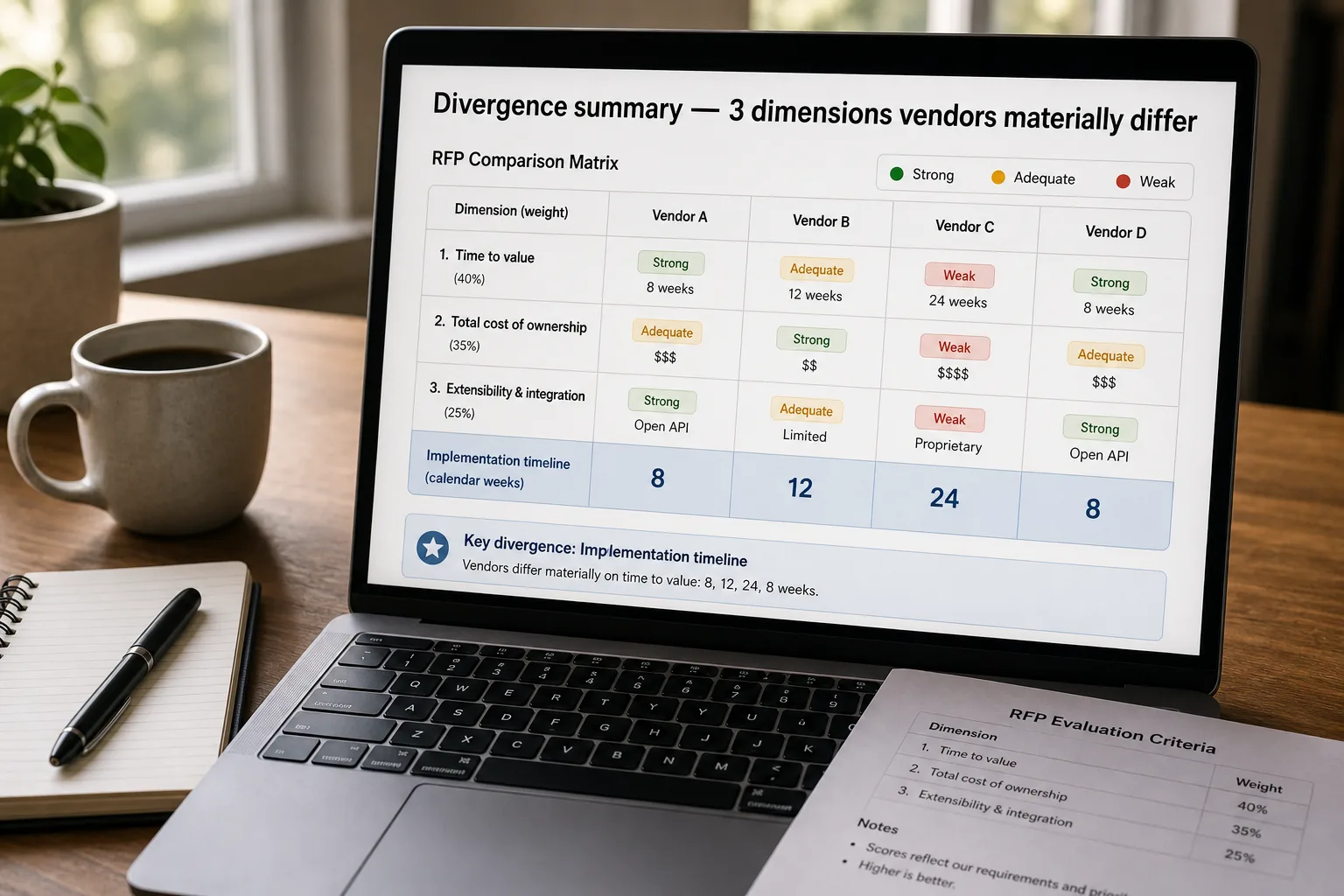
The most valuable output isn’t the total score; it’s the per-dimension comparison highlighting where vendors meaningfully diverge. “Implementation timeline: A=8 weeks, B=12 weeks, C=24 weeks, D=8 weeks” tells you something the total score hides. The pipeline should produce a summary of divergence-by-dimension: which dimensions have unanimous answers, which have a clear leader-laggard split, and which are spread across the field. These are the topics for the human discussion.
- Generate the decision-meeting deliverable — comparison matrix + divergence summary + open questions
The output of the pipeline is the input to the decision meeting: a 1-page comparison matrix (vendors as columns, dimensions as rows, normalised values in cells, with conditional formatting for divergence), a divergence summary (the 3–5 dimensions where vendors materially differ), and a list of open questions (“Vendor B’s pricing is 30% lower but their implementation timeline is 3x longer — what’s the trade-off rationale?”). The deliverable accelerates the decision conversation; the human discussion focuses on judgement, not on data assembly.
What it costs and what to expect
The cost is trivial relative to the decision value. The time-savings number is what justifies the project; the decision-quality lift is the harder-to-quantify strategic win.
Other ways to solve this
Procurement platforms with built-in evaluation (Coupa, Workday Strategic Sourcing, GEP Smart, Ivalua). Full source-to-contract platforms with structured evaluation built in. Right answer for procurement teams at mid-market and enterprise. Trade-off: significant implementation cost, formal RFx workflow that’s overkill for one-off comparisons. Strong fit for organisations with mature procurement functions.
Negotiation-platform AI (Vendr, Tropic). Different angle — these platforms help with the negotiation side, often including market-price benchmarks and vendor history. Useful complement to a structured comparison; pairs well with the pipeline above (use the pipeline for the rubric-driven selection, use Vendr / Tropic for the price negotiation phase).
Spreadsheet comparison with manual entry. The traditional approach. Works for 2–3 vendor comparisons; breaks down on 5+ where the extraction time becomes the bottleneck. Honest answer for smaller decisions or for teams without engineering support to build the pipeline.
Demos and references only, skip the written analysis. Some teams genuinely make decisions on demo quality and reference calls rather than written materials. Valid for some categories (UX-driven tools, services engagements). The written-material comparison is the structured layer; demos provide the qualitative texture. Most strong evaluations use both.
Related work
For the contract-review pattern that comes after vendor selection, see Contract review and clause extraction. For tracking the vendor’s renewal once contracted, see Lease and vendor renewal tracking. For the broader document-extraction pattern, see Extract structured data from PDFs. For classifying proposal documents and other vendor materials, see Document classification at scale.
FAQ
What if the proposals all say slightly different things about the same capability?
That's the normal case, and it's why the structured extraction matters. The pipeline normalises each vendor's statement into a comparable form. Where statements genuinely conflict (vendor A says they support X, vendor B says X is impossible), flag the conflict for the technical team to validate with a follow-up question. The structured comparison surfaces these conflicts rather than burying them in narrative.
Can we use this for evaluating professional-services proposals (consultants, agencies)?
Yes — the pattern is similar but the rubric dimensions shift. For services, dimensions include team composition, similar past engagements, methodology, deliverables, milestones, change-management approach, pricing structure. The extraction works on the same principle; the rubric just maps to different vendor inputs. Services proposals are often more narrative than software RFPs, which makes the structured extraction more valuable, not less.
How do we prevent the AI from being biased by the order it sees proposals?
Two patterns. (1) Process each proposal independently with the same prompt and rubric — no cross-proposal context — so the model has no priming. (2) Randomise the order if you do any cross-proposal generation step. Most teams don't see meaningful order bias when extraction is fully independent; the bias risk is higher in pipelines that summarise across proposals in a single call.
What about pricing that's intentionally complex — usage-based, tiered, multi-component?
Build a pricing-extraction sub-schema that captures each component (base, per-seat, per-unit usage, included quantities, overage rates, ramp / discount, multi-year terms) and produces a year-1 and year-3 normalised total. For complex pricing, also produce a scenario analysis — what does the price look like at low / medium / high usage. Tools like Vendr and Tropic publish market-rate benchmarks; cross-reference against those.
Should we share the comparison with vendors as part of negotiation?
Selectively. Sharing the dimensions where they're competitive but not leading is fair game and produces useful negotiation leverage. Sharing the full matrix with all competitors' data is rarely appropriate — it can violate the proposal-confidentiality expectations. Most procurement professionals share aggregate market positioning ("the leader in this dimension is X% better than your offering") rather than vendor-specific data.
How do we handle subjective dimensions like 'cultural fit' or 'partnership orientation'?
Don't extract these from documents. The documents will all claim strong cultural fit and partnership orientation. Score these dimensions from references calls, vendor interactions during the evaluation, and post-pilot reviews — not from RFP language. The AI extraction is for the objective dimensions; subjective dimensions live in the qualitative layer of the decision and need explicit human evaluation.