
An auditor’s email arrives on a Monday: “Here’s the evidence request for your SOC 2 Type II audit.” The list is long — configurations from your cloud accounts, access reviews from your identity provider, security policies, training records, vendor reviews, change-management logs. Someone on the security team spends the next ten days screenshotting, exporting, and labelling, while engineering work stops because everyone is being asked for access lists. The audit itself takes a few days; the prep took two weeks; and three months later the next audit cycle starts and most of the prep work has decayed into staleness.
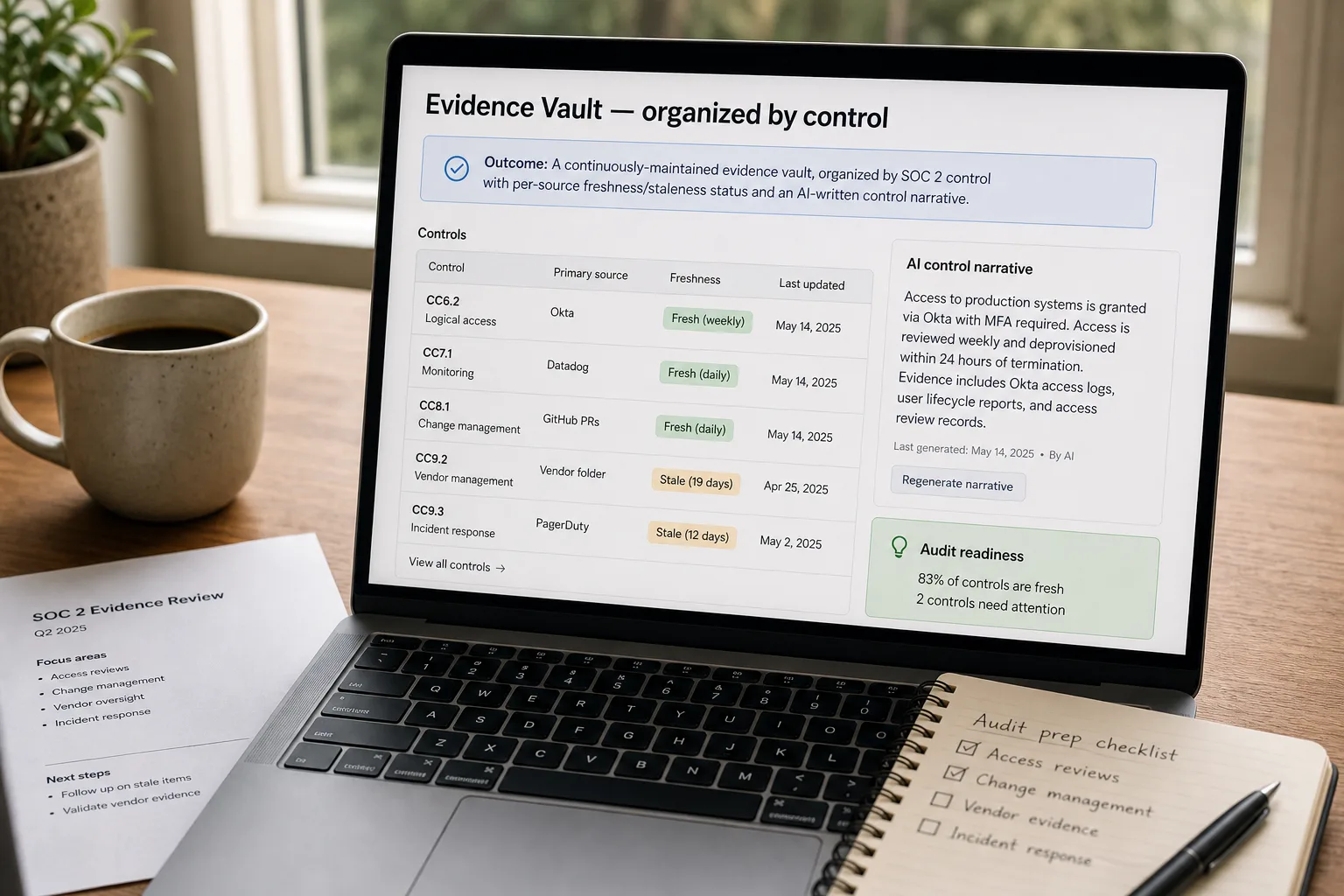
The fix is to stop treating compliance evidence as a periodic deliverable and start treating it as continuous output. Configurations pull from cloud accounts on a daily schedule. Access reviews export from Okta or Azure AD weekly. Security policies live in version control. Training records timestamp on completion. The auditor’s evidence request becomes a list of links to a continuously-maintained evidence vault rather than a two-week scramble.
This piece is the pipeline that produces that vault, the AI layer that maps each piece of evidence to specific controls (SOC 2 CC6.2 logical access, CC7.1 monitoring, and so on), and the workflow that turns audit prep from a fire drill into a status check.
Where this fits — and where it doesn't
Use this if you’re pursuing or maintaining SOC 2 (Type I or II), ISO 27001, HIPAA, or a similar framework, you have engineering and IT systems with API access (cloud platforms, identity providers, source control), and your compliance program is at the stage where ongoing evidence maintenance is the bottleneck. Common fits: SaaS companies post-series-A, healthcare-adjacent startups facing HIPAA, financial-services companies, any B2B company whose customers are now asking for SOC 2 reports.
Don’t use this if you haven’t yet completed your first compliance certification (start with a compliance platform or a consultant; the automation comes after the program exists), you’re a pre-product-market-fit startup where the audit is months away (premature; focus on building first), or your compliance work is dominated by physical-security and paper-trail evidence (the automated approach helps less for non-digital evidence types).
What you'll need before starting
- Your compliance framework’s control list — the specific controls being evidenced (SOC 2 has Trust Services Criteria; ISO 27001 has Annex A controls). Most frameworks have 50–150 controls; understand which ones apply to your in-scope systems.
- API access to your evidence sources: cloud providers (AWS, GCP, Azure), identity providers (Okta, Azure AD, Google Workspace), source control (GitHub, GitLab, Bitbucket), HR system (for onboarding/offboarding evidence), training platform (for security training records).
- A central evidence vault — usually a structured storage location (S3 bucket, dedicated SharePoint / Drive folder, or a compliance-platform repository). Organised by control, with versioning.
- A model API key for the evidence-mapping layer. Cheap-tier models suffice.
- Buy-in from the auditor or your compliance consultant that automated evidence is acceptable. It is, for most modern auditors and most controls — but verify ahead, especially if you’re using a smaller audit firm or a niche framework.
Six steps to a compliance program that runs in the background
- Map evidence types to controls — one-time setup, then reused indefinitely
Build a master mapping table: for each control in your framework, what kind of evidence demonstrates it, and where that evidence can be pulled from. SOC 2 CC6.2 (logical access controls) maps to Okta user listings and access-review exports. CC7.1 (security monitoring) maps to CloudTrail logs and your SIEM tool. CC8.1 (change management) maps to GitHub PR records and deployment logs. The mapping is the schema; everything downstream references it.
- Build evidence collectors — per source, on a schedule
For each evidence source, build a collector that runs on a schedule and writes timestamped artifacts to the vault. AWS Config rules export configuration snapshots daily; Okta exports user listings weekly; GitHub exports PR-review records on a continuous basis. Each artifact gets tagged with: collection date, source system, applicable control(s), and the schema version. Most platforms have native export or API support; some legacy systems need custom collectors. Budget 1–2 weeks per major source for production-quality collection.
- Use AI to map raw evidence to control narratives
Raw evidence (a CloudTrail log, an Okta export, a GitHub PR record) is what the system produces; the auditor needs evidence framed against the specific control language. Use an LLM to draft a one-paragraph narrative per evidence artifact: “This Okta export from 2026-04-15 shows the current user listing for the production environment, supporting SOC 2 CC6.2 (logical access controls). User access is provisioned by manager approval through Workday; the listing reflects current employment status as of the export date.” The narrative is what makes the evidence usable in the audit; the raw export is the supporting artifact.
- Validate evidence freshness and completeness — alerts on gaps
For each control, define how often evidence needs refreshing (daily, weekly, monthly, quarterly) and what completeness looks like (all production accounts represented, all employee categories covered). Run validation on a schedule: alert when an evidence type is stale, when a collector has failed, when a new in-scope system has appeared without coverage. The validation layer is what catches the silent failures — a collector that’s been broken for three weeks isn’t producing the audit evidence everyone assumes is being produced.
- Build the audit-response interface — auditor request → vault link, not screenshot scramble
When the auditor sends evidence requests, the response is a structured page or document with each request mapped to the vault location, the date range of relevant evidence, the AI-generated control narrative, and links to the raw artifacts. The interface dramatically compresses audit-response time — what previously took days of screenshotting and emailing becomes a few hours of confirming the auto-generated mapping. For repeated audit cycles, much of the response is reusable.
- Run a quarterly compliance health check — independent of the audit cycle
Each quarter, run a full evidence-vault audit independently of the external auditor’s schedule. Verify every control has current evidence, every collector is running, every alert is being acted on. The quarterly cadence is what prevents the slow-rot failure mode where the pipeline keeps running but the evidence stops being useful. Treat the quarterly check as a dress rehearsal for the real audit; it’s the cheapest way to find gaps before they become findings.
What it costs and what to expect
The audit-prep time reduction is the operational ROI. The deal-impact number is the strategic one — for B2B SaaS, compliance status is increasingly a deal gate.
Other ways to solve this
Managed compliance platforms (Drata, Vanta, Secureframe, Thoropass, Sprinto). Turnkey continuous compliance — integrations, evidence collection, control mapping, audit-response interface, often with auditor-network partnerships. Right answer for most SMBs pursuing their first SOC 2 or ISO 27001. Trade-off: monthly cost, dependency on the platform’s integration roadmap. Strongest fit for companies between series A and series C.
Self-built pipeline with cloud-native tools. AWS Config + Audit Manager, GCP Security Command Center, Azure Compliance Manager. Right for engineering-heavy teams that want to own the compliance infrastructure. Trade-off: significant engineering investment, less audit-firm-friendly out of the box, longer time-to-first-audit. Best fit for teams with strong cloud expertise who want long-term cost optimisation.
Manual evidence collection with a consultant. The traditional approach — hire a compliance consultant who runs the audit prep, collects evidence ad-hoc, and produces the deliverable. Works for one-time certifications; doesn’t scale to continuous compliance. Cost varies sharply by consultant; engineering interruption is substantial during prep weeks.
Don’t pursue formal compliance yet. Honest answer for very-early-stage companies. The audit costs (platform, consultants, time) are real; the deal-enabling benefit kicks in once you have B2B customers asking for the report. Time the program to when the customer requests start rather than ahead of them.
Related work
For the broader document-collection pattern this builds on, see Document classification at scale. For the underlying federated-search pattern that the audit-response interface uses, see Federated search across your tools. For the privacy considerations when AI handles compliance-relevant content, see AI privacy — what to watch for. For the broader risk-and-compliance lens on AI itself, see AI risk assessment for legal and compliance teams.
FAQ
Do auditors actually accept automated evidence?
Yes, for most modern frameworks and most auditors. AICPA's guidance for SOC 2 explicitly supports continuous-monitoring evidence; ISO 27001 auditors increasingly accept automated artifacts. Some niche frameworks (FedRAMP, certain HIPAA contexts) have stricter evidence requirements that may need supplementary manual collection. Always confirm with your specific auditor early — the platform vendors (Drata, Vanta) typically have auditor-network programs to ensure compatibility.
What's the difference between Drata, Vanta, and Secureframe?
Functionally similar at the SMB tier; integration coverage, pricing, and customer-success quality differentiate them more than features. Drata has strong AWS-and-developer-tools coverage; Vanta has the broadest SaaS integration list; Secureframe leans toward larger SMB / mid-market customers. Pricing is comparable. Most teams pick based on integration fit for their specific stack and the customer-success team's responsiveness during onboarding.
Can we use AI to draft the policies themselves, not just evidence narratives?
Yes, with caution. The compliance platforms typically ship policy templates; AI can adapt them to your environment. The risk is policies that look good but don't reflect actual operational practice — the auditor catches this in the interview phase. If you draft policies with AI, validate every claim against actual practice before adopting. Better pattern: write the policy with AI for the structure, then have the operational owner edit it to match reality.
What about SOC 2 Type II — continuous evidence over a 6 to 12-month period?
Type II is where continuous evidence pays off most. The Type I audit verifies controls exist; the Type II audit verifies they operated consistently over 6–12 months. Without an evidence pipeline, you're trying to reconstruct what happened months ago at audit time. With a pipeline, the evidence has been accumulating continuously and the Type II audit becomes a verification rather than an archaeology project.
How do we handle vendor-management evidence (third-party risk)?
Two layers. (1) Vendor inventory — track which vendors process your data and at what classification (the renewal-tracking pipeline from lease and vendor renewal tracking often surfaces this). (2) Vendor-security evidence — vendor SOC 2 reports, security questionnaires, contract security clauses. The platforms handle the inventory-and-questionnaire workflow; the contract analysis benefits from the AI extraction in contract review and clause extraction.
What about HIPAA, GDPR, or industry-specific frameworks?
The same evidence-pipeline pattern applies; the control-to-evidence mapping differs. The compliance platforms ship mappings for the major frameworks (SOC 2, ISO 27001, HIPAA, GDPR, CCPA, PCI DSS). Industry-specific frameworks (FedRAMP for federal contractors, NYDFS for financial services) often need additional manual evidence and specialised auditors. The platforms reduce the work but don't eliminate the framework-specific expertise needed; budget for a compliance lead or external advisor for the framework-specific aspects.
