
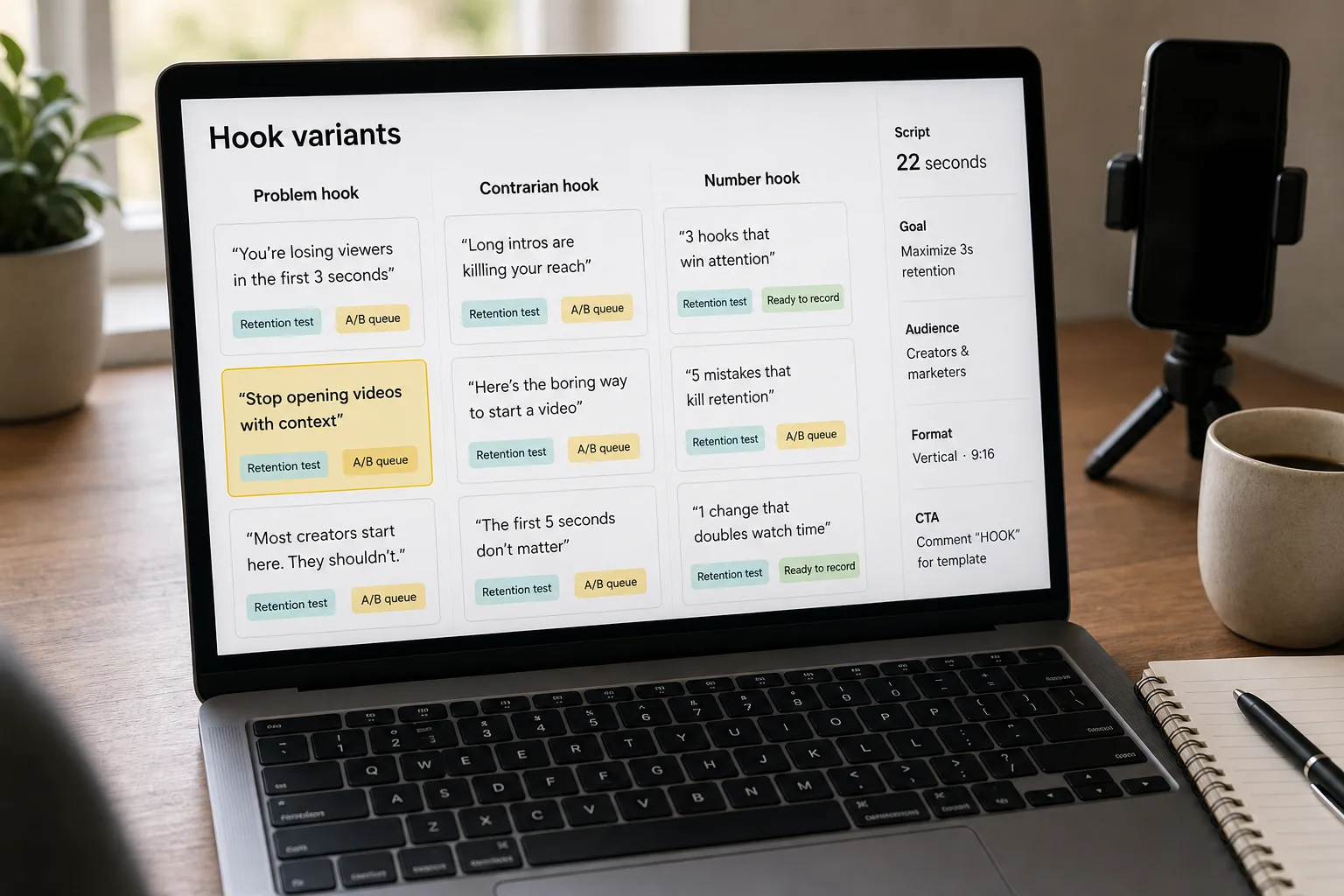
A hook is the opening line of a short-form video — the first three seconds that decide whether the next twenty get watched. The algorithm doesn’t read your caption, doesn’t care much about your follower count, and doesn’t reward effort. It watches the scroll-stop rate and the retention curve, and those are decided by the hook.
“Hey guys, today I’m going to talk about…” is the most expensive opener on the platform. It’s six seconds of dead time before the viewer learns what they’re getting. By that point, most of them are already on the next video.
The fix is not “be more interesting.” It’s a workflow that generates a high volume of hook variants — 20 to 30 from a single topic — scores them against patterns that consistently survive the scroll-stop test, A/B tests the survivors against a control, and builds a library of winners. This piece is that workflow: the patterns to target, the prompt that produces variants worth testing, the score function that filters before you waste a render on a flat hook, and the library structure that compounds the wins over months.
Where this fits — and where it doesn't
Use this if you’re publishing short-form video regularly (TikTok, Instagram Reels, YouTube Shorts, LinkedIn video) and your retention numbers tell you the issue is the first three seconds rather than the content overall. The workflow is also right for teams running paid social where hook quality directly drives CPM and CTR. The leverage of AI here is volume — generating 30 hook variants in five minutes is genuinely impossible by hand, and volume is what makes A/B testing meaningful.
Don’t use this if you’re publishing one video a month (the cost of building a library exceeds the value of each individual hook), your content is long-form (the hook problem on YouTube long-form is different — see Repurpose a podcast episode into pieces for that workflow), or your platform doesn’t show scroll-stop metrics (most major platforms do; LinkedIn video is partially opaque). And don’t use AI-generated hooks without testing them against your audience — what works for a generic creator and what works for your specific niche diverge fast.
What you'll need before starting
- A clear topic per video — usually a one-sentence summary of what the video covers. Vague topics produce vague hooks; the brief in step 2 is only as good as the topic you give it.
- A model API key — Claude, GPT, or Gemini all generate creative variants well. Cheap tier is fine; this is a volume problem, not a reasoning problem.
- Access to platform analytics — TikTok Creator Center, Instagram Insights, YouTube Studio. You need scroll-stop rate, 3-second retention, and average view duration to score real hooks against tested ones.
- A library spreadsheet or doc — three columns at minimum: hook text, video topic it ran on, retention numbers. This is what compounds. Without it, every video is a one-off.
- A platform-specific voice anchor — TikTok hooks are not LinkedIn hooks are not YouTube Shorts hooks. Pick one platform first; expand after the library is working there.
Six steps from topic to a library of tested hooks
- Pick the hook patterns that consistently work — start with five, not fifty
Across platforms and niches, a small set of hook patterns reliably outperform generic openers. The starter five: contrast (“Everyone says X, but here’s why Y”), specific number (“3 things I learned spending $5,000 on Y”), direct address (“If you’re a [specific role/situation], stop scrolling”), insider knowledge (“Here’s what nobody tells you about X”), and visceral curiosity (“This is the mistake that cost me [specific consequence]”). Pick five patterns; instruct the model to generate variants within those constraints rather than free-form. Free-form generates volume; constrained generation produces variants worth testing.
- Brief the model with the topic and the platform — not just “write hooks”
The brief is the lever. Include: the one-sentence topic, the platform (TikTok / Reels / Shorts / LinkedIn), the target audience in one phrase, the five hook patterns to use, and two examples of hooks that previously worked for you. The platform context matters more than people expect — TikTok hooks are short and direct; LinkedIn hooks land with a specific role-call; Shorts can support slightly more setup because the audience is more docile to longer payoffs. Without the platform context, you get generic LLM-flavoured openers that work nowhere in particular.
- Generate 20–30 variants per topic with structured output
Ask the model to return a JSON array of variants, each tagged with the pattern used. Twenty to thirty is the right volume — fewer and you’re not getting the benefit of variety; more and the marginal variants are paraphrases of the strong ones. Structured output makes filtering automatic. The cost is tiny (a few cents per topic), the time is two minutes, and the variety beats anything a single human can produce in the same window.
- Score before you film — filter the flat ones, keep 5–8 worth shooting
Score each variant against a short checklist before committing to film: does the first five words contain a specific noun (not “you” or “people” but a role / number / situation)? Is there a verb that implies movement or stake (not “is”, “are”, “going to talk about”)? Does it imply a payoff in the next few seconds (curiosity, contrast, consequence)? Does it sound like something you’d actually say out loud, or like LLM phrasing? The last one is the most important — AI-flavoured hooks have a tell (“Let’s dive into…”, “Have you ever wondered…”), and audiences spot it. Cut the obviously generated; keep the ones that pass.
- A/B test the survivors against a control — same content, different hook
The most reliable test is the same video with different hooks: same B-roll, same script after the first 3 seconds, only the opener changes. Publish 2–3 variants over a week with similar posting time and tags. Compare scroll-stop rate (first 1–3 seconds) and 3-second retention. The winning variant outperforms by 15–40% typical; the losing variant fails fast and gives you a clean signal. A/B testing the hook in isolation is one of the cleaner experiments in short-form because the variable is controlled and the metric is unambiguous.
- Build the library — winners with topics, patterns, and numbers
Log every tested hook in a spreadsheet or Notion database with: text, topic it ran on, pattern used (from step 1), platform, scroll-stop rate, 3-second retention, and a date. Within three months you’ll have 30–50 tested hooks, of which 8–15 will be repeatable winners. Those winners become the system-prompt examples for the next round of generation, which converges the AI variants on patterns that actually work for your audience. The library is what makes month six dramatically better than month one.
What it costs and what to expect
The cost number tells you the AI side of this workflow is free at any meaningful scale. The retention-lift number tells you the leverage — a 30% lift in 3-second retention is the difference between a video that gets pushed by the algorithm and one that doesn’t.
Other ways to solve this
Creator tools with built-in hook AI (Opus Clip, Descript, Captions). Generate hooks alongside auto-editing for short-form. Right answer for solo creators or teams that want a single workflow from long-form to short-form. Trade-off: less control over hook patterns, opaque selection logic, and the variants are tuned to the platform’s overall audience, not your specific niche.
Hand-writing every hook from intuition. Still the right answer if you’re publishing one video a week and you have strong instincts. Drops below break-even quickly as posting volume rises — at 3+ videos per week, the per-hook cost of hand-writing exceeds the cost of generating 30 and picking the best one.
Copying competitor hooks directly. Faster than this workflow; comes with two failure modes — pattern saturation in your niche (everyone using “3 things I learned…” stops differentiating) and brand voice drift (your hooks start sounding like the bigger account you’re emulating). Useful as inspiration for pattern selection in step 1; doesn’t replace the testing loop.
Don’t use hooks — let the content speak. Genuine answer for some niches (educational, technical, B2B-specific). If your audience is already filtered by topic relevance, scroll-stop optimisation matters less. Test it: publish a few videos without a deliberate hook and compare. For most consumer-facing content, the hook is the lever; for some B2B niches, it isn’t.
Related work
For the long-form-to-short-form pipeline that feeds hook generation, see Repurpose a podcast episode into pieces. For the broader content-team prompt patterns that hooks fit into, see Prompt engineering patterns for content teams. For the voice-and-style overlap with text marketing, see First-draft marketing copy without the AI tells. For the tool-by-tool comparison of writing assistants, see AI writing tools compared.
FAQ
Do these patterns work the same on every platform?
No — and assuming they do is the most common mistake. TikTok rewards short, direct, visceral hooks (3–6 words ideal). Instagram Reels are similar but tolerate slightly more setup. YouTube Shorts allows 1–2 more seconds before the payoff because the audience is more docile. LinkedIn video is its own thing — role-call openers work, casual TikTok-style openers fall flat. Generate platform-specific variants; don't repurpose hooks across platforms without retesting.
How long should a hook be — number of words or seconds?
Both. Three to six words is the visual sweet spot for TikTok / Reels overlays. Spoken hooks land in 1.5–3 seconds. The constraint is the platform's scroll-stop window: if the viewer hasn't seen something worth pausing for by second 3, they're gone. Anything that takes longer than that to set up the hook is structurally wrong; rewrite it shorter rather than adding a longer payoff.
What about visual hooks vs spoken hooks?
Both matter; visual is usually decisive on TikTok / Reels because audio is often off. Pair every spoken hook with a strong visual: a specific number on screen, a contrast cut, a clear text overlay. AI handles the spoken-hook generation; the visual side is still craft. Generate text hooks with AI, then design the corresponding visual with the same constraint (one specific element, no clutter, readable at thumbnail size).
How often should I retire and refresh hook patterns?
Test the library quarterly. Hook patterns saturate as your audience sees the same shape repeatedly — "3 things I learned…" stops working when every creator in the niche uses it. The retention-rate metric tells you when: a previously winning pattern dropping to baseline is the signal to retire it. Build new patterns by watching what's working in adjacent niches; the patterns migrate before the saturation does.
What about hooks for educational or technical content?
The patterns shift — visceral curiosity and contrast still work, but the audience filter is stricter. Specific numbers and direct addresses to a role outperform broad curiosity. "If you're a data engineer using DuckDB…" beats "This is the mistake everyone makes." The library will skew toward role-call openers and contrast hooks; that's normal for technical niches and reflects the audience self-selection.
Can I use this for paid social ads as well?
Yes — and paid social is one of the highest-leverage use cases because hook quality directly drives CPM. Run more aggressive A/B testing on paid creative; the budget gives you faster, cleaner signal than organic does. The library that works for organic short-form usually transfers to paid, with the caveat that paid audiences are colder, so direct-address and specific-number patterns outperform curiosity patterns by a wider margin.