
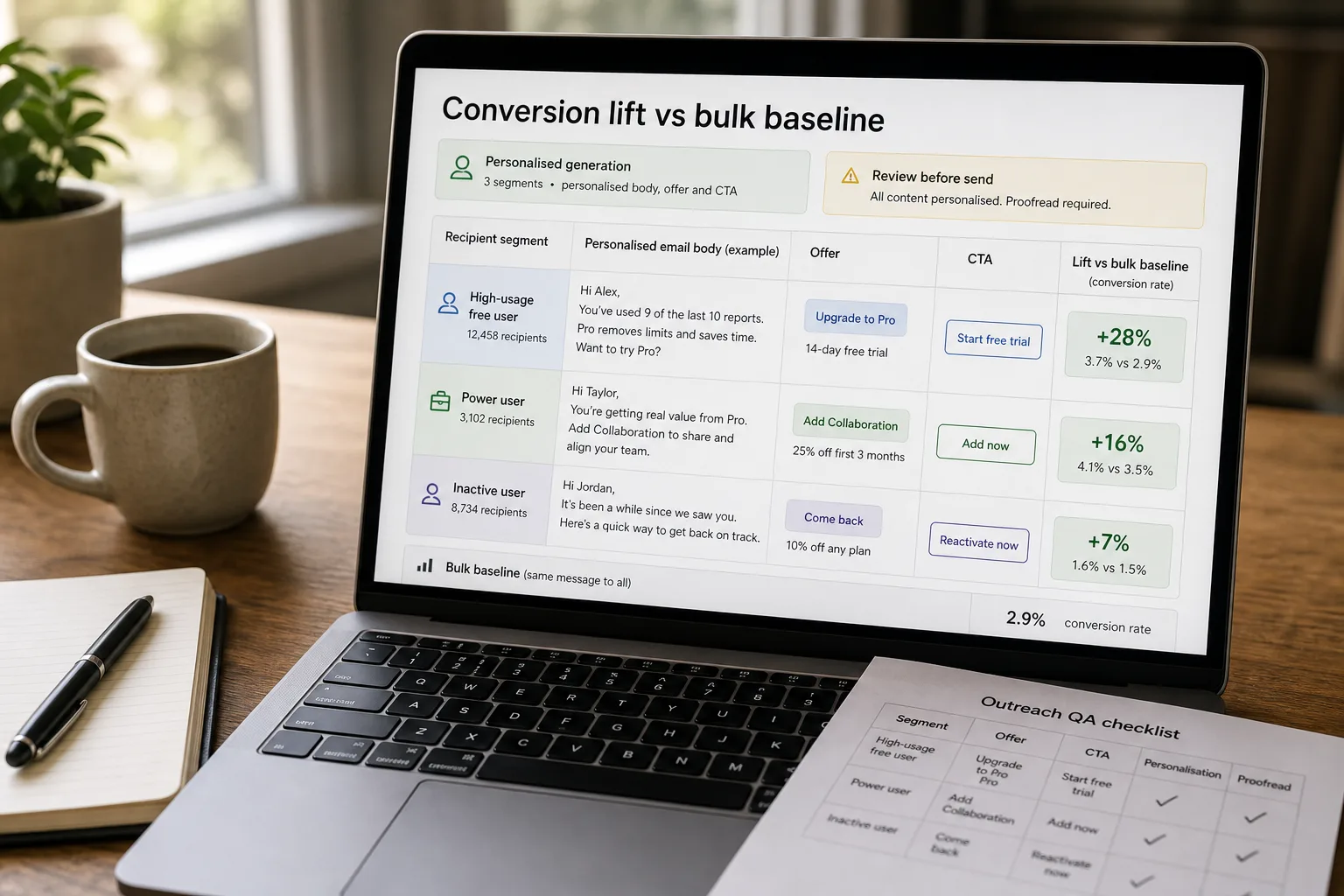
If you’ve ever promised “personalised at scale” in a marketing meeting, you know how broken that phrase has become. Merge-fields don’t make an email personalised; the recipient knows their name is substituted into a template. Genuine personalisation — different body, different offer, different framing per recipient based on what they actually do — has historically been the privilege of teams with one-to-one capacity, which doesn’t extend past a few dozen recipients.
The leverage of AI is that genuinely-different messages can now be generated programmatically using the customer data you already have. The discipline is making the differences operationally meaningful rather than cosmetic.
Where this fits — and where it doesn't
Use this if you have customer data rich enough to produce meaningful segments (usage patterns, lifecycle stage, plan, industry), your campaign goals span multiple customer states (upsell to one tier, re-engage another, retain another), and your current email motion is dominated by one-message-to-all sends. Common fits: B2B SaaS with multiple customer-success motions, DTC ecommerce with behavioural segmentation, marketplaces with seller / buyer differentiated comms.
Don’t use this if your customer data is too thin to support segmentation (very early stage, simple plans), your list is small enough that one-to-one writing works (under ~200 recipients per campaign), or your audience expects identical messaging across the base (some regulatory or contractual contexts).
What you'll need before starting
- Customer data unified in a CDP or warehouse — segment-defining attributes accessible per recipient.
- Marketing automation platform with API integration — Customer.io, Iterable, Klaviyo, Braze, Salesforce Marketing Cloud.
- A model API for per-recipient generation. Cost per email matters at volume; use cheap-tier models with structured prompts.
- A defined campaign with multi-segment goals — “drive upgrade for free-tier users with high usage; drive feature adoption for paid users who don’t use feature X; drive renewal awareness for accounts in the renewal window.”
- A baseline performance benchmark per segment. Personalisation lift is measured against this; without baseline, the test is uninterpretable.
Six steps to genuinely-different emails per recipient
- Segment by signals that affect message content — not just by demographic
Demographic segmentation (industry, company size) is the easy step; the personalisation lift comes from behaviour-based segments. Within “B2B SaaS in industry X with company-size Y,” recipients differ in: usage depth, feature adoption pattern, support history, billing trajectory. Segment by the signals that materially affect what message would land — typically 3–8 segments per campaign, not 50.
- Define the per-segment goal and framing
For each segment, define explicitly: what action you want them to take, what context the email should reference, what offer (if any) makes sense, what tone fits. High-usage free users get an upgrade pitch referencing their specific usage. Low-usage paid users get a feature-adoption nudge referencing the features they haven’t tried. Renewal-window accounts get a renewal reminder with renewal-specific value framing. The segment plus the goal plus the framing is the input to generation.
- Generate per-recipient with structured customer-context input
For each recipient in each segment, pull the customer-specific context (recent product activity, key milestones reached, account-specific facts) and pass it to the model with the segment’s goal and framing. The model produces a personalised email that references the specific recipient’s situation. The personalisation depth is proportional to the context richness; sparse context produces only modest personalisation.
- Apply brand-voice guardrails — the email needs to sound like the brand
Run generated emails through the brand-voice guardrails (see Brand-voice guardrails for marketing teams). Banned phrases, AI-tell screening, structural rules. Personalisation without voice control produces emails that are accurately-tailored and generically-phrased; the combination of both is what makes the personalisation feel intentional rather than algorithmic.
- Send through marketing automation with deliverability discipline
The volume is high; deliverability matters. Use proper sending infrastructure with warmed-up domains, monitor inbox-placement rates, throttle send rate to avoid spam-filter triggers. The technical-deliverability work is independent of personalisation quality but undermines it if neglected — perfectly-personalised emails in spam folders produce zero results.
- Measure per-segment performance — and tune the segmentation
Track open rate, click rate, conversion rate per segment. Where personalisation is working, the metrics outperform the bulk-send baseline. Where it isn’t, the segmentation or framing needs revision. The feedback loop is what turns personalisation from a one-time-build into a continuously-improving capability over a few quarters.
What it costs and what to expect
The conversion lift is the headline value. The cost per email is small relative to the lift on revenue-relevant campaigns; the trade-off favours the personalised approach at any meaningful scale.
Other ways to solve this
Marketing-automation platforms with built-in dynamic content (Customer.io, Iterable, Klaviyo, Braze). Right answer for most teams. The platforms increasingly include AI-driven content generation alongside their segmentation and send infrastructure.
Manual one-to-one writing for high-value segments. Highest fidelity per email; doesn’t scale past dozens. Pairs well with personalisation at scale — top-tier customers get human-written; the bulk get AI-personalised.
Merge-field-only personalisation. What most teams do today. Cosmetic; produces no meaningful lift over bulk-send.
Bulk send with no personalisation. Honest answer for some campaigns where the message is genuinely universal. Increasingly rare as customer data infrastructure matures.
Related work
For the brand-voice discipline that personalised emails need, see Brand-voice guardrails for marketing teams. For the upstream segmentation framework, see Customer health scoring from product and support signals. For the reactivation pattern that uses similar personalisation, see Reactivation campaigns for dormant accounts. For the broader CRM-data-hygiene that powers reliable personalisation, see CRM data hygiene at scale.
FAQ
How is this different from dynamic content in marketing-automation platforms?
Dynamic content in MA platforms uses pre-built variants and conditional logic; the AI pipeline generates per-recipient. The MA-platform approach scales to dozens of variants; the AI approach scales to thousands of materially-different emails. For most teams, both layers coexist — MA platforms handle the routing and send mechanics; AI generates the body content.
How do we avoid the model inventing context the customer doesn't have?
Strict grounding in the customer context. Every claim about the customer should be supported by data in the customer record; if the data doesn't say the customer used feature X, the email shouldn't say so. The discipline is the same as in customer support reply drafting — the model adapts, doesn't invent.
What about deliverability at high volume?
The mechanics are the same as any high-volume sending: warmed-up domains, proper SPF / DKIM / DMARC, list hygiene, send-rate throttling, complaint-rate monitoring. The personalisation doesn't help or hurt deliverability directly; the volume infrastructure is what matters. Most marketing-automation platforms handle this; custom-built pipelines need explicit deliverability discipline.
How do we measure if personalisation is actually working?
A/B test against bulk-send baseline on a holdout segment. Same campaign, same audience, half receive personalised, half receive bulk. Measure conversion rate, open rate, click rate; the difference is the personalisation lift. The first few campaigns should test rigorously; once the lift is established, the bulk-vs-personalised question is settled and you can iterate within the personalised approach.